Andrew McCarthy is right to be offended by ‘Brat Pack,’ but the stronger arguments are made by his stigmatizer
Posted: February 2026
There is an old saying, “Any publicity is good publicity.” Whether this is true for a group of young actors known as the Brat Pack is the obvious central question of Andrew McCarthy’s 2024 documentary, “Brats.”
It goes unanswered.
Appreciation of “Brats” is contingent on being cognizant of David Blum’s June 10, 1985, article in New York magazine. Or at least being cognizant of people using the term “Brat Pack,” all the time after the article came out. The crown jewel of McCarthy’s project is a current interview with Blum, though it is not depicted in the official trailer.
McCarthy is a curious, self-appointed choice to tackle the lingering stigma of one of the most powerful headlines ever written. Yet he’s actually not even in the “Brat Pack,” according to the article itself.
In the opening scenes of “Brats,” McCarthy refers to the Pack as “we.” He admits the first challenge of his documentary retrospective is identifying who is in the Brat Pack. He rattles off, “There’s me, there’s Rob Lowe, Judd Nelson, Emilio Estevez, Ally Sheedy, Demi Moore, Molly Ringwald, it’s a movable feast, I think.”
But in the article that is the basis for all of this, McCarthy is barely mentioned. Blum is mostly interested in three actors — Emilio Estevez, who was to be the article’s featured star, and Tom Cruise and Judd Nelson. Blum is also interested mostly in two movies, “The Breakfast Club” and “St. Elmo’s Fire,” which was to be released a couple weeks later. The article came about when Estevez invited Blum to tag along on a few nights on the town in L.A. Cruise is described as Estevez’s best friend but is not present on these nights out and not quoted in the article (unless he is supplying one of the off-the-record remarks).

Some of the most entertaining scenes in “Brats” are of McCarthy calling the Brat Packers and generally getting their answering machines and leaving messages, and then they call him back. To get a call from Andrew McCarthy is golden. Outsiders attempting the same contacts as McCarthy would not be so lucky. The other actors can trust McCarthy. But he also is an extremely good interviewer. Relaxed, honest, asking relevant and fair questions. Notably, he’s not shown making any attempt to call Tom Cruise or Sean Penn or Nicolas Cage, who are more prominent in the article than most of the other subjects of “Brats.” Their virtual omission from this production defeats McCarthy’s premise, that the term “Brat Pack” negatively affected all of these actors’s lives.
Blum’s article does not list McCarthy among the Brat Packers. He devotes only one sentence of the article, near the end, to McCarthy, apparently because Blum got an anonymous quote from one of the Packers about McCarthy that exemplifies the Brat Pack mindset that Blum found newsworthy. McCarthy is not in “The Breakfast Club” but is in “St. Elmo’s Fire.” Blum suggests McCarthy is a talent who could rival the Pack members. He merely notes McCarthy is “one of the New York-based actors” in “Elmo’s” and that a co-star says, “He plays all his roles with too much of the same intensity. I don’t think he’ll make it.”
But he did. McCarthy’s career in 1985 was just getting started (he says he was about 22 then), but he proved highly productive, delivering well more than a movie a year into the early 2000s. Many of the titles you’ve never heard of, but some of them, you have. This is extraordinary success in a very elite profession. Was his career shorted by stigma ... or did it run a natural course?
Whether being mentioned in Blum’s article is enough or whether that’s legitimately how everyone thinks of him, let’s, for the sake of enjoying “Brats,” just say McCarthy is “in” the Brat Pack.
Several times early in “Brats,” McCarthy will opine on what Blum’s article did to him. A couple times, he calls it “scathing.” He argues, “This isn’t the right perception of who we are,” and “From then on, my career and the career of several other people was branded without any wiggle room as to the Brat Pack.”
“Branded” is a fair term. “Wiggle room” is a more curious one.
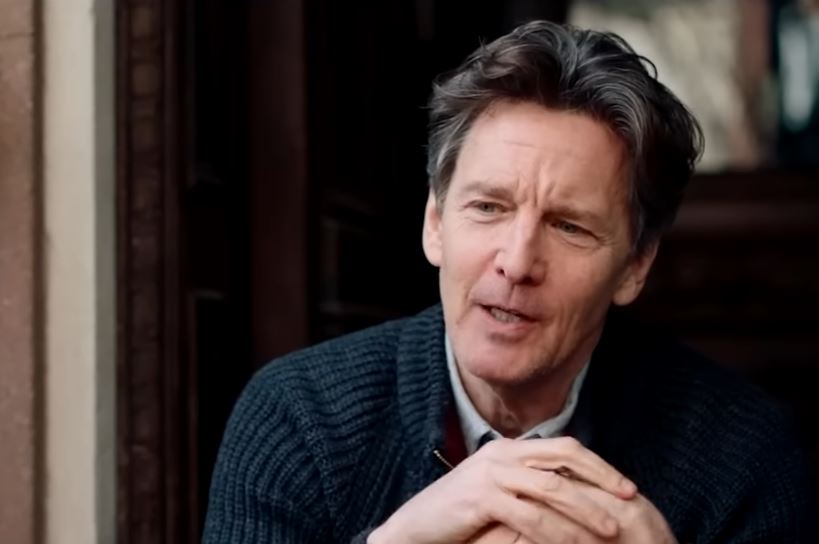
Andrew McCarthy in “Brats”
In the category of What Did They Think Was Going To Happen, why Estevez’s advisers thought being shadowed by Blum at nightclubs would be a plus seems like a head-scratcher. But maybe it’s not. McCarthy catches up with Lauren Shuler Donner, a producer of “St. Elmo’s Fire” and “Pretty in Pink” who tells him the label gave him “great cachet.” She admits that when the article came out, she thought the term Brat Pack was “fabulous” and something that “distinguished us.” Shuler Donner says Blum was “jealous” of the subjects he was shadowing, and that young people wanted to be the actors in “St. Elmo’s Fire” whom Blum was writing about.
So here we have a major split — it seems the industry liked and appreciated Blum’s work. And the general public enjoyed the term. The only people who didn’t like it, it seems, are McCarthy and his half-dozen former colleagues.
In the article, Blum ironically writes, “Estevez and Cruise share the same press agent, Andrea Jaffe of the PMK agency, who guards their reputations with the same zealous fervor she devotes to such elder clients as Farrah Fawcett — keeping their reputations clean but also keeping them hot.”
Early in “Brats,” McCarthy bluntly asks Estevez, “What the (expletive) were you thinking.”
“Well I wasn’t,” Estevez responds, adding, “It was naive of me to think that this journalist would in fact be my friend.”
Estevez can be forgiven. 20-somethings make those kinds of mistakes. But what does friendship have to do with it? He invited a writer to tag along with him at nightclubs. What did he expect the writer to write about? Method Acting?
What Blum was doing, though his assignment wasn’t televised, is what we now would call reality TV. He was revealing to the world the everyday lives of people whose everyday lives are, unfortunately or not, interesting. It’s very difficult to stop reading his article after beginning. The subjects of his article were famous enough that the contents were bound to get noticed and evaluated in Hollywood. Nothing, though, stuck like the title. It’s a term used freely in the story. There is some nuance. But seen on the original magazine covers that McCarthy shows in “Brats,” those three words are really all that matter.
For those who weren’t around in 1985 (or had somehow forgotten), McCarthy in the opening scenes of “Brats” tries to show or explain the prominence of the term “Brat Pack.” It seems like it was everywhere — and so were the actors. “Today” show, “Good Morning America,” Phil Donahue, Charlie Rose. The hosts of those programs were expressing the same concerns about the term that McCarthy expresses now. Even though a very tiny percentage of the country is subscribing to New York magazine, such was the impact of Blum’s headline that people were talking about it. Most importantly: They liked talking about it.
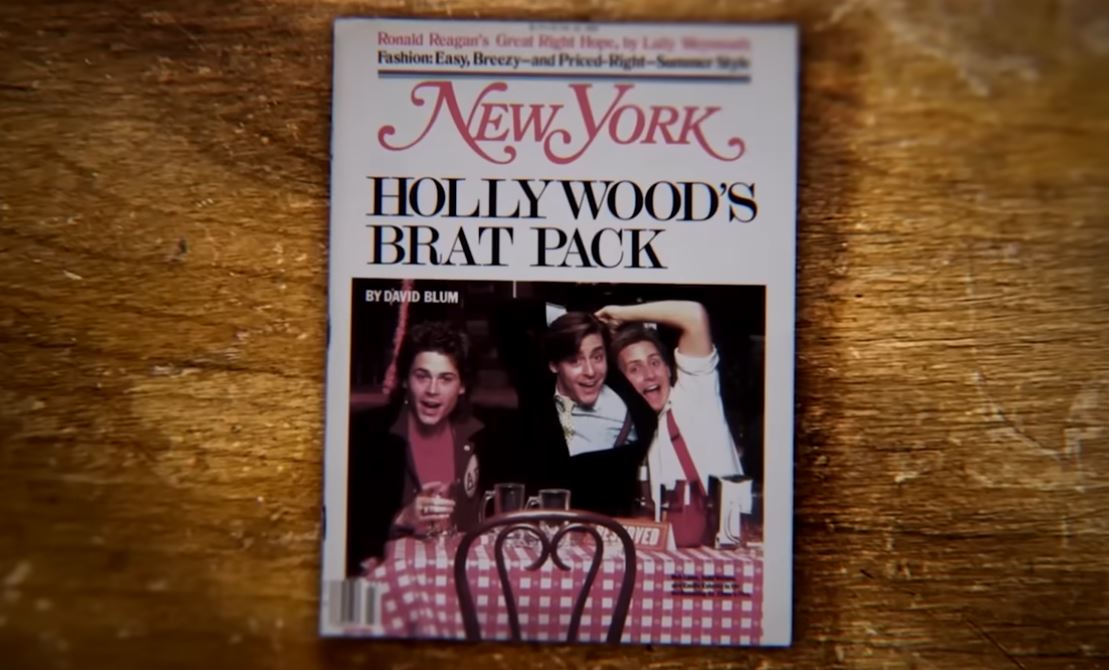
So who are the actual members of the Brat Pack? Blum’s article says, “Everyone in Hollywood differs over who belongs to the Brat Pack.” Which cannot be true because, until the article came out, no one had heard of the Brat Pack. But let’s assume he is referring to people ranking the most elite group of young film actors. Blum provides a primer: He lists Emilio Estevez as “president,” then goes on to list Tom Cruise, Rob Lowe, Judd Nelson, Timothy Hutton, Matt Dillon, Nicolas (spelled Nicholas), Cage, Sean Penn, Matthew Broderick, Matthew Modine and Kevin Bacon.
Evidently, applying for admission to the Pack isn’t necessary; you might be drafted. Blum writes that the characteristics are a “roving band” of partygoers who most importantly “sell movie tickets,” which was certainly why Cruise, despite not being around for the partying, is mentioned so prominently.
Blum’s list, despite popular misconception, is completely sexist. All of his listed members are male. McCarthy in “Brats” will connect with Demi Moore and Ally Sheedy and try to connect with Molly Ringwald, but Sheedy and Ringwald aren’t mentioned in the article, and Moore is mentioned only in passing as a “romance” of Estevez.
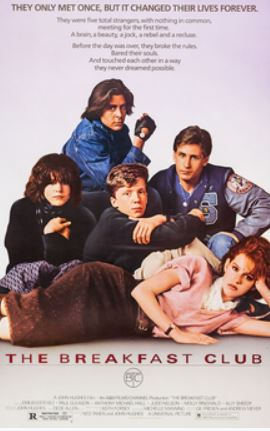
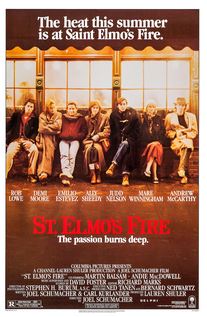
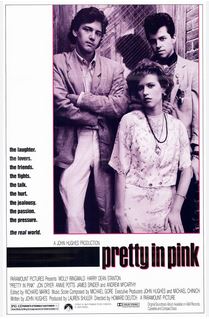
The two 1985 films sort of at the nexus of Blum’s mythical fraternity are “The Breakfast Club” and “St. Elmo’s Fire.” Blum is more interested in the latter movie. Only three actors — Estevez, Nelson and Sheedy — are in both films. McCarthy, Moore and Lowe are in the latter. Anthony Michael Hall, a “Breakfast” Clubber whose career at that point compares favorably with nearly everyone else in the article, is not in Blum’s Pack, apparently because he wasn’t visible on the party scene. He also is not featured in McCarthy’s documentary, while Ringwald is often mentioned in “Brats,” even though she, like Hall, was not in “St. Elmo’s Fire” and not in Blum’s article. Jon Cryer is not in Blum’s article but is in McCarthy’s production, apparently because Cryer appeared in “Pretty in Pink” with McCarthy and Ringwald. McCarthy interviews Lea Thompson, who calls herself “Brat Pack-adjacent” but also isn’t in the article. If anything, it seems like people in general like being lumped in to this stigmatized group if possible. Can Blum be faulted for the public taking his moniker too far ... perhaps to the point it was innocuous?
Estevez, who like McCarthy belongs, rightfully, on the Mount Rushmore of Hair to this day, seems not even certain he would erase “Brat Pack” from history if he could.
McCarthy in “Brats” bluntly asks Estevez, “If you could have the Brat Pack name not exist, would you?”
“Hmmmph. That’s a different- uh, I think that- a difficult question to answer because it’s, you can only know the known. And, uh, was it something that we benefited from? Maybe. But in the long run, um I think we did not,” Estevez opines, adding there was “more damage done by it than, than good.”
McCarthy asserts to Estevez that the “fallout” from the article was “immediate” and “big.” He tells Estevez, “I perceived it to be very harmful,” specifically for this reason: “Marty Scorsese, Steven Spielberg is not gonna call up somebody who’s in the Brat Pack.”
“You’re not wrong. You’re not wrong,” Estevez agrees. “I think it created the perception we were lightweights.”
McCarthy continues, “It did matter, and it did affect my- how I was perceived in the business certainly. ... And how I perceived myself for many years.”
As Estevez tells how he turns down all the requests he gets to do retrospectives on his movies, McCarthy asks, in one of his great questions, “How come you’re talking to me?”
Estevez explains, “Because you called me. Because you asked ... And I also thought it was time that we sort of cleared the air on a couple things.”
That clearing the air apparently is over a movie project called “Young Man With Unlimited Capital,” which was a 1974 book about the creation of Woodstock. McCarthy and Estevez reveal that they were both planning to be in the film in the mid-’80s, but then McCarthy heard that Estevez didn’t want McCarthy to be in it with him, an observation that Estevez doesn’t dispute. “I didn’t want to have anything to do with any of us,” Estevez admits, saying collaboration with Brat Packers at that point would be “kryptonite.” But Estevez never got the film made anyway. Were the actors their own worst enemy?
(Estevez does not say whether his reasons for talking to McCarthy involve being paid to do so. This may be a documentary, but there are typical credits at the end, and it’s unknown if anyone was volunteering their time for free. Sometimes people agree to make appearances in exchange for a charity donation. The economics of McCarthy’s project are not revealed.)
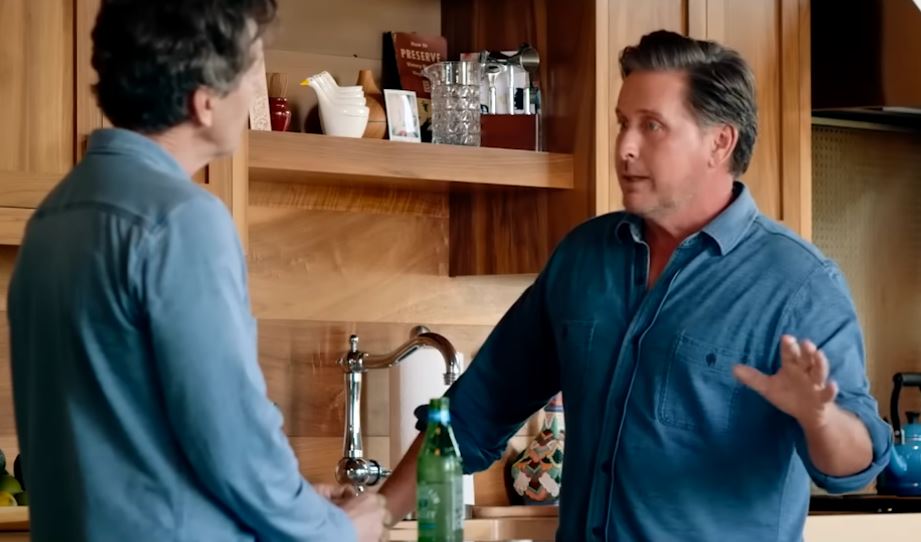
McCarthy delivers his own kind of reality TV in “Brats.” Enhancing its authenticity and workmanlike feel, he is shown making phone calls to everyone and driving a car, and his camera and sound crews are often part of the visuals. McCarthy pushes buttons without going too far and keeps an impressive pace. But he does not ask his subjects enough interesting questions that go beyond a magazine article, and his odyssey seems less a film project than a reunion with former colleagues, if an appealing one.
Like most productions wrongly labeled “documentary” on streaming services, much of “Brats” is a recap of a news/pop culture event with people nowadays commenting on it. (It is curiously a production of ABC News Studios, and despite or because of that, there are seemingly a million producers in the credit for what is a fairly small-scale production.) There is no story arc. It’s just a story of access.
There really isn’t enough material from McCarthy’s subjects to fill even 90 minutes, so he also enlists non-actors to opine on the phenomenon, including the dreaded pop-culture critics. At one point, the production digresses into an observation about John Hughes’ — and thus the Brat Pack’s — lack of diversity, as well as the importance of the soundtracks to their films. Which are very interesting subjects, but for a different production. “Brats” is about a club that you supposedly don’t want to be part of.
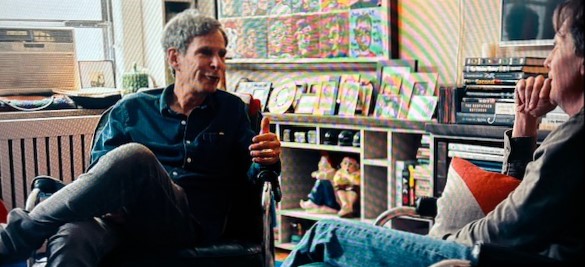
The validation of this project is McCarthy’s interview of Blum at Blum’s apartment, in which McCarthy and viewers get far more than they bargained for in terms of celebrity insight. Blum’s observations are far more impressive than all the pop culture critics’ put together. The McCarthy-Blum interview is crisp, mildly combative, honest and fair. Blum defends himself well, but not perfectly. (Notably, there’s no indication that any other “Brats” subject are asking to join McCarthy in visiting Blum.)
McCarthy impressively asks if Blum prefers “Dave” or “David.” It’s the former.
Blum does not say exactly how his party spree got set up but that it started as an assignment to do a feature on Emilio Estevez, who told him about his friends going out to dinner. McCarthy could’ve prodded for more detail about this.
Blum affirms that “I was proud of my creation of the phrase” and has “no regrets” today. But he admits to McCarthy two key revelations about his experience that cast doubt on the “Brat Pack” label: “I didn’t dislike any of them, I thought they were all quite nice,” and that “Brat Pack” was not a term that anyone was using; it was something he invented on this trip.
Blum doesn’t mention a third reason why his label may be bogus — he gives no indication that he expected the kind of behavior he witnessed or that he was under any kind of impression that Estevez was a “brat.”

A telling statement in the “Brats” official trailer
He freely tells McCarthy, “I didn’t think at the time, ‘Oh these brats,’ at all.” But before he returned to New York, he had a dinner with other writers that included Allen Richman, whom Blum says was working for People magazine, and Richman “referred to us as the Fat Pack,” which Blum found funny. (Even though the term doesn’t make sense, as Blum is certainly not fat.)
That remark set off a “light bulb” for Blum while driving, that he could call the actors he had just observed the “Brat Pack,” which he thought was “fun.” He says he never thought it’s “all that big a deal.”
One justification for Blum’s label has to be that “Rat Pack” was considered hip, not derogatory, for Sinatra & Co. Exactly where that term came from is unclear. It is most associated with Frank Sinatra and his ’60s showbiz pals Dean Martin, Sammy Davis Jr., Joey Bishop and Peter Lawford, but it’s traced back a decade earlier to a collection of stars who hung out with Bogie & Bacall in Hollywood. It was considered sort of an entertainment badge of honor.
A lot of popular terms creep into consciousness without a known author. McCarthy is probably underselling the significance of Blum’s creation in the journalistic community. Blum turned an article that would’ve gotten mild attention for a few weeks into a decades-long national talker, with two little words. Though the term in this instance is highly questionable and would be more in the realm of magazines than newspapers, it certainly “worked.” The public loved it.
The best argument against Brat Pack is that “brat,” while humorous, just isn’t correct. “Brat” is not as dubious of a word as, say, “jerk.” But a “brat” is not someone that anyone really enjoys associating with; it implies a child and a level of cuteness that makes the person more tolerable than an older person who embodies a seven-letter word beginning with “a.” Most actors — likely the overwhelming majority — would complain about being deemed too old and out of touch rather than too hip and cocky.
At the time the article was written, probably the most prominent well-known legitimate Hollywood “brat” was a young actress of the ’70s. She was, in fact, about the same age as later “Brat Pack” actors who would have nothing in common with her behavior, but they just hadn’t hit it big yet. She was called the term “brat” by one of her directors. It didn’t stop her from receiving a record salary for a “juvenile” for that film. Like the “Brat Pack” to come, it seems her career roles were determined far more by box office results than diva-ness in the trailer or magazine nicknames.
Actors who were child stars have a long list of grievances about the difficulties in transitioning to adult stardom. Some take the step, like Rick Schroder, of dropping a letter from the first name that everyone knew him as. The “Brat Pack” actors were not 8 years old when hitting fame. Given their actual ages, they probably should’ve been disqualified from being tagged with a childish label. But they still have to be considered fair game for Blum, because they became famous for playing teenagers, even if they weren’t teenagers.
There is one very powerful sentence in Blum’s article, and it is powerful not so much for the information provided, but how it’s provided. He writes, “No one from the Brat Pack has graduated from college — most went straight from high school into acting.” It implies that what has made these upstarts rich and famous does not require intellect or dedication or hard work but simply a pretty face.
Film actors will acknowledge they are gifted in ways that others aren’t. Some will surely take issue with an implication that rigorous study isn’t necessary to reach the heights of the profession. Blum is a graduate of the University of Chicago, a prestigious university. McCarthy, as he notes in “Brats,” attended NYU, also a prestigious school, but did not graduate. McCarthy does not ask Blum if academic bias may have been a factor in Blum’s article.
In their interview, McCarthy tells Blum he “took offense” with the article because it wasn’t about the “craft” of acting.
That prompts Blum to bring up the college angle again, asking McCarthy if he graduated from NYU. “I was kicked out,” McCarthy reveals, while Blum notes that Tom Cruise went from “a production of ‘A Christmas Carol’ ” to Hollywood stardom. In other words, Blum is basically arguing that honing their craft is not what made these young actors stars. Indeed, McCarthy tells of “cutting my classes” at NYU and smoking marijuana; what if Blum were writing about that? “I was not exactly the guy most likely to be in the movies two years later,” McCarthy claims, for some reason. If it’s really about the “craft,” why was he famous at 22?
(In another personal detail, McCarthy at one point says of his dad, “We did not get along for my adult life.” That is a very sad revelation, that someone with as much going for him as Andrew McCarthy could not even have a healthy relationship with his father, and is certainly a larger topic, albeit one tackled often in Hollywood.)
Blum pushes back on McCarthy’s concerns, asserting that his article made the Pack “famous forever,” and he feels “more redeemed than ever” because “you were a bunch of talented and interesting people to write about,” and here we are talking about them 40 years later.
McCarthy protests that the article wasn't written with any “affection.” Blum concedes a few things in it were “not nice,” but he thinks the buzz about the label was just funny. He points to Richard Schickel attacking Blum on Phil Donahue’s show. What Blum doesn’t mention is that Schickel, a critic, wanted or needed the relationships with Hollywood stars that Blum didn’t need or didn’t want and that Schickel’s stance on this term may not be just professional but philosophical.
Not only that, Blum thinks he deserves “more credit” for the fact “St. Elmo’s Fire” became a hit. It might well have been anyway, but he says, “Controversy sells.”
McCarthy asks a great question, whether the article helped out Blum’s career. Blum says not as much as he thought it would. Blum says if he could change anything, he wouldn’t, and further justifies the article by telling McCarthy that both were in their 20s at the time and in your 20s is the time when you’ve got to “take chances.”
McCarthy closes with a surprise question as he’s leaving Blum’s apartment: “Do you think you could’ve been nicer.” Blum, who during the interview draws an analogy to Woody Allen’s fame providing Knicks tickets as well as other things, says any stigma is “collateral damage” from publicity.

Dave Blum in “Brats”
Could “Brat Pack” actually have helped the careers of the “member” actors, as Blum seems to think? Estevez correctly notes that we’ll never know. Yet the chief complaint of him and McCarthy — that the article wrongly made them appear as “lightweights” and that it would preclude Spielberg from calling them — seems less valid given that Cruise has starred in films of Spielberg and other acclaimed directors, Sean Penn and Cage have won Oscars, and Rob Lowe remains incredibly busy alternating between TV and film. And that performances speak for themselves. As does selling movie tickets — cited in Blum’s article as the top criteria for Pack membership. If the argument is that “After the article, people thought we were brats on movie sets, so they wouldn’t hire us,” then that suggests they were more of a commodity as actors than difference-makers.
It would be one thing if Estevez had lost the Maverick role in “Top Gun” once Blum’s article came out. But he wasn’t at that level yet. The whole concept of The Brat Pack shows the tiers of elite filmmaking. Starring in a movie like “The Breakfast Club,” as great of an accomplishment as it is, is not the same as starring in “Indiana Jones” or “Pretty Woman” or “Titanic.”
What McCarthy and Estevez aren’t acknowledging here is that every actor is typecast; that’s why these two became world-famous for playing teen/young adult roles while in their early 20s and why Clint Eastwood, were he 20 at the same time, probably would not have have been. McCarthy and Estevez may have a magazine article to blame, but many others not in famous articles undoubtedly share the same frustration, particularly regarding TV. How many of the casts of “90210” or “Dawson’s Creek” found greater fame in movies than on their TV shows? Actors in teen/young adult dramedies get a great head start, but time is fleeting — they can only play those kinds of characters for so long.
In their conversation in “Brats,” Estevez demonstrates that he is farther along than McCarthy in philosophizing about Blum’s article. Estevez allows that “maybe” the Pack “members” did actually benefit from the label. He at least entertains the notion. (They are, in fact, more famous today than young ’70s stars such as Jan-Michael Vincent and Robby Benson and William Katt, who never got such a tag.) What no one says in “Brats” is that there quite possibly are many young actors of the time who wished they were in the article but aren’t.
Everyone in “Brats” does seem to agree on a few things, namely that Hollywood in the 1980s was making movies about young people like never before. McCarthy asserts in early scenes that, “In the history of Hollywood, it had never been like this.” Actually, in the ’70s, there was “Billy Jack,” and decades earlier, there was “Rebel Without a Cause” and Mickey Rooney. But he’s right that the group therapy idea was much an ’80s thing. Hollywood has to make movies for teens; if not, the industry would dry up very quickly. But John Hughes burst onto the scene with a new type of suburbia subgenre that is unique to the ’80s and still resonates today. The actors are correct that it was a one-of-a-kind era.
Many of the anecdotes in Blum’s article are not unusual and not newsworthy. The best involves Estevez in a ticketing situation. Estevez plans to catch “Ladyhawke,” starring Matthew Broderick, at Mann’s Village Theater. Estevez tells Blum, “I have a friend who works here who’ll get me in free.” The problem is that Estevez realizes, “Guess he’s not working tonight.” Which means Estevez either has to pay like everyone else, or find another sympathetic usher, or skip the movie. (If you don’t understand why this is major drama and if paying for a ticket seems like a trivial thing for Hollywood stars or just an ego trip, you don’t know enough about Hollywood; for example, there’s Quentin Tarantino’s “Once Upon a Time...")
Estevez’s solution is to find a phone (it takes him a while, actually, and the movie is just about to start) and call the theater and reveal who he is and ask if he can get a pass. The gambit works; “the manager and the ticket taker welcomed him to the theater and told him how much they loved his movies.”
A more blunt and damning revelation from Blum’s article is Estevez relating that a Playmate of the Month whom he is seeing actually thinks a bar exam is for bartenders.
In “Brats,” McCarthy’s exploratory phone calls entertain. His road trips to interview his celebrity friends promise a litle more than they deliver. The friends do agree with him on the “Brat” subject, they’re just not troubled enough or bored enough to attempt this kind of endeavor themselves. (And maybe they’re just sick of the topic anyway and tired of getting calls from other people about it.)
It won’t come as any solace to McCarthy. But there’s a meritocracy here. “Brat Pack” was only the beginning for some (Cruise, Penn, Cage) who are no longer even associated with it, to the point McCarthy won’t even call them ... and the peak for others, who didn’t reach the same kind of blockbuster status and who got McCarthy’s voicemail messages. And are talked about today largely only because of Blum’s terminology.

Ally Sheedy in “Brats”
McCarthy’s odyssey, which doesn’t build on any kind of story arc, feels a bit like an episode of TV’s “American Pickers.” McCarthy in fact resembles “Pickers” star Mike Wolfe (Wolfe does not quite look like a movie star, but they do resemble each other), who spends the program traveling earnestly to people’s homes in hopes of getting them to cough up treasures at a fair price. He’ll procure a few things but often not the fantastic antique that the owner just won’t part with. McCarthy isn’t asking for Coca-Cola machines and gas station signs; the problem is, he’s not really asking his friends/co-stars for anything except to agree with him. Are they going to tell him who they’re dating (then or now) and which people in Hollywood they really can’t stand and what they think about Donald Trump? Probably not, but McCarthy doesn’t bother to ask.
In a beautiful moment at the end of “Brats,” Sheedy assures McCarthy that the label did change their lives. But only Estevez can seriously attempt the claim of character assassination. And he’s not the one behind “Brats.” “The Brat Pack” probably wasn’t a career killer or even a stigma as much as just Something The Actors Got Really Sick Of Hearing. “Brats” is their chance to vent. And that’s OK. They were a little bit wronged. They are liked. They are appreciated.
To this day, people aren’t totally sure whether “Brat Pack” was a harmful term, or even who’s in it. What is certain is that Blum hit media gold like few others and that the Brats, apparently to Blum’s surprise, don’t appreciate it. You can’t blame Blum for being clever. You can, perhaps, blame him for being inaccurate. Roger Ebert wrote that effectiveness, not accuracy, is what matters ... but he was talking about film, not journalism. It would be nice if Blum made an enormous pop culture achievement that was enjoyed equally by his subjects. Blum can take satisfaction that everyone in this production, not just himself, would probably admit, if they had to do it all over again, everything the same, they would.
3.5 stars
(February 2026)
“Brats” (2024)
Starring:
Andrew McCarthy as
Self - Actor ♦
Emilio Estevez as
Self - Actor ♦
Ally Sheedy as
Self - Actor ♦
Demi Moore as
Self - Actor ♦
Rob Lowe as
Self - Actor ♦
Timothy Hutton as
Self - Actor ♦
Lea Thompson as
Self - Actor ♦
Jon Cryer as
Self - Actor ♦
David Blum as
Self - Journalist, New York Magazine ♦
Lauren Shuler Donner as
Self - Producer St. Elmo’s Fire & Pretty in Pink ♦
Howard Deutch as
Self - Director, Pretty in Pink ♦
Bret Easton Ellis as
Self - Author, Less Than Zero ♦
Kate Erbland as
Self - Film Critic ♦
Malcolm Gladwell as
Self - Author ♦
Susannah Gora as
Self - Author, You Couldn’t Ignore Me if You Tried ♦
Marci Liroff as
Self - Casting Director, Pretty in Pink, St. Elmo’s Fire: Footloose & All the Right Moves ♦
Ira Madison III as
Self - Pop Culture Critic ♦
Michael Oates Palmer as
Self - Screenwriter ♦
Loree Rodkin as
Self - Talent Manager ♦
John Ashton as
Self - Actor
(archive footage) ♦
Kevin Bacon as
Self - Actor
(archive footage) ♦
Jacqueline Bisset as
Self - Ellen
(archive footage) ♦
Matthew Broderick as
Self - Actor
(archive footage) ♦
Johnny Carson as
Self - Host, The Tonight Show Starring Johnny Carson
(archive footage) ♦
Dick Cavett as
Self - Host, The Dick Cavett Show
(archive footage) ♦
Tom Cruise as
Self - Joel
(archive footage) ♦
John Cusack as
Self - Actor
(archive footage) ♦
Sammy Davis Jr. as
Self - Actor
(archive footage) ♦
Phil Donahue as
Self - Host, Donahue
(archive footage) ♦
Michael J. Fox as
Self - Marty McFly
(archive footage) ♦
Merv Griffin as
Self - Host, The Merv Griffin Show
(archive footage) ♦
Bryant Gumbel as
Self - Co-Host. Today
(archive footage) ♦
Anthony Michael Hall as
Self - Actor
(archive footage) ♦
Arsenio Hall as
Self - Host, The Arsenio Hall Show
(archive footage) ♦
John Hughes as
Self - Director
(archive footage) ♦
Alan Hunter as
Self - MTV VJ
(archive footage) ♦
David Letterman as
Self - Host, Late Night with David Letterman
(archive footage) ♦
Kelly McGillis as
Self - Actress
(archive footage) ♦
Judd Nelson as
Self - Actor
(archive footage) ♦
Barry Norman as
Self - Host, Film
(archive footage) ♦
Deborah Norville as
Self - Co-Host. Today
(archive footage) ♦
Conan O’Brien as
Self - Host, Late Night with Conan O’Brien
(archive footage) ♦
John Parr as
Self - Singer, St. Elmo’s Fire (Man in Motion)
(archive footage) ♦
Jane Pauley as
Self - Co-Host. Today
(archive footage) ♦
Sean Penn as
Self - Actor
(archive footage) ♦
Molly Ringwald as
Self - Actor
(archive footage) ♦
Charlie Rose as
Self - Host, Charlie Rose
(archive footage) ♦
Richard Schickel as
Self - Film Critic, Time
(archive footage) ♦
Joel Schumacher as
Self - Director, St. Elmo’s Fire
(archive footage) ♦
Gene Shalit as
Self - Film Critic, Today
(archive footage) ♦
Martin Sheen as
Self - Father of Emilio Estevez & Charlie Sheen
(archive footage) ♦
James Spader as
Self - Steff /Self
(archive footage) ♦
Eric Stoltz as
Self - Keith Nelson
(archive footage) ♦
Fee Waybill as
Self - Lead Singer, The Tubes
(archive footage) ♦
Mare Winningham as
Self - Wendy Beamish
(archive footage)
Directed by Andrew McCarthy
Written by: Andrew McCarthy
Producer: Adrian Buitenhuis
Producer: Derik Murray
Executive producer / producer: Brian Gersh
Executive producer / producer: Paul Gertz
Executive producer / producer: Brian Liebman
Executive producer / producer: Andrew McCarthy
Associate producer: Michael Wills
Associate producer: Lydia Anderson
Associate producer: Gemma Strongman
Senior archive producer: Bianca Cervantes
Archive producer: Matthew Van Deventer
Line producer: Stephen Sawchuk
Senior executive producer: David Sloan
Executive producer: Jessica Nickelsberg
Executive producer: Dan O’Meara
Executive producer: Tom Quinn
Executive producer: Victoria Thompson
Executive producer: Kent Wingerak
Music: Johannes Winkler
Cinematography: Edward Herrera, Alice Boucherie, Evans Brown, Adrian Buitenhuis
Editor: Tony Kent
Production manager: Ritesh Matlani
Special thanks: Robert Andrus
Special thanks: Kelly Briter
Special thanks: John Engstrom
Special thanks: Leslee Feldman
Special thanks: Beth Fletcher
Special thanks: Charome Kaocharoen
Special thanks: Dana Lee
Special thanks: Roni Lubliner
Special thanks: Kristie Macosko Krieger
Special thanks: Binny Onqa
Special thanks: Jess Onqa
Special thanks: Jack Rizzo
Special thanks: Steven Spielberg