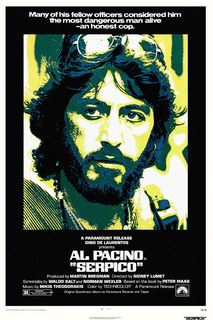
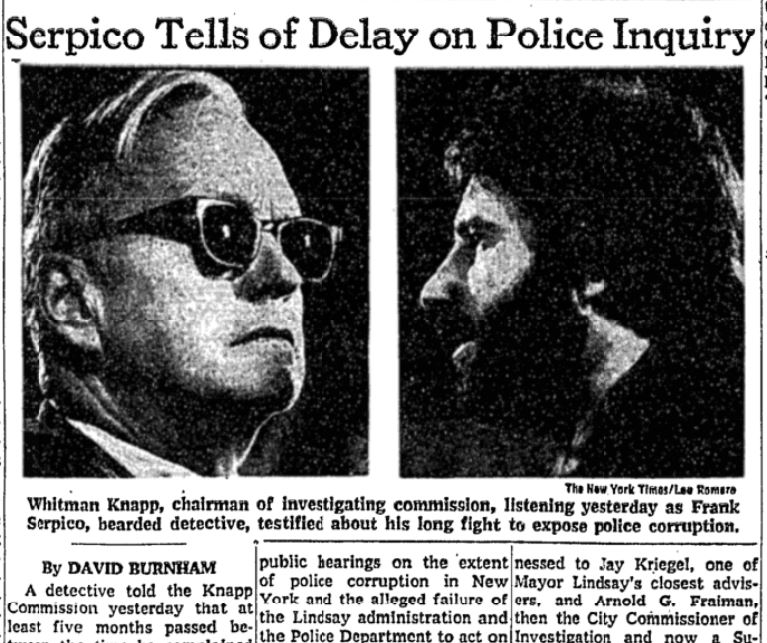
Frank Serpico in film, TV;
statement to Knapp Commission
Posted: October 2026
Details of the 1973 feature film “Serpico,” starring Al Pacino, and 1976-77 NBC TV Friday night series “Serpico,” starring David Birney, both based on the life of New York City Police Officer Frank Serpico, born April 14, 1936, who testified in 1971 to New York’s Knapp Commission about alleged police corruption. Sources on production info and awards: Oscars.org, Internet Movie Database
“Serpico” (1973) — 2-hour, 10-minute feature film starring Al Pacino, directed by Sidney Lumet, rated R, released Dec. 5, 1973, based on the book by Peter Maas. The film budget was estimated at $3 million and the gross reported as $29 million. The film received 2 Academy Award nominations: Al Pacino for Best Actor (lost to Jack Lemmon, “Save the Tiger”). and Waldo Salt, Norman Wexler for Best Adapted Screenplay (lost to “The Exorcist,” William Peter Blatty). The movie poster featuring Al Pacino is admired by John Travolta in “Saturday Night Fever.”
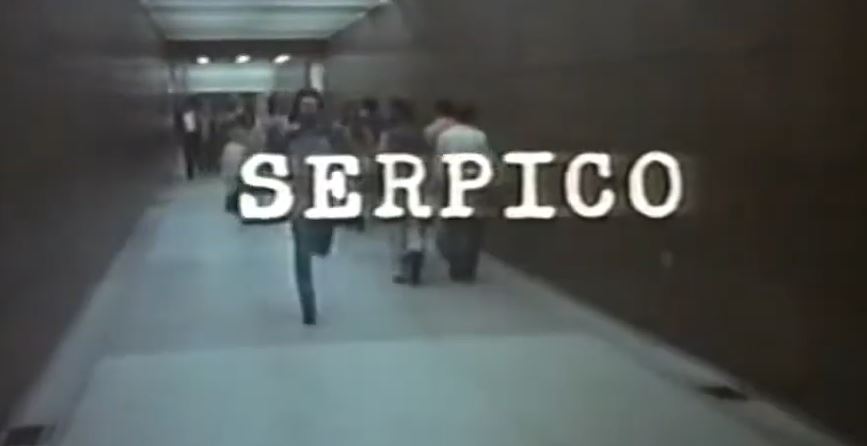
“Serpico” (1976-77) — 1-hour NBC TV series airing for 16 episodes, starring David Birney as Frank Serpico. The series premiered Saturday, April 24, 1976, with a 2-hour production titled “The Deadly Game.” which included Burt Young and Allen Garfield. The regular series began Friday, Sept. 24, 1976, with the 1-hour production “The Country Boy.” The last episode, titled “One Long Tomorrow,” aired Friday, Jan. 28, 1977. Like Birney, Tom Atkins also appeared in all 16 episodes. Other actors appeared in a small number of episodes. A Chicago Tribune report in January 1977 said “Serpico” was being canceled in favor of “Quincy.” On June 30, 1976, Chicago Tribune critic Gary Deeb wrote “early indications are both good and bad.” Deeb wrote that the 2-hour pilot shown in April was “mighty impressive” but that the series may “soft-pedal” the theme of police corruption. Deeb quotes producer Emmet Lavery: “We will not overemphasize the corruption.” On Nov. 25, 1976, Lee Winfrey wrote in the Chicago Tribune, “Of all the new television series this fall, no other has plunged so quickly from a level of potential quality down into a pig sty of muck.”
According to the New York Times of Wednesday, Dec. 15, 1971, Frank Serpico gave this partial statement to the Knapp Commission:
“Through my appearances here today I hope that police officers in the future will not experience the same frustration and anxiety that I was subjected to for the past five years at the hands of my superiors because of my attempt to report corruption.
“I was made to feel that I had burdened them with an unwanted task. The problem is that the atmosphere does not yet exist in which an honest police officer can act without fear of ridicule or reprisal from fellow officers.
“We must create an atmosphere in which the dishonest officer fears the honest one and not the other way around. I hope that this investigation and any future ones will deal with corruption at all levels within the department and not limit themselves to cases involving individual patrolmen.
“Police corruption cannot exist unless it is at least tolerated at higher levels in the department. Therefore, the most important result that can come from these hearings is a conviction by police officers, even more than the public, that the department will change. ...”