Shark repellent: ‘Revenge’ finally scared Hollywood out of the ‘Jaws’ business
“I can’t stand the dream sequences. Why do they do that in a movie. If there’s anything that annoys an audience, it’s the dream sequence. I hate that stunt. It’s old, it’s cheap, it’s a lousy gimmick, and I wish they would stop doing it.”
— Gene Siskel, in the “Siskel & Ebert” review of “Jaws: Revenge”
“Jaws: The Revenge,” a 1987 film, scores a stark 2% on Rotten Tomatoes. Why, then, would it still be playing on cable television 40 years later?
That’s a good one for the Hollywood accountants.
Maybe some programmer inadvertently clicked on the wrong “Jaws.” Maybe someone owed someone a favor.
Or maybe it’s not really that bad or unusual.
You’ve seen worse.
The curious are going to go see this movie regardless; those in search of a serious film are unlikely to get beyond the title.
“Jaws: The Revenge,” directed and produced by Joseph Sargent, a veteran of the Battle of the Bulge, is going to come down to two decisions: Who/when is going to be the most important human death, and how will the creature be destroyed/defeated.
“Revenge” fails each decision. The ending has not an ounce of creativity and is even confusing. But the opening may be the biggest mistake. The credits roll while a camera apparently from a shark’s point of view takes us through deep wreckage underwater and occasionally surfaces to check out the scene around town.
Then it immediately kills a member of the shark-fighting Brodys, just as we’re being introduced to the family’s current status.
It should be horrifying. We have just seen the very happy mother-son relationship and learned that the son, Sean Brody, a police officer, is engaged. It’s Christmas Eve, and he’s ready to go home for the night, just when someone calls asking if someone can clear a drifting “dock pile” that’s stuck in the channel and has to be cleared before fishermen arrive.
Then we get a practice performance of “The First Noel” for an upcoming Christmas show, which at first is dysfunctional and intended to be funny as the director complains about the production, only to turn haunting as the young officer is first maimed and then finished off on the boat by a shark as we hear “Born is the king of ...” The Chicago Tribune’s Dave Kehr says in the movies, that’s known as an “ironic counterpoint.”
Intended to be startling, yes. A little weird, yes.
There doesn’t seem to be much official investigation of this tragedy nor any town hall meetings about closing the docks, but 13 minutes in, mom is the one who has figured out what is happening: Some shark(s) is targeting her family. (Yes.) “It waited all this time and it came for him,” she tells her second/older son, Mike, who works in the Bahamas but has come to Amity for the funeral of his brother, whose fiancee will quickly disappear from the plot. Mom will warn Mike to stop working in the ocean while nevertheless coming down to the Bahamas to join him for a vacation. “I don’t want you working in the water,” she says, but Mike insists his job is “perfectly safe” and that he merely collects big snails and that great white sharks don’t like warm water.
To keep audiences from potentially ending up in tears, note that the two Brody sons are in that “accepting the risk” category. Sean was a cop, and Mike is an ocean researcher who insists on going into the water despite the presence of the shark. Being personally targeted by a random great white shark that will jump onto watercraft has to be one of those things that goes with the territory.
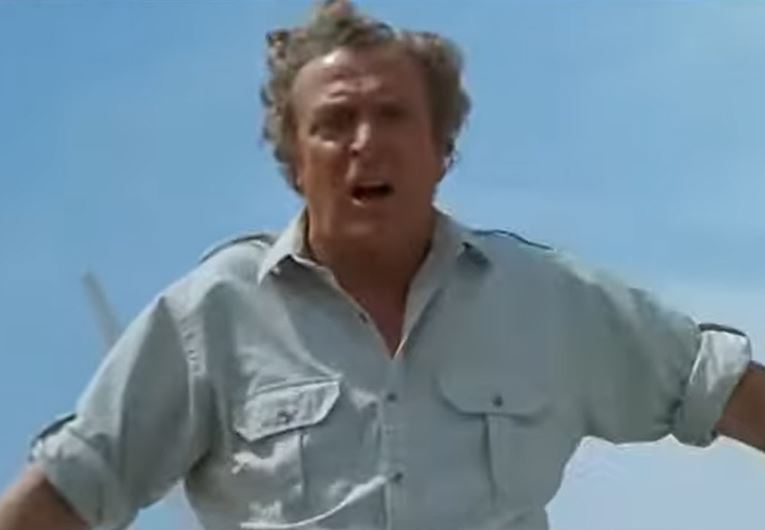
Roger Ebert and Gene Siskel, in what has to be one of their most entertaining episodes, trade broadsides on this picture, each trying to point out some fallacy that maybe the other hadn’t thought of. Roger notes that the camera at times gives us the shark’s point of view from above water. Gene says Michael Caine swims onto a boat with a “freshly laundered” shirt. Roger points out that sharks in the previous films died, so who is this particular shark?
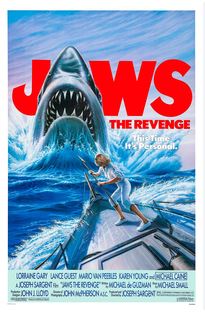
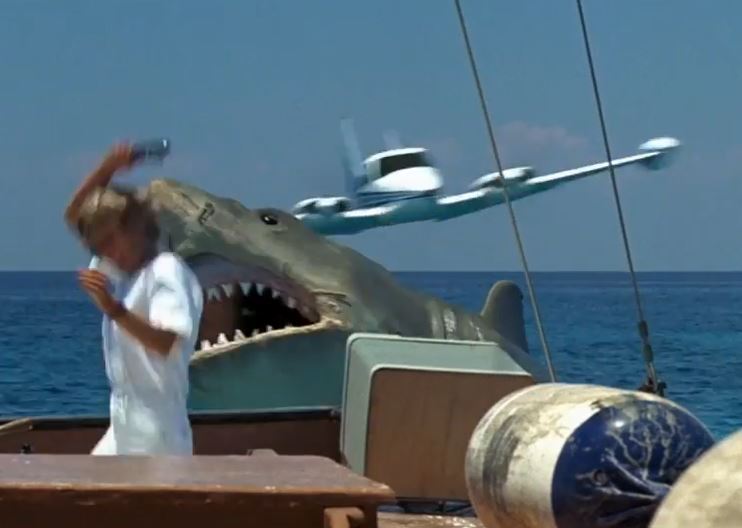
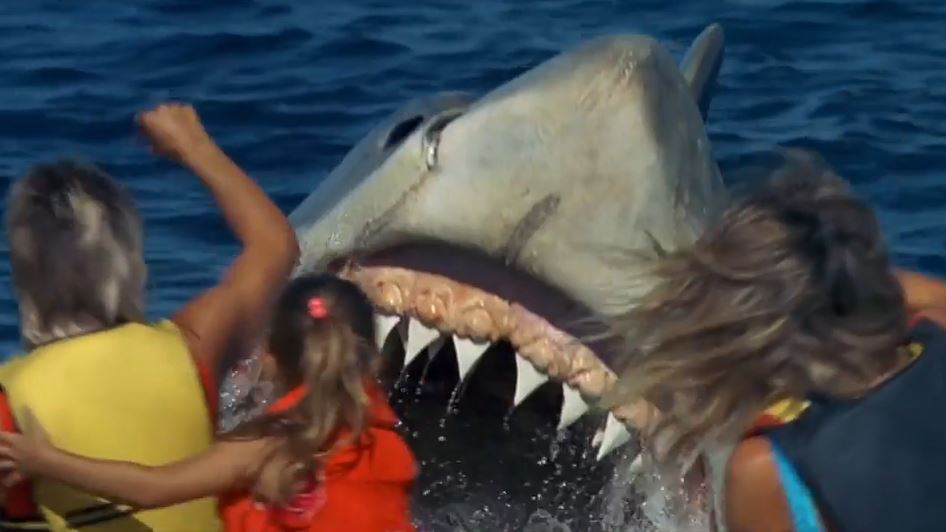
The movie would be helped immensely if it simply ginned up some completely new victims, or, if it’s adamant about keeping the Brodys around, provide a marginally plausible reason as to how a shark could track human beings. (If you think such a premise is beyond ridiculous, know that it’s used in the earlier film “Orca.”) It may have to be a fantasy approach. (In Hollywood, people get paid big money to be creative.) We almost get a breakthrough when the shark, in its first attack in the Bahamas, nearly makes a go of it aboard the ship. A supershark that can survive on land would be quite an invention. “This time, it’s personal,” says the voice in the trailer, quite an understatement.
The biggest indictment of “Jaws: The Revenge” actually is not the illogical plot. It’s that the movie isn’t funny. If you’re thinking it might qualify for the so-bad-it’s-good tag, forget it. It’s not quite ridiculous enough to prompt laughter. Surely someone upon getting about a third of the way through the script had to be thinking, “This could be hilarious.” The original “Jaws” is serious. And Michael de Guzman’s script decides that “Revenge” will be taken seriously. Perhaps the Oscars should have noticed that Lorraine Gary (who actually came out of retirement for this film), Lance Guest, Mario Van Peebles and Michael Caine somehow managed to play this movie straight.
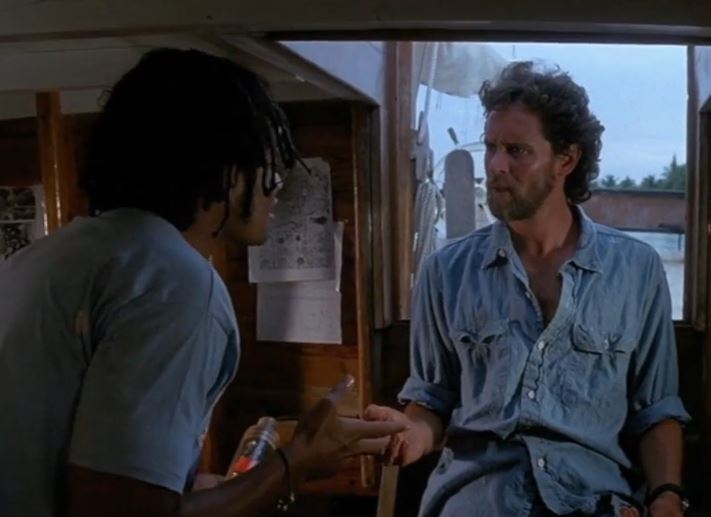
De Guzman’s feeble attempt at comedy is mostly in the trash-talking dialogue between Mike and his co-researcher buddy Jake. This is effective once or twice; by the sixth or seventh time gets quite predictable. Apparently as a filming condition, the Bahamian government demanded Jake not wear dreadlocks, concerned about image. Mario Van Peebles reportedly successfully appealed that demand to the Bahamas tourism board.
Michael Caine, who can and does make any bad picture not so terrible, has a few good one-liners, but he is mostly tasked with the sensitive side of the film, expressing romantic interest in Ellen and representing to her that life does go on. She is enjoying this new discovery in her life, except whenever her newfound Spider-Sense goes off, warning her that either her son or little granddaughter, Thea, is in shark danger. Her son has concerns either about Hoagie or about mom’s new relationship, which Kehr calls “Oedipal juice.” On the flight in the Bahamas piloted by Hoagie, Mike does what any passenger would: ask a distracted pilot of a small plane who’s already holding a small child in his lap and is attempting joyriding if it’s really true that he’ll have to fly the rest of his life to pay off his gambling debts. (Mike, however, is turned on by his wife’s welding.)
Caine and Gary actually have good chemistry. These characters deserve new names, new identities, a fresh start in a different movie. Another plus is the racial harmony of Mike and Jake, characters who also could use a different assignment.
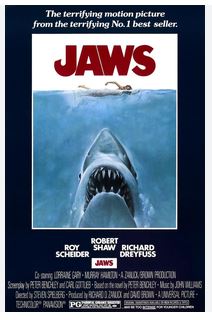
One of the crazy things about sequels is that, with few exceptions, Hollywood is far more interested than the moviegoing public is. But why? Surely in 1987, more and easier money would’ve been made by simply re-releasing “Jaws” — basically found money — than going to the trouble of making a new “Jaws” that utterly no one was clamoring for. (Check out what the original was still grossing in its 50th anniversary year of 2025.)
In interviews that can be viewed in YouTube clips, Sargent basically admits that the aspirations for “Jaws: The Revenge” weren’t great, that he was just trying to entertain audiences with a fresh twist on a proven concept. It would be the fourth — and last — of the series. Should it be judged like any other movie? Trying to entertain people? Or should it be judged only with some kind of point spread, that it employs the name of a famous and cherished brand and therefore is obligated to be better than garbage.
The movie can correctly be called stoopid. But it’s actually not boring. Maybe it is in the final 20 minutes, when we’re yawning about how the shark will meet its demise, but there’s some unexpected drama as to what happens with Jake. (Apparently those who saw the original movie may have gotten a different outcome than those currently seeing it on cable.) It’s barely 90 minutes. Nobody’s losing an entire afternoon over this.
An April 1987 article in the Chicago Tribune by Donna Rosenthal about the production of “Jaws: The Revenge” is about the most informative article that could ever be written about a movie in production. Rosenthal writes that the movie was put together on a nine-month schedule (when two years was typical) because Sid Sheinberg, the president of Universal parent MCA and coincidentally the husband of Gary, decided in September 1986 that he wanted a “Jaws” movie for the summer of 1987.
Rosenthal spoke with Roy Scheider by phone. He spurned “Revenge” but was a big star of the first film and second and only appeared in the latter because of a “contractual obligation.” Scheider says the first film “did it right” and indicates there was no need for more. He tells Rosenthal that he “could probably continue doing ‘Jaws’ pictures for the rest of my life because it seems Universal will.”
(A January 1987 Tribune article by Desmond Ryan says Universal was “trying to prevail upon” Scheider to join the film. He didn’t, so “Revenge” audiences were told he had a heart attack (somehow caused by a shark) while seeing his picture in a still photo.)
Gary appreciated the opportunity far more than Scheider. “I haven’t had an acting job since the phone stopped ringing, nine years ago,” Gary admits to Rosenthal. “I was miserable. There aren’t many parts for older actresses.”
With the movie taking place, at least in the beginning, in the Northeast again, Rosenthal says its eight days of shooting and 250 extras filled hotels and restaurants on Martha’s Vineyard, a fisherman observing, “ ‘Jaws’ is a huge relief to our economy.”
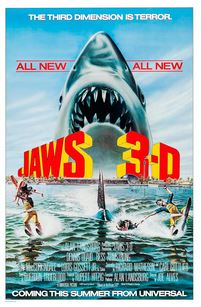
Caine was getting a “reported” $1.5 million, Rosenthal writes, and stood up for the picture: “The plot is gripping, the characters compelling and the shark much more realistic. ‘Jaws 2’ and ‘3-D’ were so awful — I was rooting for the shark.”
Caine, according to Rosenthal, made six films in 1986 and had a “packed schedule” for 1987. But he had apparently had it with L.A., telling Rosenthal he was moving to a 15th-century manor on the Thames in a few months. Caine deemed Beverly Hills a “Golden Ghetto” where “My brain has been turning to jelly.” More practically, he had moved to Los Angeles 8½ years earlier but found “I’ve been making movies everywhere but there.”
Movies such as “Jaws: The Revenge” may seem too frivolous for serious criticism. But in fact, they deserve scrutiny because they are a big part of the Hollywood machine. Remakes are everywhere. A lot of times, they may be dubious recycled concepts but made by talented people who contribute a good idea or two (see Roger Ebert’s lone screenwriting credit). Horror/adventure movies get funded and get made. Most are probably busts, but a few succeed.
Kehr gives “Revenge” 1 star; Siskel did not review it for the Tribune but writes in a summer-movie article, “When you see and hear the nasal Lorraine Gary on screen you want the shark to eat her.”
Roger Ebert apparently gives the film zero stars and a thumbs-down, explaining that he could buy a few crazy assertions in the movie while going on to list all the ones he can’t.
Rosenthal writes that the film cost $23 million, not a small budget in 1987, but Gary is quoted in the Tribune at a different time that year as saying it actually was a $30 million film. It reportedly grossed $51 million and evidently made a little money, though presumably no one’s getting rich off percentages.
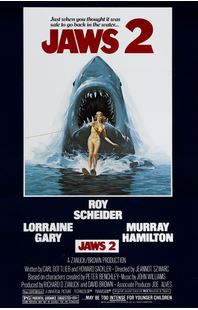
If the son of a famous painter also paints, and he’s just not as good as his father, you can’t blame him for tarnishing the family name. Or can you? “Jaws: The Revenge” may have disappointed critics and a lot of fans, but it didn’t tarnish anything — “2” and “3-D” had already done that. “Revenge” actually met a very low bar. People who hold the rights to the “Jaws” franchise are people who see scripts every day. They have to make a movie about something. Perhaps “Jaws” seems as strong of an option as any. The public likes the concept. It’s worked before. Was anyone clamoring for a fourth “Jaws”? No, but enough went to see it. Maybe all you have to do is play the John Williams music and sell tickets.
“Revenge” closed down the franchise. There hasn’t been a new “Jaws” since. And maybe that’s the major success here? That even though “Revenge” apparently made money, Hollywood saw what a fourth sequel hath wrought and decided, enough is enough ... an outcome no one seems to have a problem with.
People still got paid, from Michael Caine to the extras on Martha’s Vineyard. The compressed shooting schedule of “Revenge” is the reason Caine was unable to attend the 59th Academy Awards on March 30, 1987, where he would win his first Oscar, for Best Supporting Actor for “Hannah and Her Sisters.” This happenstance so intrigued the editors of the Internet Movie Database that they included a rare description on the portal for the 1987 Oscars with a purported “later” quote from Caine: “I have never seen it, but by all accounts it is terrible. However, I have seen the house that it built, and it is terrific.” (He says in a video that the house was “bought,” and it was bought for his mother.)
He’s right about those accounts.
But you’ve seen worse.
2 stars
(June 2026)
“Jaws: The Revenge” (1987)
Cast:
Lorraine Gary as
Ellen Brody ♦
Lance Guest as
Michael Brody ♦
Mario Van Peebles as
Jake ♦
Karen Young as
Carla Brody ♦
Michael Caine as
Hoagie ♦
Judith Barsi as
Thea ♦
Mitchell Anderson as
Sean Brody ♦
Lynn Whitfield as
Louisa ♦
Jay Mello as
Young Sean Brody (archive footage) ♦
Cedric Scott as
Clarence ♦
Charles Bowleg as
William ♦
Melvin Van Peebles as
Mr. Witherspoon ♦
Mary Smith as
Tiffany ♦
Edna Billotto as
Polly ♦
Fritzi Jane Courtney as
Mrs. Taft ♦
Cyprian R. Dube as
Mayor ♦
Lee Fierro as
Mrs. Kintner ♦
John Griffin as
Man in the Boat ♦
Diane Hetfield as
Mrs. Ferguson ♦
Daniel J. Manning as
Jesus ♦
William E. Marks as
Lenny ♦
James Martin as
Minister ♦
David Wilson as
Tarkanian ♦
Romeo Farrington as
Romeo ♦
Anthony Delaney as
Charles Townsend ♦
Heather Thompson as
Shirley ♦
Levant Carey as
Houseman ♦
Darlene Davis as
Irma ♦
Barbara Alston as
Additional Voices ♦
Tina Lifford as
Additional Voices ♦
Marilyn Schreffler as
Additional Voices ♦
Doris Hess as
Additional Voices ♦
J. D. Hall as
Additional Voices ♦
John Lafayette as
Additional Voices ♦
Dominic Hoffman as
Additional Voices ♦
Charles Bartlett as
Additional Voices ♦
David McCharen as
Additional Voices ♦
LaGloria Scott as
Additional Voices ♦
Kaleena Kiff as
Additional Voices ♦
Rocky as
Additional Voices ♦
Eldon Ratliff as
Additional Voices ♦
Shauna McCoy as
Additional Voices ♦
Joanna Lipari as
Additional Voices ♦
Terrence Beasor as
Additional Voices ♦
Jan Rabson as
Additional Voices ♦
Barbara Iley as
Additional Voices ♦
Cathy Cavadini as
Additional Voices ♦
Judi Durand as
Additional Voices ♦
Lillian Garrett as
Additional Voices ♦
Larry Moss as
Additional Voices ♦
Naomi Ruth Stevens as
Additional Voices ♦
Daamen J. Krall as
Additional Voices
Directed by: Joseph Sargent
Written by: Michael de Guzman
Written by: Peter Benchley
Producer: Joseph Sargent
Associate producer: Frank Baur
Music: Michael Small
Cinematography: John McPherson
Editing: Michael Brown
Casting: Nancy Nayor
Production design: John J. Lloyd
Art direction: Don Woodruff
Set decoration: John M. Dwyer, Hal Gausman
Makeup and hair: Chris Lee, Tony Lloyd, Dan Striepeke
Unit production manager: Frank Baur
Post-production supervisor: Francine Fleishman
Stunts: Ray Baum, Deborah Bryan, Roydon E. Clark, Diane Hetfield, Kevin McAfee, Gavin McKinney, Tom Morga, Paul Sherrod
Special thanks: E. John Deleveaux
Special thanks: John E. McCosker