Steve McQueen died of heart attack at 50 while battling mesothelioma
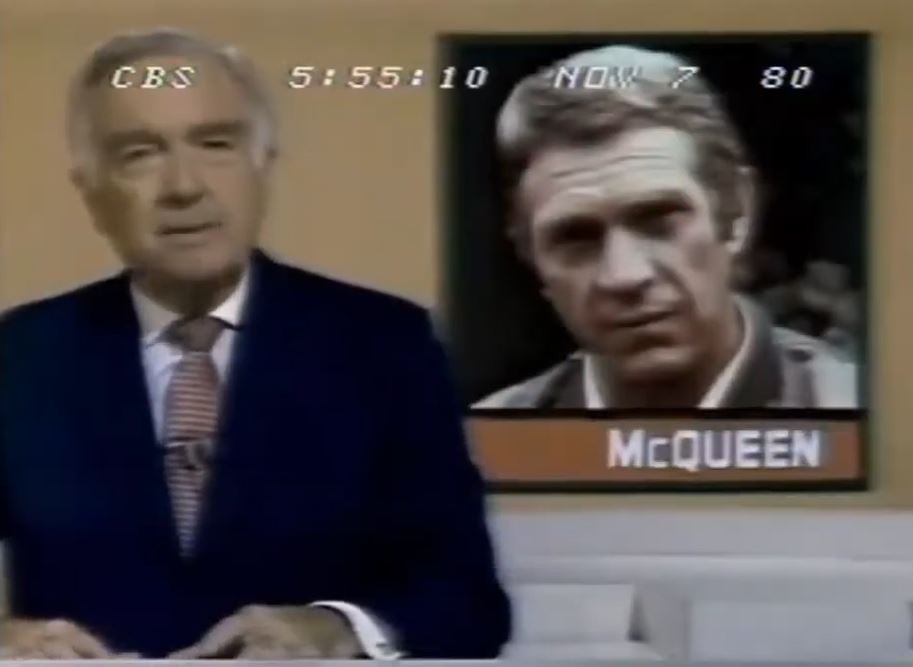
Steve McQueen died of a heart attack at age 50 in a hospital in Juarez, Mexico, on Nov. 7, 1980.
According to the New York Times obituary, McQueen had been battling mesothelioma and died after undergoing surgery to remove a cancerous tumor.
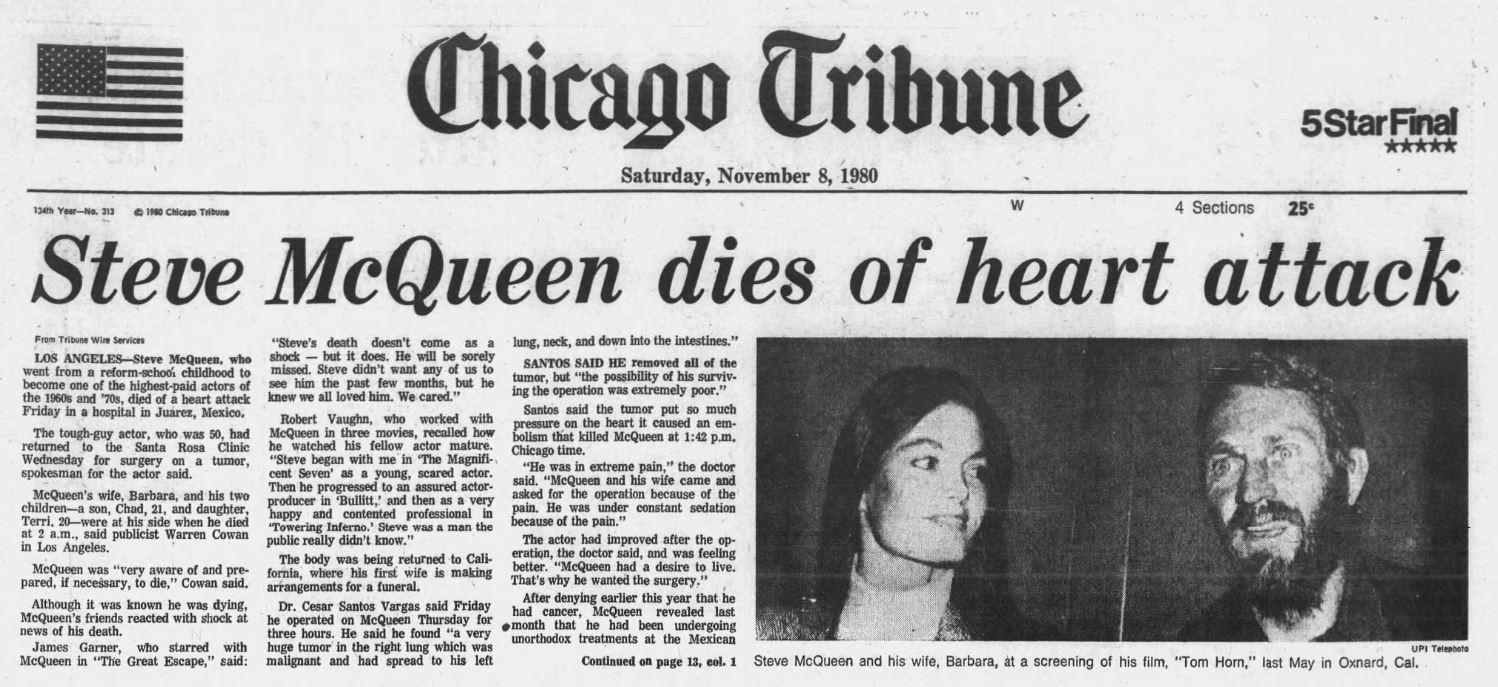
His third wife, Barbara Minty (who’s now 73), and two children, son Chad, 21, and daughter Terri, 20, were at the bedside, according to McQueen’s publicist Warren Cowan.
The Chicago Tribune obituary stated, “The body was being returned to California, where his first wife is making arrangements for a funeral.” But the New York Times obituary cited Cowan as stating no funeral was planned.
According to The New York Times of Nov. 12, 1980, the National Enquirer in March 1980 broke the news of Steve McQueen suffering from mesothelioma.
The Chicago Tribune obituary stated that Dr. Cesar Santos Vargas operated on McQueen a day before his death for three hours and found “a very huge tumor in the right lung which was malignant and had spread to his left lung, neck, and down into the intestines.” The doctor said McQueen was in “extreme pain” and sought the operation because of the pain, and “the possibility of his surviving the operation was extremely poor,” and an embolism killed him hours later.
According to both the Chicago Tribune and New York Times obituaries, McQueen had been battling the mesothelioma with an unorthodox regimen of special diets, nutritional supplements, animal-cell injections and laetrile in Mexico. He was living at his ranch in Santa Paula, Calif., and checked in to the Juarez clinic for the last time “using the pseudonym Samuel Sheppard.”
On Sunday, Nov. 9, 1980, The New York Times published an Associated Press story raising questions about the experimental treatment McQueen received. Dr. Edward Zalta, president of the Los Angeles County Medical Association, said “the unconventional therapy could’ve contributed to his death.” Santos Vargas said it was clear that McQueen did not have long to live; he “looked more pregnant than a fully pregnant woman.” That article says McQueen’s treatment at Plaza Santa Maria Hospital, developed by Dr. Donald William Kelley, included laetrile, coffee enemas and a diet “largely of raw vegetables.” Kelley said the treatement “made the quality of his life excellent during the past four months.”
On its website, the National Cancer Institute states, “No controlled clinical trials of laetrile have been reported. Anecdotal reports and case reports have not shown laetrile to be an effective treatment for cancer.”
According to The Cleveland Clinic, “Asbestos exposure is the most common cause of mesothelioma,” but, “it can take decades for cancer to develop after asbestos exposure,” and, “people with mesothelioma don’t always have a history of asbestos exposure.” According to the Mayo Clinic, “Experts believe that being around asbestos causes many mesotheliomas. But not everyone with mesothelioma has been around asbestos. Exactly what causes the cancer may not be known.”
The Chicago Tribune obituary stated McQueen’s first wife, Neile Adams (who’s now 94), called the Mexican doctors who treated McQueen “charlatans and exploiters” and said that Minty was too young and naive to intervene.
An Associated Press story published Monday, Nov. 10, 1980, quoted Cowan as saying “Cremation has taken place,” citing information from Minty.
An Associated Press story published Thursday, Nov. 13, 1980, said McQueen’s ashes were scattered by airplane over the Pacific Ocean. It cited “a family friend who declined to be identified.” It said “a small gathering” including family, stuntmen, “local residents” and pilots was held Nov. 9 at McQueen’s Santa Paula ranch. It said “eight open-cockpit biplanes flew in formation over the McQueen ranch.” Neile Adams and Ali MacGraw (who’s now 87), McQueen’s first two wives, visited during the event.
Steve McQueen, one of the few dozen biggest movie stars of all time, received one Oscar nomination, for Best Actor for “The Sand Pebbles” (1966). He lost to Paul Scofield (“A Man for All Seasons”). Other nominees were Michael Caine (“Alfie”), Alan Arkin (“The Russians Are Coming the Russians Are Coming”) and Richard Burton (“Who’s Afraid of Virginia Woolf?”).
The Chicago Tribune obituary quoted this statement from James Garner: “Steve’s death doesn’t come as a shock — but it does. He will be sorely missed. Steve didn’t want any of us to see him the past few months, but he knew we all loved him. We cared.”
There is no indication that President Jimmy Carter nor President-elect Ronald Reagan, who had just won the White House that week, issued a statement on McQueen’s death.
(October 2026)