3 famous movies about Titanic
If screenwriters were sitting around a Hollywood office discussing a movie about the Titanic, they’d have lots to talk about.
It could be something about hubris, of human fallibility.
It could be something about class warfare, the superrich and the poor arguing over the limited number of lifeboats.
It could be something about a survival test.
It could be about heroism.
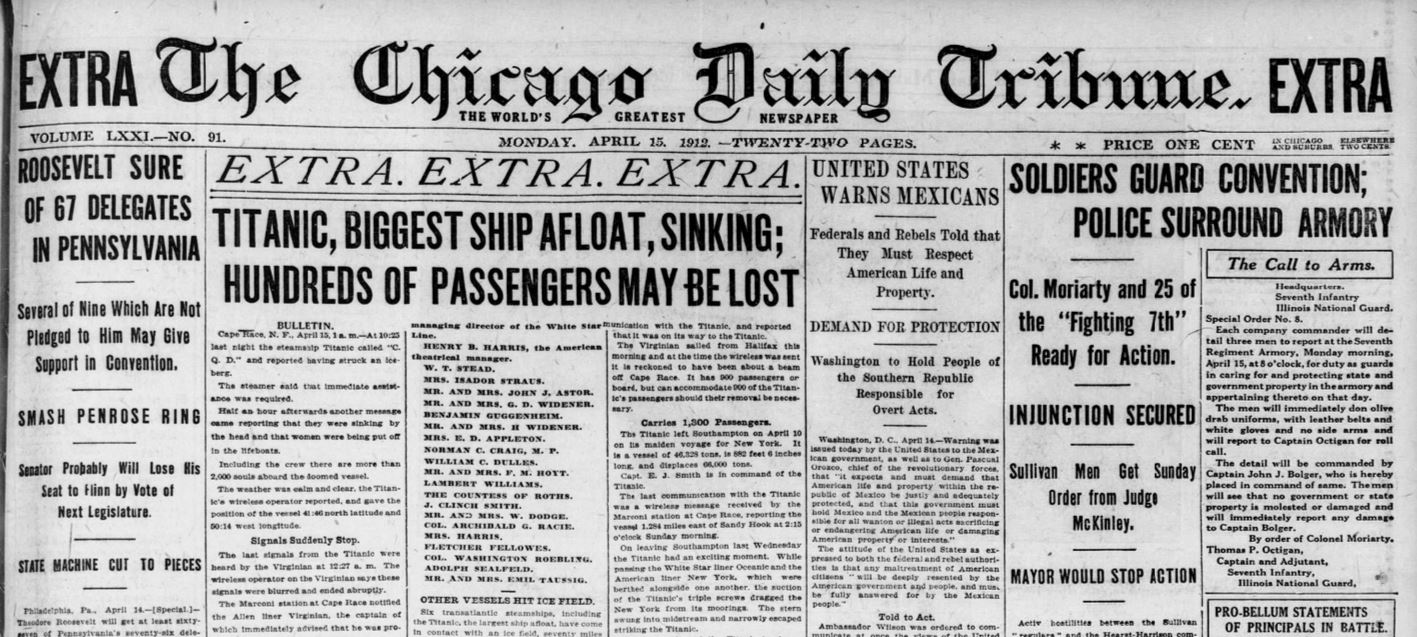
Those are the natural topics. The Titanic set sail on April 10, 1912, from Southampton, England, its famous “maiden voyage” during which it first stopped in France and then Ireland before heading on to the United States. The ship was not full with passsengers and perhaps only around half capacity. The ship on April 14, apparently just before midnight, struck an iceberg in the North Atlantic. The ship was not actually punctured, but the hull was dented enough to begin separating, allowing water in. It would sink about 2½ hours later.
In 1912, Hollywood was just getting started. And a month after Titanic sank, Dorothy Gibson an actress who survived the disaster, starred in a short film, “Saved From the Titanic,” wearing the clothes she wore on that night. (Gibson was fortunate to be playing bridge late on the evening of April 12, meaning she was awake during the iceberg collision and was among the first to the lifeboats, which initially at least were filled as low as half-capacity.)
But within a couple years, “Saved From the Titanic” would be lost, apparently forever. And the new industry of moviemaking had centuries of other famous stories to catch up on. Given the enormous drama of the sinking, it’s surprising that Hollywood didn’t take up the subject of Titanic more often. Cost and sets could be among the reasons; filming a water disaster would’ve been an extraordinary ask in the early years of Hollywood.
Titanic feature films emerged in the 1950s. But to this day, there are three that resonate:

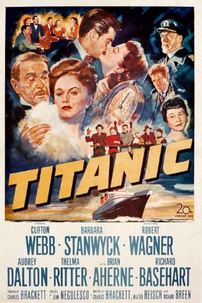
1953: “Titanic” (B/W, 98 minutes, Approved, directed by Jean Negulesco, written by Charles Brackett, Richard L. Breen and Walter Reisch, 20th Century Fox and Paramount Pictures) — The first “feature film” of the tragedy, it stars Clifton Webb and Barbara Stanwyck among a mix of real and fictional characters and is perhaps most well-known for featuring a young Robert Wagner. Not known for strict adherence to accuracy, the plot is one that would become standard in disaster movies of the 1970s — couples with relationship issues suddenly finding themselves with a much bigger problem. A Chicago Tribune review finds “The ill fated ship is more real than her passengers and crew” but appreciates “engrossing attention to detail.” It says the “final scenes,” which include the singing of “Nearer, My God, to Thee,” are “photografically impressive.” It ends with survivors in lifeboats awaiting rescue. Won Oscar for Best Writing, Story and Screenplay; nominated for Oscar for Best Art Direction-Set Decoration Black-and-White (Lyle R. Wheeler, Maurice Ransford, Stuart A. Reiss)
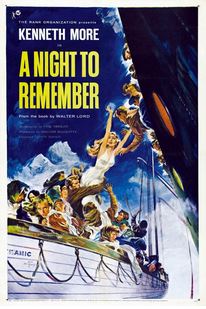
1958: “A Night to Remember” (B/W, 123 minutes, Not rated, directed by Roy Ward Baker, screenplay by Eric Ambler and story by Walter Lord, The Rank Organisation) — A British production with a British-centric take deemphasizing some of the American personalities, acclaimed for its devotion to detail and accuracy. The sinking is of course gripping, but the acting dramatic arc is limited and centers on the real Second Officer Charles Lightoller, the most senior crew member to survive, played by Kenneth More. Lightoller comes to the realization that overconfidence was perhaps the cause of the disaster and that he’ll never feel sure about anything again. Like “Titanic,” it does show men in dubious instances taking seats on lifeboats they know they shouldn’t be in. Though survivors witnessed the sinking, exactly how Titanic sank was not clear. This film in its most haunting scenes depicts the bow lowering to near water level as the stern rises, then sinking in one piece, an assertion contradicted by the 1985 discovery of the wreckage. It ends with the rescues having been made by the Carpathia and the captain reporting the numbers of the living and the dead. No Oscar nominations; won Golden Globe for Best English-Language Foreign Film, nominated for BAFTA for Best British Screenplay
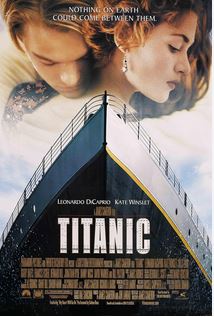
1997: “Titanic” (Color, 194 minutes, Rated PG-13, directed by James Cameron, screenplay by James Cameron, 20th Century Fox and Paramount Pictures) — One of the biggest films ever made. Is significantly enhanced beyond the above two films by the September 1985 discovery of the wreckage by the team of Jean-Louis Michel and Robert Ballard, which revealed not only debris but that the ship split in half before or during sinking. With most of the film a flashback, the story is told in present day, allowing use of computers and descriptions to show/theorize what happened to the ship. A treasure hunter in search of a necklace linked to the Titanic is contacted by the woman, now 100, who owned it; she recounts her experience on the voyage. The sinking is actually the backdrop to a fictionalized love story, not a whole lot different than, say, “Dirty Dancing,” in which a young woman of upper class meets a blue-collar young man, to disapproval from the elites. Being in flashback format, does not end with the sinking or rescue but with the survivor fantasizing how the voyage might have gone without a wreck. Reportedly the most expensive film ever made at that time, it proved a staggering success, earning 14 Oscar nominations and 11 wins and eventually grossing over $2 billion. If there was any disappointment, it was in the lesser Oscar reception for the film’s actors; none won an Oscar and neither of the two male stars was nominated. The two actresses did not compete in the same category but shared a character, which could’ve hurt the chances of each. Oscar nominations:
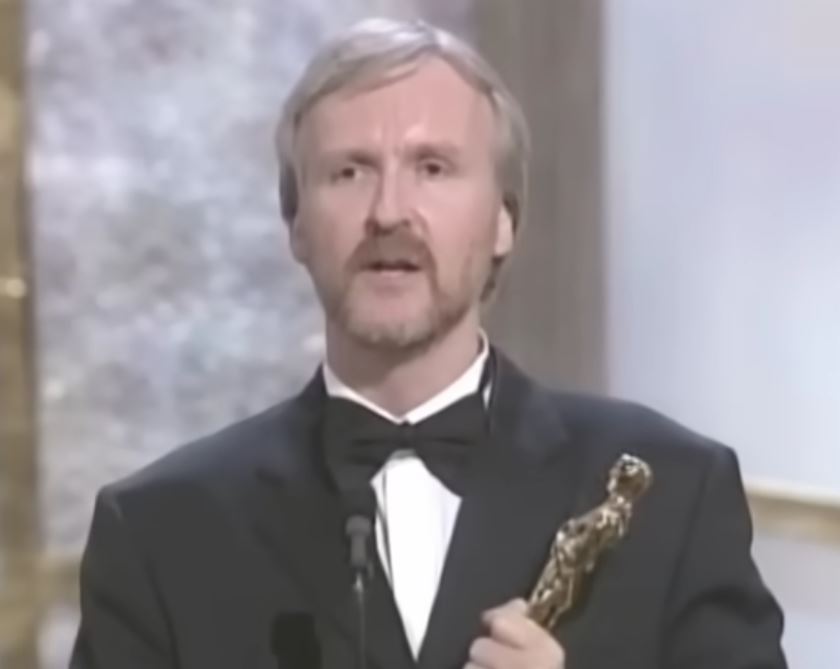
WON Best Picture (James Cameron, Jon Landau)
WON Best Director (James Cameron)
WON Best Best Cinematography (Russell Carpenter)
WON Best Art Direction-Set Decoration (Peter Lamont (art director), Michael Ford (set decorator))
WON Best Costume Design (Deborah L. Scott)
WON Best Sound (Gary Rydstrom, Tom Johnson, Gary Summers, Mark Ulano)
WON Best Film Editing (Conrad Buff IV, James Cameron, Richard A. Harris)
WON Best Effects, Sound Effects Editing (Tom Bellfort, Christopher Boyes)
WON Best Effects, Visual Effects (Robert Legato, Mark A. Lasoff, Thomas L. Fisher, Michael Kanfer)
WON Best Music, Original Song (James Horner (music), Will Jennings (lyrics), For “My Heart Will Go On,” performed by Céline Dion)
WON Best Music, Original Dramatic Score (James Horner)
NOMINEE Best Actress (Kate Winslet) (lost to Helen Hunt, As Good as It Gets)
NOMINEE Best Supporting Actress (Gloria Stuart) (lost to Kim Basinger, L.A. Confidential)
NOMINEE Best Makeup (Tina Earnshaw, Greg Cannom, Simon Thompson) (lost to Men in Black, Rick Baker, David LeRoy Anderson)
Impact: Comparisons should be made between the Titanic films and movies about invented disasters. The invented disasters have a major cinematic advantage. Their characters find solutions to the problems. There are either just the right amount of characters sacrificed (“The Towering Inferno,” “Airport 1975”) so that we still feel good about the outcome, or, the death toll percentage can be huge (“The Poseidon Adventure”), but the whole crisis is fictional, so we’re not leaving in tears.
Quentin Tarantino has applied alternate endings to historical events in at least two films, and the films are not insensitive, and no one appears offended. That suggests the same could be possible for Titanic, except ...
Because of the massive success of James Cameron’s movie, it seems hard to believe anyone will attempt another telling of the Titanic for decades to come. There is always something new to be said in any film, but the idea of any filmmaker raising huge amounts of money to invent what likely would be another tragic love story, and somehow find a song like Celine Dion’s/James Horner’s, only to be inevitably compared negatively to Cameron’s film, seems a massive reach. The story is probably best left to lie in peace.
(June 2026)