Warren Beatty should’ve opened correct Best Picture card at the podium after mistake realized
Posted: June 2025; updated August 2026
Meryl Streep has been nominated for 21 Academy Awards.
Jordan Horowitz has been nominated for 1.
Streep has actually “lost” 18 times. It’s doubtful that any of those “defeats” felt like what Horowitz experienced late on Feb. 26, 2017, in what so far has been his lone Oscar opportunity.
Maybe he’ll get another someday.
And maybe not.
This is a tough business.
Extremely tough.
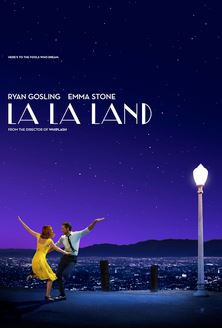
“La La Land” is an outstanding 2016 movie featuring superstars Emma Stone and Ryan Gosling, directed by Damien Chazelle. You’ve heard of them. You probably haven’t heard of Jordan Horowitz or the movie’s other two nominated producers, Marc Platt and Fred Berger.
In early 2017, they earned one of the world’s most prestigious honors — an Oscar nomination. Actually, each year, a lot of people receive Oscar nominations. Some nominations are for likely one-of-a-kind or obscure productions. Others go to people who will be heard from multiple times during awards season in their careers.
A nomination alone is quite an achievement. Being a nominee though is just a start. Most of them, because of the intense scrutiny and forecasting given to these awards, know well in advance that they won’t win a statue. Most categories, like certain red states/blue states in politics, are actually conceded by the pundits. Some categories are considered to have two strong contenders. Almost no categories are considered to have more than that.
The “La La Land” nominees though had every reason to believe victory was possible. The film’s 14 nominations tied a record. Chicago Tribune critic Michael Phillips’ preview on the day of the ceremony called the movie “this year’s dominant Oscar-nominated picture,” and while Phillips allowed that “Moonlight” could win best picture, he wrote that “La La Land” “retains the oddsmakers’ favor going into the final lap, for many reasons.” Probably not even Steven Spielberg nor Alfred Hitchcock ever had this much momentum for a film at any single Academy Awards.
Indeed. Leading up to the best picture announcement, “La La Land” had already won six statues. One win went to lead actress Emma Stone, and another went to director Damien Chazelle, whose category typically — but not always — is voted in lockstep with best picture.
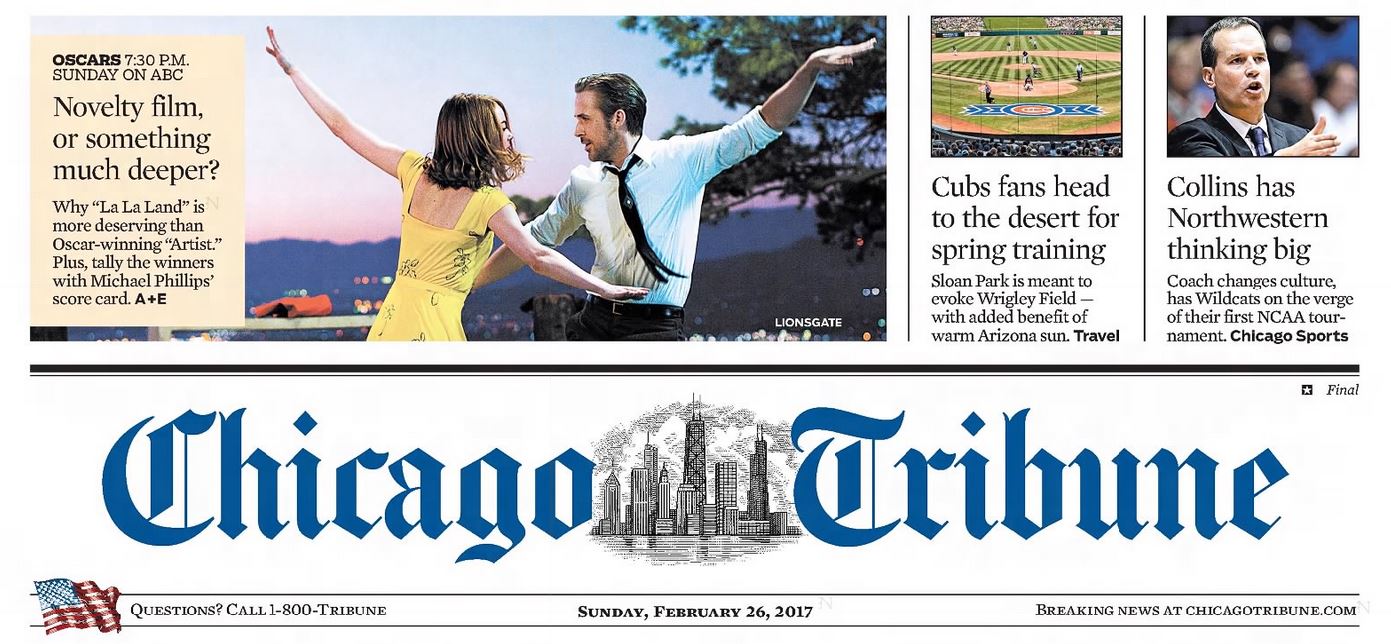
The Chicago Tribune’s 2017 Oscars preview highlights “La La Land.”
As the night culminated in the best picture announcement, a massive, mind-boggling mistake was about to be made. The wrong card was somehow handed to presenters Warren Beatty and Faye Dunaway. And the presenters weren’t going to stop and question it. Had the card listed a winner of a more obscure film not in the running for best picture, such as Colleen Atwood’s costumes for “Fantastic Beasts and Where to Find Them,” everyone would’ve immediately realized the mistake, and no group would’ve gathered at the podium to make speeches.
(A day after the event, PriceWaterhouseCoopers issued a statement apologizing for the mistake and declaring, “We are currently investigating how this could have happened.” A couple days later, the Associated Press reported that PwC accountants Brian Cullinan and Martha Ruiz, who handled the envelopes, were “permanently removed from all film academy dealings.”)
Instead, the card read was for best actress, which had the names “Emma Stone” and “La La Land.” Beatty, obviously confused and unwilling to ask for an offstage clarification, showed it to an impatient Dunaway, who blurted out the film’s title.
Which was not in the slightest unexpected.
It brought the ecstatic “La La Land” ensemble to the podium. For best picture winners, only the producers are supposed to speak, but directors or actors sometimes do. Horowitz took the mike first — in a 2020 podcast, he said the producers “had some conversations about order prior to that ... just to be prepared” — and proceeded to deliver a wonderful speech.
Horowitz said:
“Thank you. Thank you, all. Um, thank you to the Academy. Thank you to Lionsgate. Thank you to our incredible cast and crew. We’re all up here right now. Um, thank you to Jamie Feldman to Gary Gilbert. Thank you, uh, to my parents for supporting, uh, my choice to pursue a career in the arts, even though it was a little bit crazy. Um, Arthur Horowitz, you are my fantasy baby, um, and to my kind, generous, talented, beautiful, blue-eyed wife and creative partner, Julia Hart. Whew. You have, uh, inspired me to become the man I am right now, um, and more importantly, the man I’m still becoming. Um, there’s a lot of love in this room, um, and let’s use it to create and champion bold and diverse work, work that inspires us towards joy, towards hope, and towards empathy.”
If anyone has ever attempted to put together a potential damage-control guide for the Oscars, here is what they should consider — that Beatty still could’ve saved the moment with a redo.
As the “La La Land” producers were speaking, the mistake was being discussed behind them, and someone — unclear who — actually opened the correct envelope.
Had someone simply informed Beatty of the mistake ... without opening the correct envelope ... Beatty could’ve returned to the microphone, explained that the wrong card was read, asked everyone to return to their seats, and then opened the correct card.
It still would’ve been embarrassing, and an immediate letdown for the “La La Land” team, but the drama (always a key in Hollywood) would’ve been preserved, the crew of every Best Picture nominee would again be sitting in anticipation, and the “Moonlight” team ultimately would have the moment it deserved.
Instead, the card was opened behind the scenes (presumably in hopes it would match Dunaway’s announced winner and then nobody would have to know about the mistake), and a justifiably angry group of filmmakers already on the stage had to announce that someone else had won.
Obviously there were multiple fails in this episode. There were two biggies to start with, then someone panicked and made the biggest — opening the correct card in secret.
Horowitz turned the mike over to Platt, who proceeded as if “La La Land” had won. When it was Berger’s turn, the word was out backstage, and after a few tributes, Berger bluntly told the crowd, “We lost, by the way.”
Which makes Horowitz, Platt and Berger among the rarest of people — those who made a winning speech at the Oscars despite not winning.
They still haven’t. Platt has been nominated four times for best picture. That is a large amount for this category. Still, his other entries, “Wicked,” “The Trial of the Chicago 7” and “Bridge of Spies,” all fine movies, were never seen as contenders and probably were nominated only because the category has expanded to up to 10 nominees rather than the standard five.
Berger has received a second nomination, for “A Complete Unknown,” also a movie regarded as unlikely to win, and it didn’t.
The chances of any of these three ever again being a best picture nominee for a consensus front-runner that receives 14 nominations are extremely remote.
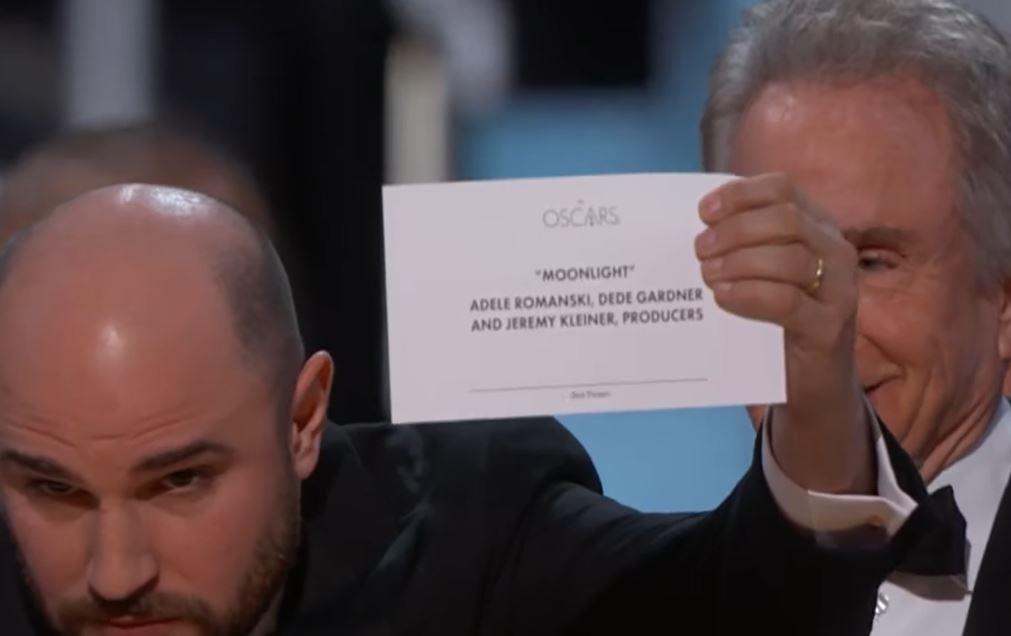
Jordan Horowitz holds up the “Moonlight” best picture card.
How did they happen to put together such a juggernaut as “La La Land”? The answer has to be that they’re not only good — but lucky.
According to an interview with Berger, Chazelle made a pitch in 2010 — when he was not famous and had one unrated film to his credit — to Berger and Horowitz. Emma Watson and Miles Teller would be enlisted, then drop out, which apparently led to Platt’s presence in seeing the project to fruition with different stars. Six years after Chazelle’s pitch, the movie is released, it’s a hit, and three producers are celebrating what is quite possibly the greatest moment in their professional lives.
Until it wasn’t.
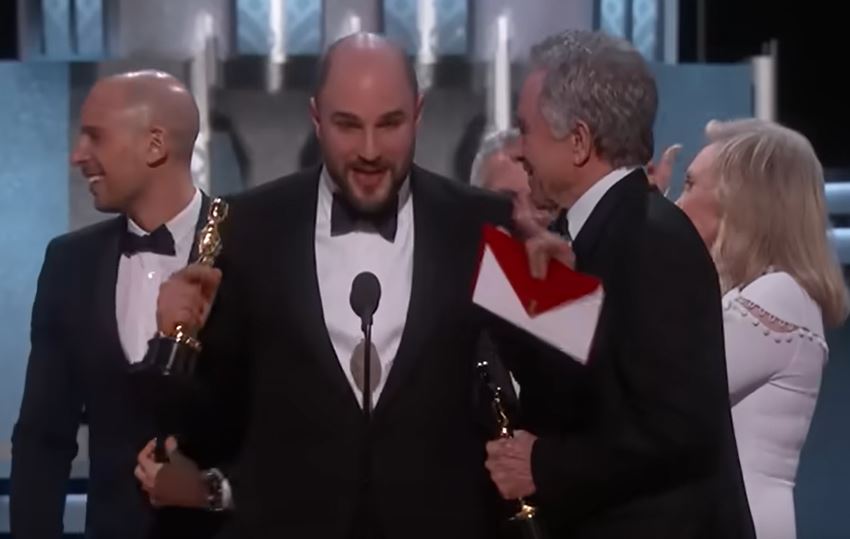
Of the three, it was Horowitz who made the most emphatic statement. He took over the sort-of empty mike before Beatty could get to it and declared, “Guys, guys, I’m sorry. There’s- there’s a mistake. ‘Moonlight,’ you guys won Best Picture. ... This is not a joke. Come up here- ...”
Horowitz even grabbed the correct best picture card out of Beatty’s hands, held it for the cameras and announced again, “This is not a joke. ‘Moonlight’ has won Best Picture. ‘Moonlight.’ Best Picture.”
Hollywood is in the business of manufactured drama. But there’s nothing like the real thing.
Horowitz’s performance may be the most authentic in Oscars history. Overflowing with excitement and recognizing he was speaking live on national television, without using note cards, he graciously mentioned others involved with the film, and his family members, and he delivered a beautiful tribute to his wife. Many others have done it; that alone would not be extraordinary.
As word emerged on stage of the mistaken card being read, and the correct card being opened (by someone), Horowitz took over the mike and brushed Beatty aside and, rather bluntly, announced the winner. This is a Mount Everest of disappointment falling on a human being (apparently 36 years old at the time) who is at the same time attempting to sincerely congratulate his acquaintances who actually had won this incredibly prestigious award.
He’s trying to be gracious. Literally, he is gracious, but there’s obvious anger over this mistake. He’s chippy. Barry Jenkins, “Moonlight” director, roared in celebration, but even he, like its lead producer Adele Romanski, initially seemed less elated than confused. That’s real.
Had the correct card been read initially, few people would recall any of the producers of the two films, and this version of the Oscars would be known by trivia buffs as among the handful where best director/best picture did not go to the same film. The “La La Land” team, like that of “Saving Private Ryan,” would occasionally remark in interviews about the disappointment of not winning best picture after so many other wins.
Had the correct card been read.
It wasn’t.
And for a small number of people, an undeniable emotional earthquake.
It’s not unreasonable to ask whether the “La La Land” crew actually should be happy that this incident happened. Horowitz and the others got to make Oscar speeches and mention people though they did not win. They have to be the most famous group of filmmakers for not winning the Best Picture Oscar, ever (other than maybe the “Citizen Kane” gang). Instead of just the disappointment over a tough loss, they have a story to share forever.
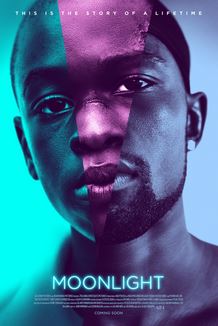
Why did “Moonlight” win the biggest prize? It was not much of an upset, if at all. It had eight nominations and two other wins. The guess here is that “Moonlight” was regarded as more ambitious and having more of an edge, while “La La Land” was viewed as more box office mainstream or classic entertainment. Those same sentiments, though, could easily have produced the opposite result.
Emma Stone and Damien Chazelle and Barry Jenkins have been or will be back for more. For their less-famous producers, there’s hardly any assurances.
What does this incident mean? That the revelation of our biggest prizes is almost as important as the prizes themselves. That the process of learning the winner, of anything, is high drama that the contestants are entitled to. That even the recipients of this enormous honor, because of the way it was unveiled, were cheated too, cheated of the spontaneous joy that all too rarely happens to us. That even the world’s elite can have a devastating letdown. That most of us don’t have to respond to it on live national television as it’s happening. That life is about moments. Hopefully Horowitz will have another.