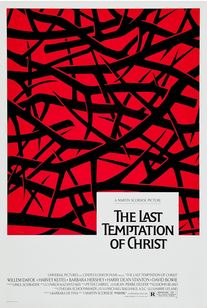
How much money did Martin Scorsese’s ‘The Last Temptation of Christ’ actually make?
Movie boycotts are rare, perhaps because they almost certainly seem to accomplish the opposite of their goal — more people end up seeing the movie than would’ve otherwise.
Admittedly, the impact is very hard to prove. Exactly how many people saw a movie because of protests vs. how many avoided it because of protests is pretty much unquantifiable.
But there was a consensus view in the Chicago Tribune and New York Times of August 1988 that demonstrations against the movie were only prompting sellouts of the initial screenings of Martin Scorsese’s “The Last Temptation of Christ.”
Gene Siskel and Dave Kehr of the Chicago Tribune both asserted on Aug. 12, 1988, that protests would “only serve to fuel attendance” (Siskel’s words) and that without protests, the movie would probably be “no more commercial than the 1985 box office disaster ‘King David’ ” (Kehr’s take).
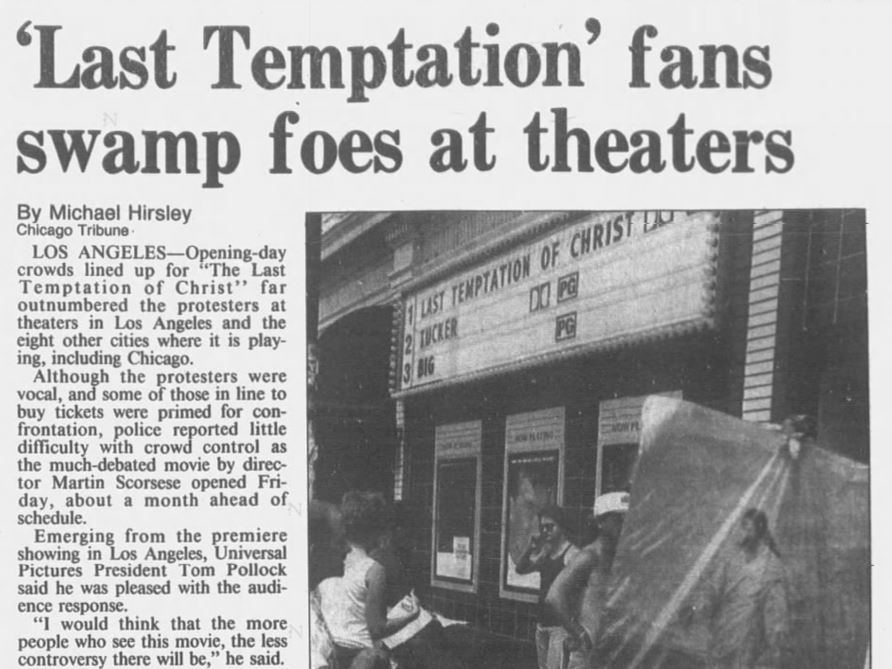
A Tribune headline two days later states “ ‘Last Temptation’ fans swamp foes at theaters.” The opposition was not phantom. That story, by Michael Hirsley in Los Angeles, notes 10,000-15,000 people did rally against the film days earlier near Universal City studios, that a sign was vandalized, and that protesters did boo and heckle ticket buyers at the first screenings, which “ensured” sellouts.
A New York Times article that weekend by Aljean Harmetz said it actually was “about 7,500 pickets” in Hollywood. According to the Times, a Universal spokeswoman said the studio grossed about $4,500 from protesters who had to pay $3 a car for parking.
It seems “Temptation” may have been a bigger hit with the media than with moviegoers.
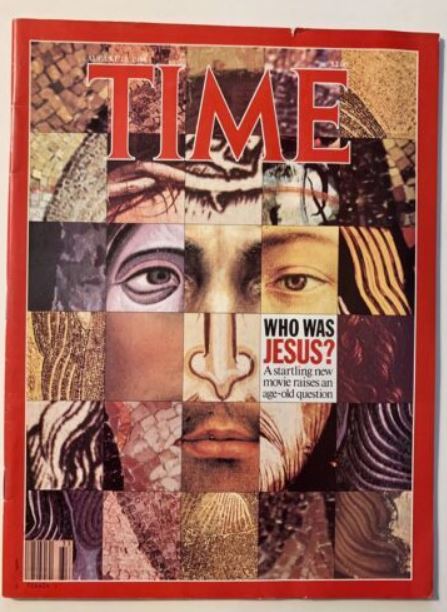
Ahead of the release, the movie made the cover of Time magazine. But the 4,400-word article by Richard N. Ostling only mentions Scorsese in the first and last paragraph and instead delves into scholarly interpretations of Jesus.
On Aug. 12, the same day as the reviews by Kehr and Siskel, the Chicago Tribune ran columns from Mike Royko (Page 3) and Michael Hirsley on the subject of “Temptation” and also published an editorial declaring not whether the movie is “faithful or blasphemous” but only that “Scorsese’s Jesus is not the Jesus who will last.”
Five articles about a movie in one day in a very large metropolitican newspaper.
With coverage like this, who needs advertising? Evidently, Universal — which still took out a full-page ad in the Aug. 12 Chicago Tribune to promote the film.
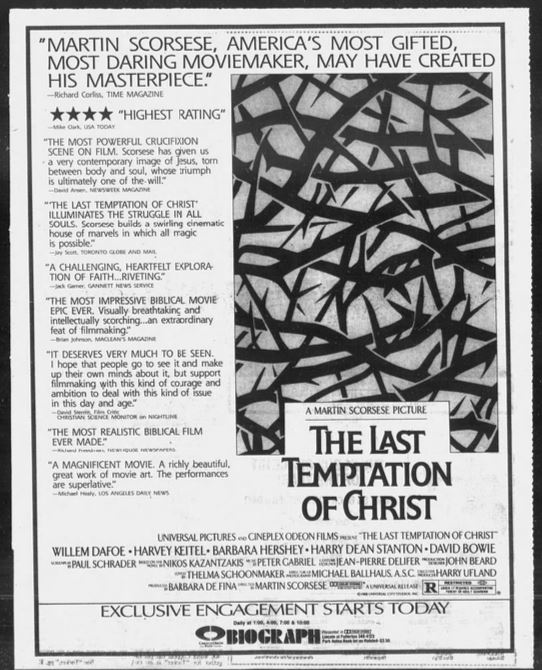
The ad for “The Last Temptation” in the Chicago Tribune on Aug. 12, 1998.
In Chicago, “Temptation” was shown initially only at the Biograph theater, and police said 675 people — a large number for something like this — did picket the opening day, though that crowd dwindled sharply in the days after, the paper reported, while the screenings were sold out.
A follow-up New York Times article on Aug. 24, 1988, by Harmetz labeled the film a “hit” in its headline and quoted William Soady, Universal’s president of distribution, as saying “We chose major upscale markets.”
“Temptation” opened at one theater each in nine cities: Los Angeles, Chicago, Toronto, Seattle, Washington, San Francisco, Minneapolis, Montreal and New York. Notice none of those cities is in the South, a point made by the New York Times.
That Aug. 24 New York Times article says executives at other studios were actually “second-guessing” Universal for opening “too cautiously,” in not enough markets. The article said big theater chains had agreed to screenings, but General Cinema, at the time the fourth-largest chain, had declined to show the movie.
The story says the film cost $6.5 million, well below the average at the time of $16 million. The article admits that the box office would “not be known for months.”
And after that article, based on website searches, the New York Times ceased caring about the box office of “The Last Temptation of Christ.”
But how much money did “The Last Temptation of Christ” actually make?
The gross was evidently about $8 million, according to just about every source, except for one biggie:
“The Last Temptation of Christ” Wikipedia page.
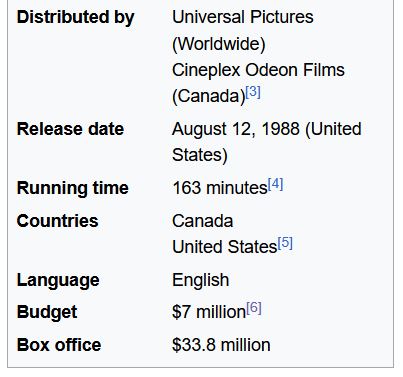
It shows in its fact box, without sourcing, that “Temptation” grossed $33.8 million. In the course of the article, that number is listed again, apparently attributed to a $25 million international haul and citing a 1995 article in Variety that is not available. (It’s a film about miracles; such a number would certainly be one.)
Yet the Rotten Tomatoes web page (way at the end) lists box office as “Gross USA” at $8.2 million. The Internet Movie Database web page lists “worldwide” gross as $8.8 million. The American Film Institute web page, a source for researchers, says “Temptation” “earned less than $10 million at the box office, according to CNBC.”
Was “Temptation” quietly going gangbusters in other countries? Box Office Mojo lists its only international releases as Mexico in 2004 (grossing $487,867), France in 2008 (grossing $4,250) and New Zealand in 2022, when it grossed $132.
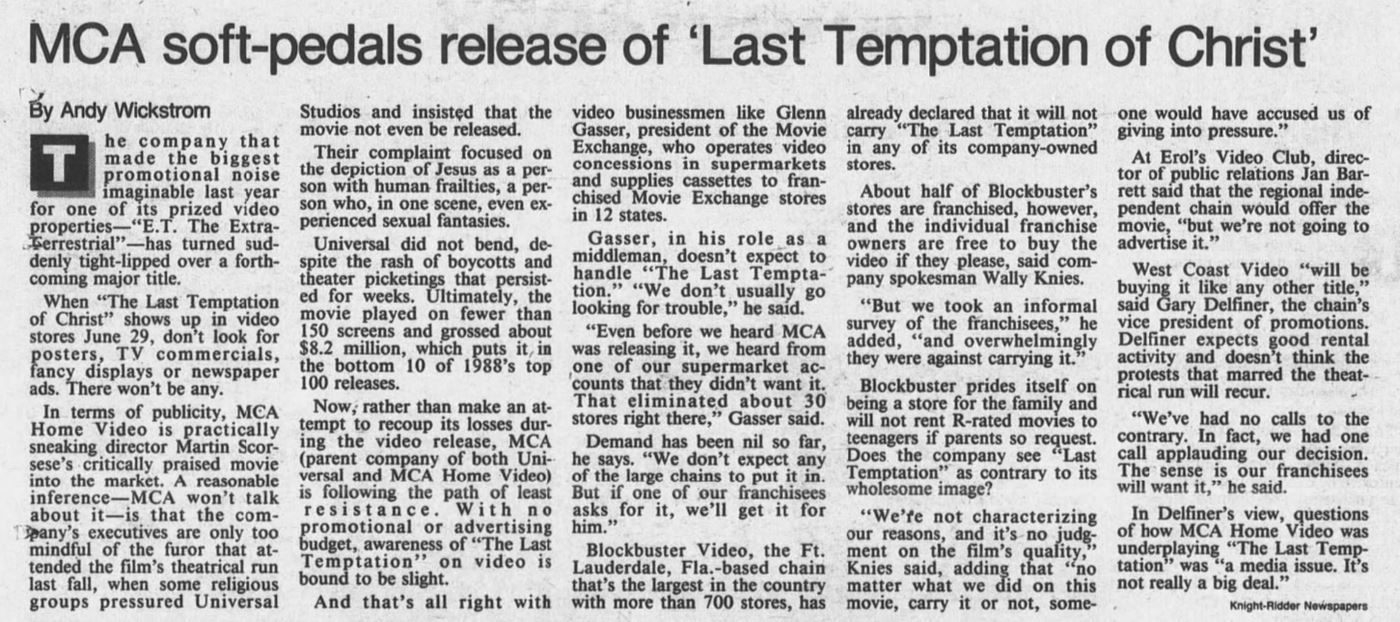
Here’s the most convincing account of the numbers: The Chicago Tribune, in a June 2, 1989, article by Andy Wickstrom about “The Last Temptation” and how MCA was “practically sneaking” the movie into video stores, reports, “Ultimately, the movie played on fewer than 150 screens and grossed about $8.2 million, which puts it in the bottom 10 of 1988’s top 100 releases.”
Mel Gibson’s “The Passion of the Christ” 16 years later grossed $610 million worldwide, per Box Office Mojo.
A year after the release of “Temptation,” on Aug. 11, 1989, the Chicago Tribune checked in with video stores; one manager said “It’s renting superbly.” There was no picketing reported, however, the story notes that condemnation of the film was still being felt; Blockbuster Video refused to stock the movie in its 45 Chicago stores. Said Scott Beck, chairman of Blockbusters Midwest, “We have a policy ... if there is a film that a substantial number of our customers find offensive, we won’t carry the film. This is the 12th time we’ve used the policy. It has served us well.”
To this day, “The Last Temptation of Christ” continues to be a fixture of the arthouse scene. It has perhaps no bigger champion than Gene Siskel, who decreed it his top movie of 1988, even though its crucial and controversial passage is, essentially, a dream sequence, a concept he trashed a year earlier when it happens in the movie “Jaws: The Revenge,” saying on his TV show, “I can’t stand the dream sequences. Why do they do that in a movie.”
Siskel on his show with Roger Ebert calls “Last Temptation” the “equivalent of a recruiting film for Christianity,” and Gene proclaims it features “the most compelling Jesus ever put on film.”
Ebert, though, says it didn’t make his Top 10 but something like the 11-20, a “very effective film” but one that is “a little bit unstructured, a little bit unclear as to exactly where it was going.” (Ebert’s No. 1 film of 1988 actually was a different Willem Dafoe film, “Mississippi Burning.”)
Pauline Kael apparently didn’t review “Temptation” but opined in March 1989 that Scorsese’s “ambivalences and confusions became visible.” Kael says Dafoe “looked like a Flemish Christ” and played “perhaps a bit of a fool, and maybe a charlatan,” but even non-Christians seeing the film “wanted more and more miracles.”
“The Last Temptation of Christ” falls under the category of movies such as “JFK” and even the frivolous “The Pursuit of D.B. Cooper,” in which the movie is the result of insatiable demand for more information about a particular subject. In the absence of additional information, there’s broad artistic license.
Scorsese and Mel Gibson aren’t clergy. They’re filmmakers. Almost certainly, a big part of why the Christ story appealed to both is because of the violence. You can show the protagonist being whipped, maimed, humiliated, suffering, you can show blood, and as depressing as that may sound and appear, it’s vivid filmmaking. (Scorsese likes portraying the animal entrails and the knives that accompany them.) There’s also a very significant traitor, certainly a fascination of Scorsese all the way through “The Irishman,” and thus it’s no surprise that Judas has a co-starring role in “Temptation,” a far stronger role than that of Peter.
Kael is correct about the “ambivalences” of the film. For two hours, most of “Temptation” is the well-known stories of the Bible. By resorting to what is, for all purposes, a climactic dream sequence, Scorsese is getting away with making a very controversial assertion about Jesus without actually confirming it — “withdrawn,” as a lawyer might say after a provocative courtroom remark.
Technically, Scorsese’s movie will invoke the approach of two very different, very commercially popular works — “It’s a Wonderful Life” and “Superman II.” The protagonist of the former sees how the world might be without fulfilling his destiny, and in the latter it is revealed how a typical married life would bring distress to those who look up to him, and ultimately himself. The character, in a flash moment, seems to wonder why it’s necessary to have to sacrifice in order to constantly save all of these people. “Temptation” seems like a longing for a savior who is more human than he feels perhaps is conveyed in Christianity; quite frankly, one who is more forgiving and “one of us,” not so much a judge of us.
A week before the film’s release, Scorsese told Siskel, “When I was a student in a Catholic seminary prep school ... I took the Gospel very seriously. ... I wasn’t, and I’m still not, strong enough. It’s those kind of feelings that the movie is about.” He adds, “If we can see Jesus struggling, that should be of some comfort to all of us. But eventually, He does show compassion for Judas and for the others. So we think, ‘Maybe He really does love us, too.’ ” His approach is naive, though, in that he apparently believes Christians in general will find “comfort” in such a starkly different portrait that includes Jesus in the presence of barely clothed women.
According to Siskel, the Roman Catholic Church in the United States condemned the film and called it “morally offensive,” a quote attributed in another article to Cardinal Bernard Law. The New York Times said the movie was labeled by the Church as “morally objectionable,” a label also given to “Die Hard” and “Bull Durham.”
While Siskel mentions more than once that “Temptation” opponents likely hadn’t seen the film and that their protests were boosting the box office, he also writes that those protests apparently did succeed in causing a notable addition to the film: a statement in the opening text that the movie is not based on the Gospels but on a book, an “obviously protest-inspired disclaimer,” Siskel says.
It seems unlikely that opponents of the film feared some kind of subversion by Scorsese, as though he were attempting his own branch of Christianity. Tribune columnist Mike Royko, in a somewhat satirical column upon the film’s opening, suggests that the argument against it is that it “could undermine the faith of those who do see it.” Scorsese would argue the opposite. Most likely, many of the protesters assumed that this was another perceived jab, if not left hook, by Hollywood at traditional values.
The Temptation novel, written by Nikos Kazantzakis of Greece and published in 1952, also drew protests.
Though “Temptation” was released during a presidential campaign year, it appears neither George H.W. Bush nor Michael Dukakis brought up the subject; in fact, nowhere in Chicago Tribune or New York Times articles is it ever indicated that campaigns were asked to comment.
Hollywood may have felt buffaloed by protesters. Or it may have been less impressed than the protesters were. “Temptation” received just one Oscar nomination, though a fairly big one: Best Director for Scorsese. He lost to Barry Levinson of “Rain Man.” Willem Dafoe was mostly overlooked on the awards circuit. Harvey Keitel evidently was a Razzie nominee.
Even those who dislike the protesters should be dismayed that this kind of activity — nationwide picketing at a film’s theatrical release — probably won’t ever happen again. Theatrical releases of movies for grownups have far less cachet, not to mention Hollywood interest, than in the 1980s, and Hollywood, quietly extremely risk-averse despite what it sometimes seems, wouldn’t consider the argument over “Last Temptation” worth it. Nowadays, it’d be straight to streaming, and even that may be subject to internal debate.
40 years later, some things have changed. The Catholic Church did not condemn the Oscar-winning movie “Spotlight” — it actually praised it. Would “Temptation” find a more receptive audience today? The picketers quickly went away. So did, coincidentally, the moviegoers. Scorsese in 1988 made a great debate. Did he make a great movie? His vision amounts to the crucifixion being somehow even tougher than it seemed. That’s a hard sell.
2.5 stars
(July 2026)
“The Last Temptation of Christ” (1988)
Cast:
Willem Dafoe as
Jesus ♦
Harvey Keitel as
Judas ♦
Paul Greco as
Zealot ♦
Steven Shill as
Centurian ♦
Verna Bloom as
Mary Mother of Jesus ♦
Barbara Hershey as
Mary Magdalene ♦
Roberts Blossom as
Aged Master ♦
Barry Miller as
Jeroboam ♦
Gary Basaraba as
Andrew Apostle ♦
Irvin Kershner as
Zebedee ♦
Victor Argo as
Peter Apostle ♦
Michael Been as
John Apostle ♦
Paul Herman as
Phillip Apostle ♦
John Lurie as
James Apostle ♦
Leo Burmester as
Nathaniel Apostle ♦
Andre Gregory as
John The Baptist ♦
Peggy Gormley as
Martha Sister of Lazarus ♦
Randy Danson as
Mary Sister of Lazarus ♦
Robert Spafford as
Man At Wedding ♦
Doris Von Thury as
Woman with Mary Mother of Jesus ♦
Tomas Arana as
Lazarus/Voices in Crowd ♦
Alan Rosenberg as
Thomas Apostle ♦
Del Russel as
Money Changer ♦
Nehemiah Persoff as
Rabbi ♦
Donald Hodson as
Saducee ♦
Harry Dean Stanton as
Saul/Paul ♦
Peter Berling as
Beggar ♦
David Bowie as
Pontius Pilate ♦
Juliette Caton as
Girl Angel ♦
Mohammed Mabsout as
Other Apostles ♦
Ahmed Nacir as
Other Apostles ♦
Mokhtar Salouf as
Other Apostles ♦
Mahamed Ait Fdil Ahmed as
Other Apostles ♦
Russel Case as
People at Sermon ♦
Mary Seller as
People at Sermon ♦
Donna Marie as
Voices in Crowd ♦
Penny Brown as
Voices in Crowd ♦
Gabi Ford as
Voices in Crowd ♦
Dale Wyatt as
Voices in Crowd ♦
Domenico Fiore as
Voices in Crowd ♦
Ted Rusoff as
Voices in Crowd ♦
Leo Damian as
Voices in Crowd ♦
Robert Laconi as
Voices in Crowd ♦
Jonathon Zhivago as
Voices in Crowd ♦
Illeana Douglas as
Voices in Crowd ♦
David Sharp as
Voices in Crowd ♦
Khalid Benghrib as
Dancers ♦
Redouane Farhane as
Dancers ♦
Fabienne Panciatili as
Dancers ♦
Naima Skikes as
Dancers ♦
Souad Rahal as
Dancers ♦
Otmane Chbani Idrissi as
Dancers ♦
Jamal Belkhayat as
Dancers
Directed by: Martin Scorsese
Written by: Nikos Kazantzakis (novel)
Written by: Paul Schrader (screenplay)
Producer: Barbara De Fina
Executive producer: Harry Ufland
Music: Peter Gabriel
Cinematography: Michael Ballhaus
Editor: Thelma Schoonmaker
Casting: Cis Corman
Production design: John Beard
Art direction: Andrew Sanders
Set decoration: Giorgio Desideri
Costumes: Jean-Pierre Delifer
Makeup and hair: Aldo Signoretti, Manlio Rocchetti, Mirella Ginnoto, Federico Laurenti, Mario Michisanti, Luigi Rocchetti, Maurizio Silvi, Zineb Bendoula, Zhor Bennani, Claudia Bianchi, Ferdinando Merolla
Production manager: Laura Fattori
Unit manager: Marco Valerio Pugini
Stunt coordinator: Franco Maria Salamon