Princess Grace died at 52 after ‘cerebral vascular incident’ while driving on mountain road
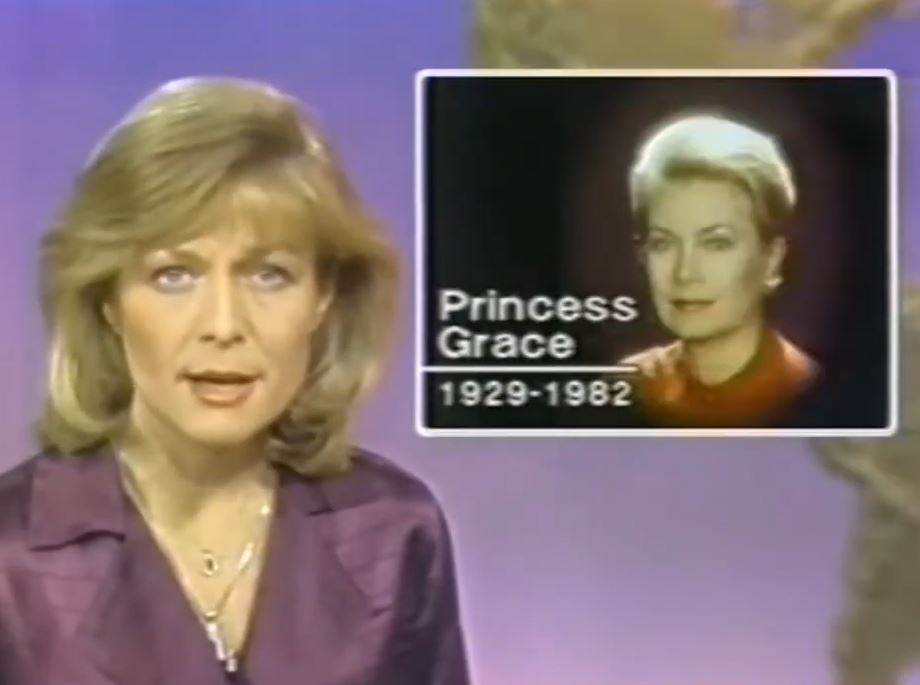
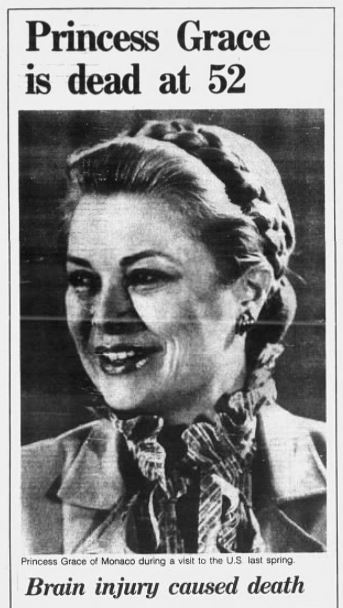
Princess Grace of Monaco, the former movie star Grace Kelly, died at age 52 on Sept. 14, 1982, in Monte Carlo, a day and a half after the Rover 3500 she was driving plunged 120 feet off an embankment.
The cause of death, according to the palace, was “intracerebral vascular hemorrhage.”
However, exactly what caused the fatal cerebral hemorrhage was not clear.
It appears that all of the public information about Grace’s cause of death came from two doctors who treated her, Prof. Jean Chatelain and Dr. Jean Duplay, who gave “separate interviews” two days after she died, according to the account in The New York Times of Sept. 17, 1982.
There is no question that the car crashed, and that Grace had at least one stroke-like event around the time of that incident. Which of those events led to the other may always raise questions.
Grace was driving, around 10 a.m., from her summer home in Roc Agel back to Monaco with her 17-year-old-daughter, Princess Stephanie, in the passenger seat. The two doctors determined that the 52-year-old Princess experienced a “cerebral vascular incident” while driving.
Duplay said, according to the Chicago Tribune, “She suffered brain lesions both before and after the accident.”
That would of course indicate that Grace was stricken and lost control of the car, which happened to be on a mountain road, which was why the car plunged and rolled for 120 feet.
It seems entirely possible that the first stroke-like attack may well have been fatal and that the impact of the crash did not cause Grace’s death.
But that possible conclusion is complicated by the assertion of a second brain incident “after the accident.” The New York Times’ account said the CAT scan, which was only administered hours after the accident because the first hospital Grace was taken to did not have the equipment, “showed that there were two problems, one related to the apparently initial malaise, and the second caused by the impact of the crash, the doctors reported.”
A bystander, 62, saw the crash and pulled Stephanie out and said Grace was trapped in the front and had blood across her head and face. He called authorities, who removed Grace through a back window.
Duplay claimed, according to the Times, that the first stroke-like incident was a “small attack.” And Chatelain suggested the first attack may have been little more than a passing headache: “It was an incident which, if it occurred at home — well, she might have sat down and perhaps felt better soon. It could have been relatively benign, but you can’t say for sure. It’s conjecture,” Chatelain said, according to the Times.
Apparently — apparently — the doctors were suggesting Grace was stricken by some kind of attack, lost control of the car, and then a second stroke-like attack — occurring either while the car was rolling, or sometime afterwards — is what proved fatal.
The information the doctors provided appears to have come from two sources, according to the Times report: “an examination of the Princess’s brain function Monday night and from information given them by her daughter.”
The Times account stated, “French and Americans doctors, asked about the explanation, said they were uncertain, on the basis of the available information, how Princess Grace’s doctors could determine exactly when the brain injuries or incidents occurred.
On the day after Grace’s death and before the doctors’ statements, the Chicago Tribune consulted a neurosurgeon at Chicago’s Rush-Presbyterian-St. Luke’s Medical Center, whose opinions proved remarkably similar to what the doctors in Monaco would report a day later. The neurosurgeon said the stated cause of “cerebral vascular hemorrhage” could indicate a stroke occurring before the accident. The neurosurgeon said a second-most-likely cause would be an aneurysm, and a third possible cause would be head trauma from the accident. This neurosurgeon said, “It is not uncommon for a person to have this type of stroke while driving and then have an accident.” He further said, the Tribune reported, that were the bleeding on the brain caused by the accident, it would be rapidly diagnosed and attempts made to surgically correct it. There is no indication from palace statements that such action was ever taken.
The neurosurgeon also suggested a fourth possibility, that a rupture occurred after the accident.
The doctors’ conclusions are certainly open to speculation. However, those conclusions are far more realistic than the information the palace of Monaco was spewing out that week. And articles in the Times and Tribune about their statements focused far more not on how speculative those findings were but how off-base the palace’s early accounts of the crash were.
Immediately after the accident, the palace indicated the brakes failed on the car and said Grace had a fractured right thighbone, broken rib and “shattered collarbone.” Nothing about a possible stroke or brain damage. Grace and her daughter were even “reported to be in good condition.” Grace’s brother, John Kelly, told reporters after her death, “I was led to believe she was out of danger.”
The Times reported that “By Monday night it was apparent that Princess Grace was unlikely to survive, the doctors said. However, a palace spokesman was still reporting on Tuesday afternoon that Princess Grace’s condition was stationary.”
The Times reported, citing the doctors, that by Monday evening, “her life had been maintained artificially for several hours until her immediate family, informed of the hopelessness of the situation, determined that the procedures should be abandoned.”
The Chicago Tribune reported on Sept. 15, 1982, that “Police quoted by a French news agency said neither Princess Grace nor Stephanie was wearing a seatbelt when the accident occurred.”
The Chicago Tribune on Monday, Oct. 23, 1989, published an excerpt of the book Rainier and Grace: An Intimate Portrait, by Jeffrey Robinson, that included an account of the crash and interview with Princess Stephanie. That account says the drive began “about 10 a.m.” According to the excerpt, “Somewhere along the road Grace complained of a headache, Stephanie said. It continued to bother her as they headed down the hill.” Grace “seemed to black out” and when opening her eyes, appeared “disoriented” and “probably missed the brake and hit the accelerator.” “Neither Grace nor Stephanie was wearing seat belts.”
Grace Kelly, who appeared in “High Noon,” “Dial M for Murder” and “Rear Window,” was an Oscar winner and two-time Oscar nominee, winning Best Actress for 1954’s “The Country Girl” and receiving a nomination for Best Supporting Actress for 1953’s “Mogambo” (lost to Donna Reed, “From Here to Eternity”)
President Ronald Reagan issued this statement upon the death of Princess Grace: “Nancy and I were shocked and deeply saddened to learn of the tragic and untimely death of Her Serene Highness, Princess Grace of Monaco. Princess Grace was deeply loved by the people of Monaco because she was a compassionate and gentle lady who had a deep and abiding affection for her adopted country and people. As an American, Princess Grace brought character and elegance to the performing arts and always found time to make important contributions to her craft. The Principality of Monaco and the world community have suffered a great loss. To the people of Monaco and to the Royal Family, we extend our deepest sympathy.”
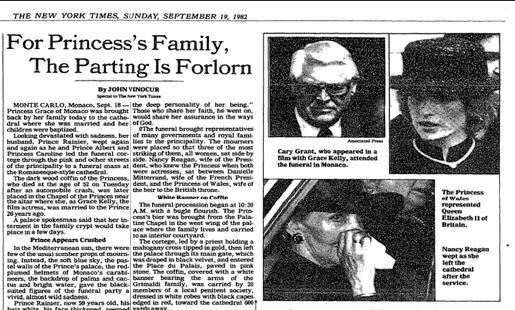
Nancy Reagan, Princess Diana and Danielle Mitterrand attended Grace’s funeral, as did two sisters of Grace, Margaret Conlan and Elizabeth Levin, and a brother, John Kelly. Another relative, Secretary of the Navy John F. Lehman Jr., and Pennsylvania Gov. Dick Thornburg attended. Mourners included people of European royal families, auto racing champion Jackie Stewart, and Cary Grant, who co-starred with Grace in “To Catch a Thief” and would pass away four years later after suffering a stroke.
(November 2026)