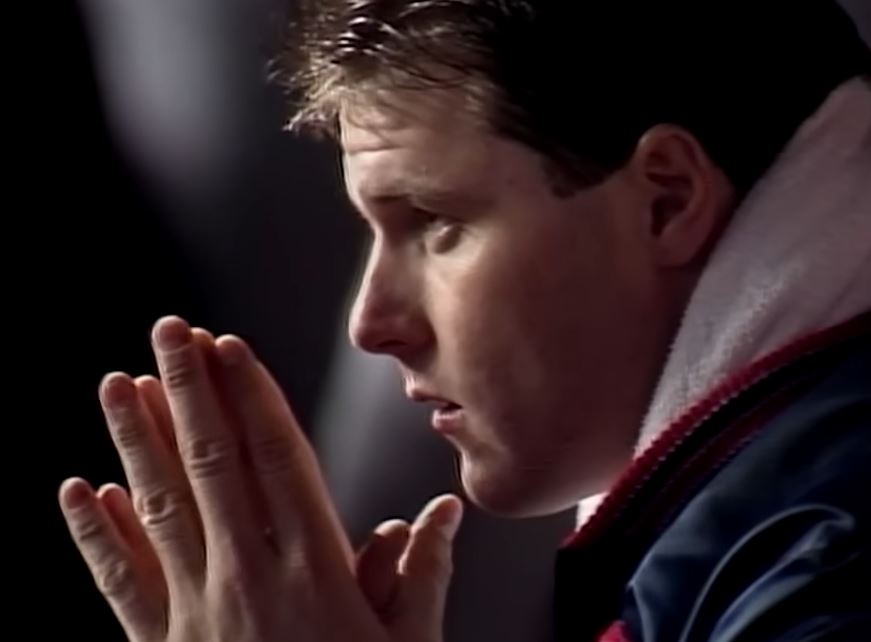
Roger Clemens watches Gary Carter at the plate in the 10th inning of Game 6
Unforgettable baseball images — why was Roger Clemens taken out of Game 6 of the 1986 World Series?
Posted: December 2025
One of the most famous images in baseball history — honestly, maybe the most famous — belongs to Boston Red Sox catcher Carlton Fisk, whose late-night home run certified Game 6 of the 1975 World Series as one of sports’ epic moments.
The Red Sox actually lost that World Series the next day. No one talks about that game. Other teams down 3-2 in the World Series have also rallied to win Game 6. The 1975 version would’ve been talked about over the winter, then gradually forgotten — if not for the remarkable television and newspaper photography capturing Fisk at the plate, leaping and waving his arms, willing the ball fair.
It’s not always the victorious pictures that define the situation.
There’s a case to be made that Roger Clemens is the greatest pitcher in the history of baseball. Others have undeniably had bigger single seasons. Roger Clemens broke a storied record at 23, won 7 Cy Young Awards, and took a team to the World Series at age 42. This is one of the world’s greatest competitors.
Clemens’ most famous season is the one he put together in 1986, only his third year in the big leagues. He went 24-4, won not only the Cy Young Award but American League MVP, and spearheaded the Boston Red Sox’ first trip to the playoffs in 11 years.
One of the most acclaimed pitchers in college baseball history at Texas, it seems hard to believe that Clemens could’ve surprised anyone in the big leagues. Yet he was not the ace of the Red Sox staff entering 1986; he had shoulder surgery the previous season and didn’t make a start until the fourth game of 1986. His salary for this incredible season was only $340,000, according to Baseball Reference. He quickly made history, striking out a record 20 batters in one game on April 29. He was 14-0 before suffering his first loss.
While Clemens was stunning the baseball world with a brilliant season, the New York Mets were busy dominating the National League. They went 21-5 to start the season and held a 15-game lead in the Eastern division by July, en route to a staggering 108-win season, a number that ties the 1975 Cincinnati Reds juggernaut for 4th-most in league history.
Both the Mets and the Red Sox had what could be called magical seasons in 1986, but exactly why remains a mystery. Neither would be considered among the greatest of the past 50 years. Clemens was the lone superelite player of the two teams; the Mets’ own version of Clemens, Dwight Gooden, inexplicably began a permanent decline that season. Each team relied heavily on veteran hitters over 30 whose best years were in the past. Both teams narrowly escaped their League Championship Series. Neither was a sure thing.
While there were several future HOFers in the park for Game 6, history surely decrees Clemens as the finest player in uniform that night. As the starting pitcher in Game 6, his team up 3 games to 2, he had the opportunity to win the World Series for Boston. This was his greatest season. He was not injured. Nor was he being used on short rest — it was five days’ rest, actually, which he saw as a major plus, saying before the game, according to the Chicago Tribune, “It should help me. I’ll be strong. I’ll go right at them. I’ll do everything I can to end this thing. I’ve been wanting it for a long time.”
In the curious way that modern baseball works, the best player on the field wouldn’t be around for the game’s most important moments. Clemens pitched 7 innings of Game 6. He threw 134 pitches. That’s a high number, virtually unthinkable today. In the 1986 Series, a designated hitter was used in games at the American League park, but not at the National League park. In the top of the 8th inning, with a runner on 2nd base and 1 out and the Red Sox leading 3-2, Clemens was due to bat. He previously had only attempted bunts. He was pulled by manager John McNamara for a pinch-hitter, who struck out.
The exact reason for the pinch-hitter has been disputed. McNamara insisted in 2011 that after retiring the Mets in the 7th inning, Clemens entered the dugout and announced, “That’s all I can pitch.” Clemens has stated he was actually willing to keep going. It’s entirely possible that both recollections were accurate, that Clemens may have made a declaration, then offered to keep going anyway. Clouding the mystery, McNamara said in 2011 that reports of a blister were inaccurate, that Clemens actually had a paper cut. Yet McNamara was previously quoted as using the term “blister.”
Clemens pitched brilliantly in Game 4 of the ALCS, shutting out the California Angels for 8 innings, then ran into trouble in the 9th, and the Red Sox lost both a 3-0 lead and eventually the game. Had the World Series Game 6 been tied 2-2 in the 8th with Clemens coming to the plate, pinch-hitting would’ve made a lot of tactical sense. Pinch-hitting with a 3-2 lead, it has to be assumed that, for perhaps any number of good reasons, McNamara doubted that Clemens could shut out the Mets in the 8th and 9th innings.
Memories fade. McNamara managed the Red Sox for two more seasons, through 1988. While an active manager, he’s not going to tell newspapers that his star pitcher wanted out of the game. It seems his only beef with the aftermath of the situation is the possible perception, based on some of Clemens’ comments, that McNamara refused to let Clemens continue.

Roger Clemens watches Ray Knight come to bat in the 10th inning of Game 6
Clemens would spend the rest of Game 6 of the World Series on the bench, rooting on teammates to hold the lead(s) of the last few innings and — according to exceptional photography from the NBC camera crew — warily awaiting the outcome. Rarely has a camera crew caught a player of this significance in various moments of anticipation as an epic moment in his career was unfolding.
Calvin Schiraldi, at the time a quality young relief pitcher who’d had a good half-season and like Clemens attended Texas, was called upon to preserve Clemens’ lead in hopes of securing a 2-inning save. But he gave up the tying run in the 8th. McNamara left him in for the 9th, which was scoreless, and brought him back out for the 10th, where he actually retired two tough hitters before the New York Mets started teeing off and — with the game already tied — Bill Buckner made the famous error.
While Clemens was the star, teammate Bruce Hurst had outperformed him in the postseason and, late in Game 6, was thought to be the choice for Series MVP had the Red Sox won that night.
Also in the dugout for the Red Sox was Tom Seaver. He was on the Red Sox roster but injuries and age prevented him from pitching in the postseason. In 1969 against the Baltimore Orioles, he went 10 innings to win the pivotal Game 4, decided by a very controversial bunt by J.C. Martin in which the throw hit Martin running inside the baseline and bounced away, allowing the winning run to score.
A few times in history, a starting pitcher in Game 6 has appeared in relief in Game 7. Clemens in 1986 did not pitch in Game 7, though the Red Sox went through six other pitchers, starting with Hurst on short rest, and lost 8-5.
Was Clemens burned out in the playoffs? Perhaps. But he was eased into it. His regular season ended a few innings prematurely on the last day when his elbow was struck by a line drive by the Orioles’ John Stefero in the 2nd inning. He had ample rest before facing the Angels in Game 1 of the ALCS and dismissed concerns that the elbow could be injured. He quickly had a bad 2nd inning and fell behind 4-0 but inexplicably ended up throwing 142 pitches in an 8-1 loss. He was then brought back on 3 days’ rest for Game 4 and threw 134 pitches that night. He was called upon again on 3 days rest to win Game 7, after Dave Henderson swung the momentum back to Boston, and again on 3 days rest for Game 2 of the World Series, before McNamara gave him 5 days. The pitch counts certainly raise eyebrows, although it has to be said that McNamara gave Clemens every chance to win.
Though his 1986 postseason was a letdown compared with the regular season, there is no question that Clemens was the driving force and story of this team, that without him, they are not in the playoffs.
Baseball by 1986 was a different game than a decade or two earlier, and it’s an even much more different game today. Many starting pitchers are stars, but their impact has waned. They don’t pitch as many innings as they used to, and in playoff games, the hooks come super-quick, as analytics have found that performance tends to drop off after a certain amount of innings, or pitches thrown, or times through the lineup.
Clemens’ career seemed to be winding down with the Red Sox in 1996. Then he signed with the Toronto Blue Jays and somehow won back-to-back Cy Young Awards. George Steinbrenner was long interested in Clemens, and a trade was worked out with the Yankees, already a juggernaut in 1999. Clemens had two mediocre seasons with New York but won his two World Series titles, then returned to Cy Young form in 2001, pitching brilliantly in two World Series games that kept the Yankees, blown out a couple times by the Arizona Diamondbacks, afloat until the final inning of Game 7. He pitched in the 2003 World Series for the Yankees, delivering a quality start in a pivotal Game 4 that was lost in extra innings and tilted the Series to Florida.
Still not done, Clemens pitched for Houston in 2004 and won the Cy Young Award at 41; the next year, he led the league in ERA and fronted the Astros’ upstart World Series team that fell to the White Sox.
Clemens never delivered a World Series to Boston, but he earned two titles with the Yankees and gave his four teams more than their money’s worth. What’s perhaps missing from the incredible resume is that workhorse type of Series with a clinching performance on short rest, something like Gibson and Koufax and Lolich in the ’60s, or Viola and Hershiser in the ’80s, or Randy Johnson in 2001.
Forever associated with Texas, Clemens actually was born in Dayton and moved to Houston for his high school years. He never had the kind of polarizing relationship with Red Sox fans like the team’s most famous player, Ted Williams (from San Diego), but he’s not a Northeasterner. Fisk was from New Hampshire; Carl Yastrzemski from Long Island. Yaz and Williams were from an era when the greatest stars played entire careers with one franchise. Well into Fisk’s career, and from the start of Clemens’, perceptions of loyalty had changed rapidly. Fisk and Clemens each gave the Red Sox probably their best work but still left with many good seasons left.
“Captain” is an unofficial but important distinction in baseball. Most teams go without the title for long periods and only bestow it when someone seems to have earned it. Yastrzemski was long the Red Sox captain, succeeded by Jim Rice, but after Rice retired, neither Clemens nor anyone else received the honor for 15 years. Clemens has never served as a captain in the big leagues. Internet searches indicate there has been no managerial interest.
In 2000, Sean McAdam of the Providence Journal wrote for ESPN that Clemens is “wound way too tight and is prone to erratic and boorish behavior.” That may be fair or unfair. Is it possible that Clemens is such a hyper-intense competitor, a trait that would otherwise pay off immensely for any athlete over the course of a long career, that he couldn’t relax when critical moments required it?
One wonders.
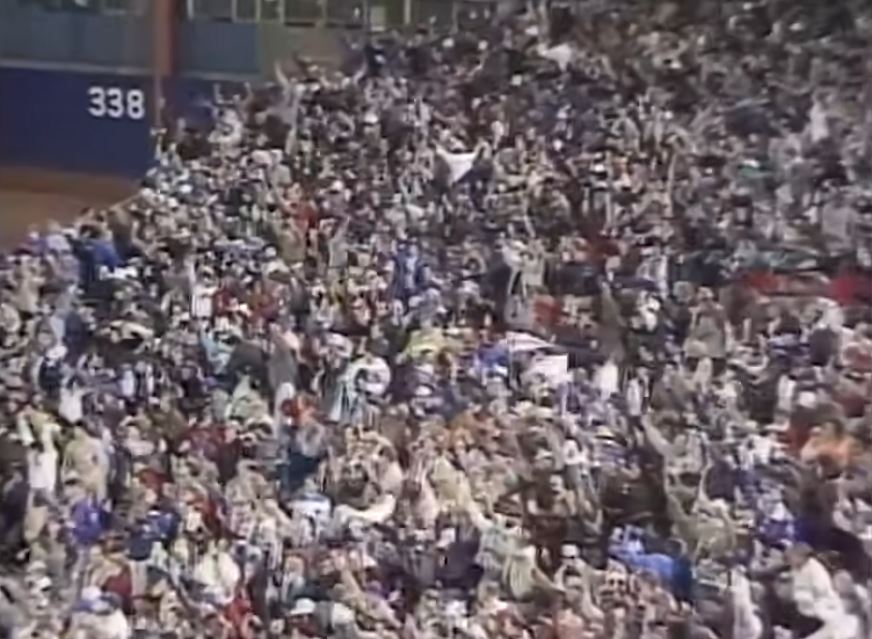
New York Mets fans celebrate Ray Knight’s winning run
The 1986 New York Mets were nowhere near a Murderers Row and had no one who would qualify as one of the toughest hitters Clemens ever faced. But they lived in the moment, sensed it and seized it. He left with a lead. He didn’t beat them.
NBC’s shots of Clemens in the dugout were only part of a sensational telecast. Fans hoping not to witness a 10th inning Red Sox celebration shook Shea when Kevin Mitchell scored and erupted when Ray Knight crossed home plate.
The final inning is posted on the New York Mets’ YouTube channel with viewer comments. “My tears always come down when I see this.” “The end of this game always brings a tear to my eye.” “Thing I remember most is that no one wanted to leave.”