
How Charlie Finley dismantled the
3-time World Champion Oakland A’s
Posted: August 2026
The Oakland A’s of 1972-74 were among the finest teams in baseball history.
They won 3 straight World Series — the only franchise other than the New York Yankees to do so.
They won the first of those World Series without their superstar, Reggie Jackson, who was injured in the 1972 ALCS.
In 1972-73, they won back-to-back Game 7s in the World Series, and back-to-back Game 5s in the ALCS.
In 1974, finishing off the ALCS in 4 games and the World Series in 5, the A’s were better than ever. (The 1974 World Series is briefly referenced in “Licorice Pizza.”)
Then, out of hubris, pettiness, or incompetence, it all came apart, and the A’s were an afterthought.
Owner Charles O. Finley, one of the most colorful characters in sports history, is mostly known for eccentric or obnoxious behavior.
Which makes his incredible run of success all the more remarkable.
Finley by 1974 had not only turned the A’s into a juggernaut, they figured to have several big years left. Their three best players (pick any order) — Jim “Catfish” Hunter, Reggie Jackson and Rollie Fingers — and most of the rest of the starters were under 30. They had the best pitching staff in baseball, including World Series stalwarts Hunter, Fingers, Ken Holtzman and Vida Blue. In 1975, the A’s would dominate the American League All-Star lineup.
Not only were the A’s loaded in the 1974 World Series, their timing was favorable. Major League Baseball was about to lose the “reserve clause,” a staple of contracts that had bound players to teams indefinitely at the teams’ discretion. An arbitrator’s ruling in late 1975 would lead to big league free agency — but not until after the 1976 season. After 1974, the A’s presumably could’ve kept their stellar lineup intact for two more seasons, after which letting aging players go might in fact be a good strategy.
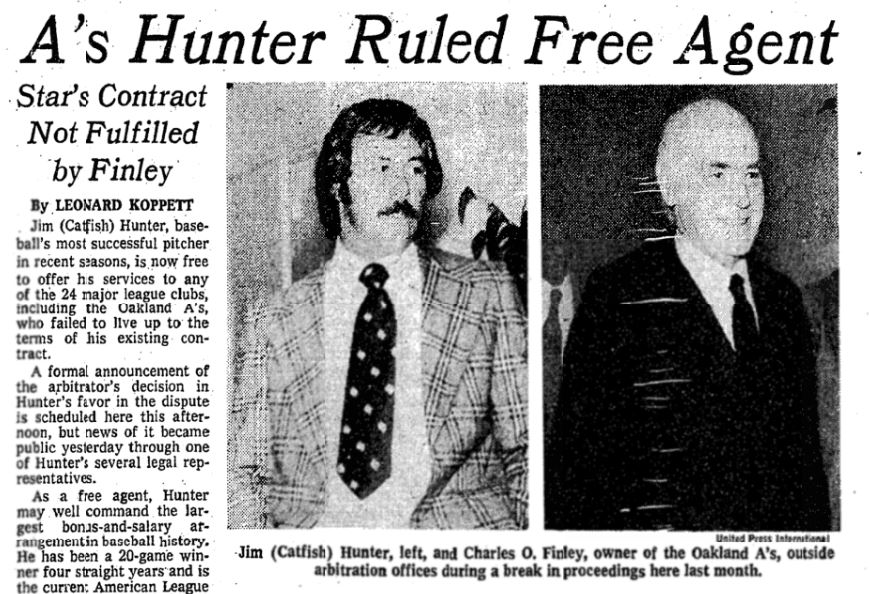
But in 1974, Finley decided to play hardball with Cy Young winner Jim Hunter. And when Catfish got away, so did the team’s chance of a 4-peat or 5-peat.
Before the 1974 season, Hunter agreed to a 2-year contract with Finley. He would be paid $100,000 a year, which at that time was a common salary for star players.
According to a New York Times article by Leonard Koppett on Dec. 16, 1974, the contract stipulated $50,000 each year to be paid to Hunter as regular salary, then the remaining $50,000 “was to be paid to some deferment plan of Hunter’s choosing.” Koppett writes that “the deferred payments were not made because Finley disapproved of the method Hunter chose (since this seemed to involve unfavorable tax consequences for Finley).” Subsequent New York Times articles said the deferred payments provided a tax advantage for Hunter, and that Finley had rushed the deal through and overlooked the tax considerations.
By the end of the 1974 regular season, the deferred payments had not been made. Hunter took his case to arbitration, arguing Finley had broken the contract, therefore, Hunter had no contract and was a free agent. Arbitrator Peter Seitz, who would make the reserve clause ruling a year later, sided with Hunter in December 1974 and declared him a free agent. In late December and early January, as Hunter was entertaining offers from other teams, Finley claimed he could still make the payment and maintain the contract, a decision he lost. Seitz’s ruling was specific to Hunter and did not affect other players, but, at the peak of his career and only 28, it gave Hunter enormous leverage for receiving a better contract from the A’s — or somebody else.
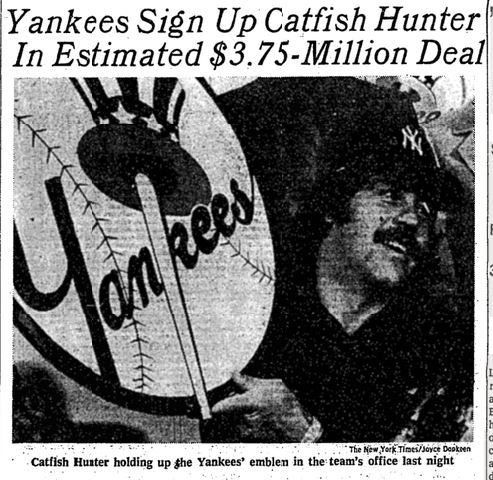
That somebody else was George Steinbrenner’s Yankees, who signed Hunter for $3.75 million over 5 years, what the Times’ Murray Chass writes was “a record for baseball” and “the most celebrated bidding war in American sports history.” Steinbrenner did not take part in the negotiations, according to Chass’ article, because he was “forbidden from participating in Yankee affairs under terms of his two‐year suspension from baseball following his conviction for illegal political contributions.”
Finley famously feuded with his players and even managers while somehow putting baseball’s best product on the field. He even made great trades, specifically acquiring Holtzman, who would start Game 1 of the World Series for 3 consecutive seasons, from the Cubs for Rick Monday and also got Bill North from the Cubs for Bob Locker. After the 1973 season, he had successfully blocked the Yankees from hiring acclaimed Manager Dick Williams, who had resigned out of exasperation with Finley. Through 1974, Finley’s controversies had not significantly affected the A’s on-field performance.
An insurance mogul in Northwest Indiana, Finley in the 1950s made several attempts to buy a baseball team. In the 1950s, in all of the major sports, there weren’t many teams available. Around 1960, Finley finally got one — the Kansas City Athletics, who were decades removed from their roots as a powerhouse in Philadelphia and were mostly known for sending a lot of good players to the New York Yankees.
Not satisfied with one of baseball’s smaller markets, Finley looked to move the team. He stopped shipping good players to the Yankees and started running the roster as a de facto general manager in much the same way that Jerry Jones has run the Dallas Cowboys. Finley started calling the “Athletics” the “A’s” and ushered in the massive change in big-league uniforms by changing the A’s colors from a traditional red and blue to green and gold. To this day, Finley’s mid-’70s color combos are among baseball’s most sensational uniforms.
Oakland in the 1960s built the Coliseum, one of the first modern sports stadiums, and was looking for tenants as the American League was looking to put more teams on the West Coast. The A’s moved to Oakland for the 1968 season.
Incredibly, as the mid-’60s suddenly brought the end of the 4-decades-running New York Yankees dynasty that would be succeeded by the Baltimore Orioles, Finley almost singlehandedly was building a club that, for a decade, would outperform both ... and, after the economics went south, even supply a batch of players for the Yankees’ late-’70s revival.
It’s true that the A’s, then a last-place team, were helped by the onset of Major League Baseball’s draft in 1965 that ended the “bonus baby” era. Reggie Jackson was the 2nd pick in the 1966 draft. But Finley signed Jim Hunter and Rollie Fingers in 1964 and Bert Campaneris, from Cuba, a few years before that. Joe Rudi was acquired before the draft and reacquired after being lost on waivers. Any team could have drafted Sal Bando, Gene Tenace and Vida Blue.
Charlie Finley kept a remarkable core intact for many years and only enhanced it with savvy trades and acquisitions. The fight he picked with Hunter — over Finley’s own apparent oversight — did not sink the A’s, but it reshaped the World Series picture for the rest of the 1970s.
The 1975 A’s went 98-64, the best record in the American League, winning by 7 games their 5th straight American League West Division title. Hunter for the 1975 Yankees went 23-14 with a 2.58 ERA, pitching 328 innings, but the Yankees only finished in 3rd place in the East at 83-77. His impact would take another year.
Oakland faced Boston in the ALCS. Without Hunter, the pressure on Holtzman and Blue was great. Manager Alvin Dark started Holtzman in Game 1 at Boston and again, on just 2 days rest, in Game 3 in Oakland, the first night ALCS game. He lost both games, and Blue lost Game 2, and the World Series streak was over.
The Big Red Machine won the 1975 World Series. Boston gave them a 7-game fight, but an Oakland team with Hunter could’ve set an epic rematch of their 1972 World Series.
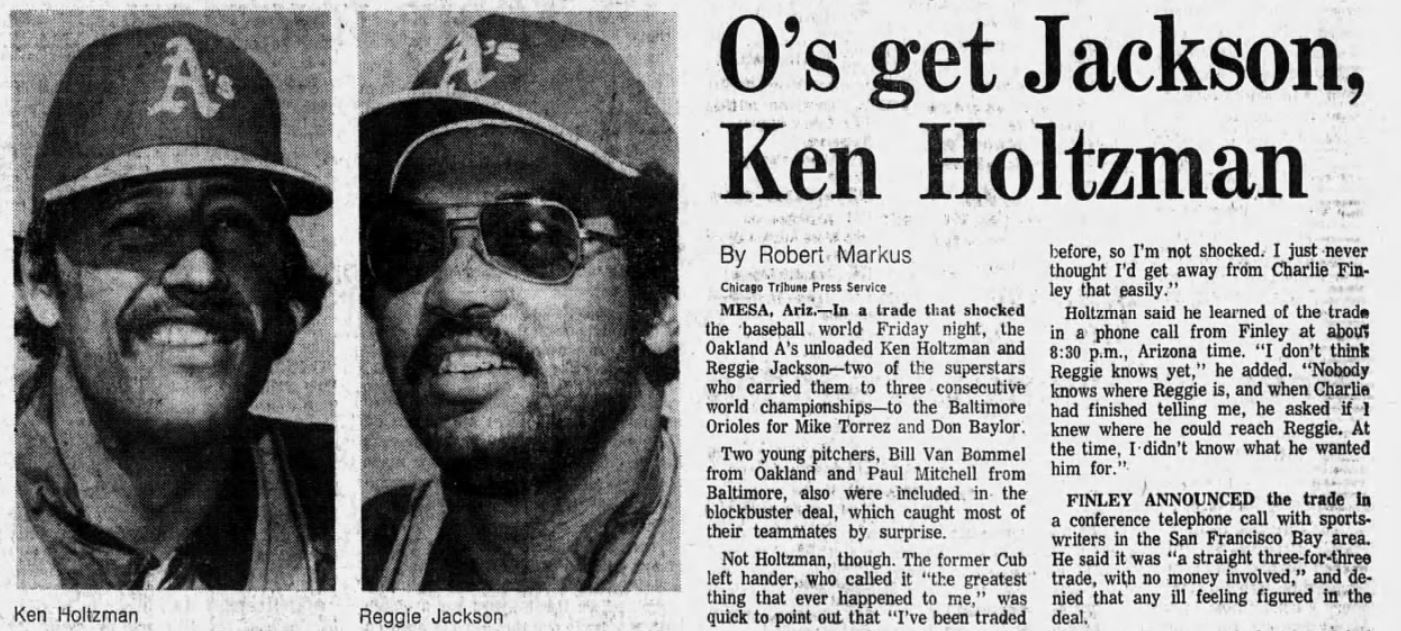
Heading into the 1976 season, the A’s nevertheless figured to be a World Series contender again. But a decision was nearing on baseball’s reserve clause and all-out free agency, and Finley decided to cut bait, evidently fearing his star players would be lost after the season to free agency with no compensation. On April 2, Finley announced a stunning trade of Jackson and Holtzman to Baltimore, receiving Don Baylor and Mike Torrez.
Torrez for Holtzman at that stage may have been a good swap. Losing Jackson was the end. “I feel that Baylor is the equal of Reggie Jackson,” Finley somehow told reporters.
Holtzman was glad to be gone, telling the Chicago Tribune that “Nobody could be worse to deal with” than Charlie Finley.
But Finley was just getting started. In June, he sold Fingers and Rudi to the Red Sox for $1 million apiece and Blue to the Yankees for $1.5 million. Those transactions were voided a few days later by Commissioner Bowie Kuhn, who acknowledged that players had been sold in the past, but that this mass unloading from a strong team midseason was “inconsistent with the best interests of baseball, the integrity of the game and the maintenance of public confidence in it.”
With the players returned to Oakland, Finley, insisting the sales go through, refused to play them and only reinstated them after A’s players threatened a strike.
The 1976 Oakland A’s managed to go 87-74 and finish 2nd in the AL West to Kansas City. The A’s were 10 games back in June, July and August, but gained ground in the last 6 weeks and only lost the division by 2 1/2 games.
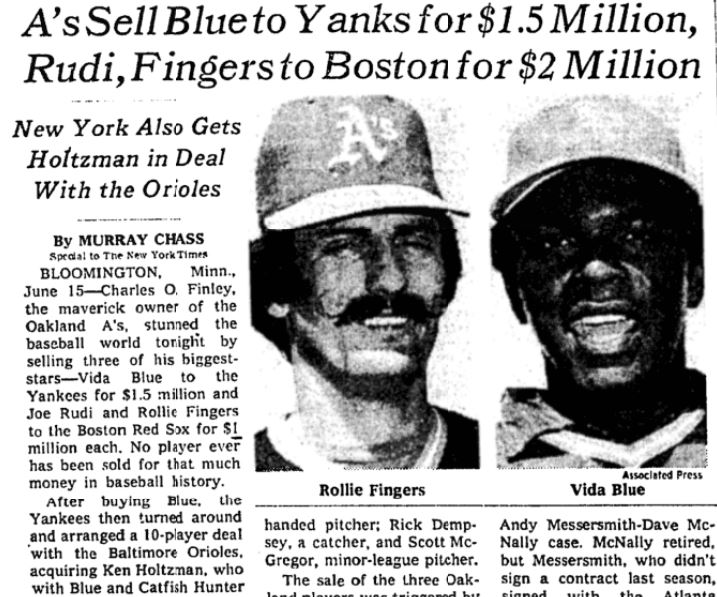
After that season, with the onset of free agency, Fingers and Rudi left for good, and so did Bando, Tenace and Campaneris. Blue remained under contract with the A’s for 1977. After that season, Finley made a deal to send Blue to the Cincinnati Reds for $1.75 million and minor leaguer Dave Revering. Kuhn voided that deal too. Finley tried again in early 1978, finally sending Blue to the Giants for a collection of players and $300,000. Finley also bashed Kuhn for allowing the New York Mets in June 1977 to trade Tom Seaver to the Reds for a collection of unknown players; “the return value was surprisingly low,” the New York Times reported.
During this time, Finley was also selling the A’s to Marvin Davis, who was going to move the team to Denver, but that ended up not happening either.
Had the A’s simply gotten old, gotten injured or diminished as a ballclub, Finley would not be to blame for the end of a dynasty that he built. The economics of baseball were rapidly changing in the mid-1970s. Finley and actually numerous other team owners were not going to be able to compete. That’s fair. The fact Charlie Finley unraveled this historic dynasty two years before he had to? That’s on him.
How the A’s biggest stars of the 1970s World Series champions were dispersed:
Jim “Catfish” Hunter, 1974: Signed in December 1974 as a free agent with the New York Yankees.
Reggie Jackson, 1976: Traded April 2, 1976, with Ken Holtzman and Bill VanBommel to the Baltimore Orioles for Don Baylor, Mike Torrez and Paul Mitchell.
Sal Bando, 1976: Signed in November 1976 as a free agent with the Milwaukee Brewers.
Rollie Fingers, 1976: Signed in December 1976 as a free agent with the San Diego Padres. Finley attempted to sell Fingers to the Boston Red Sox in June of 1976, but the sale was voided by Bowie Kuhn.
Joe Rudi, 1976: Signed in November 1976 as a free agent with the California Angels. Finley attempted to sell Rudi to the Boston Red Sox in June of 1976, but the sale was voided by Bowie Kuhn.
Bert Campaneris, 1976: Signed in November 1976 as a free agent with the Texas Rangers.
Gene Tenace, 1976: Signed in December 1976, as a Free Agent with the San Diego Padres.
Vida Blue, 1976/1978: Acquired June 1976 by the New York Yankees. Transaction voided by Commissioner Bowie Kuhn. Acquired December 1977 by the Cincinnati Reds. Transaction voided by Commissioner Bowie Kuhn. Traded March 1978 to the San Francisco Giants for Gary Alexander, Dave Heaverlo, Phil Huffman, John Henry Johnson, Gary Thomasson, Alan Wirth, Mario Guerrero and $300,000.