
‘Eddington’ bears one similarity to the pandemic — How soon will this be over?
“Eddington” is not a particularly good movie. It’s useful, though, because it’s one of the early examples of how a director might tackle the COVID-19 pandemic — a subject of massive implications at the time but mostly ignored at the cinema since the cinema reopened. Probably, in the minds of Hollywood, the last thing the public wants to be reminded of is shelter-in-place.
“Eddington,” created and directed by Ari Aster, is made as a dark comedy, but it’s generally not funny. And not very visual either despite being a western — amid the empty streets, the very limited drama here isn’t exactly shown, but relayed through speeches by the characters. That will change when it starts to turn into a “Law & Order” type of procedural, only to invoke “The Departed”-like violence pulp; people getting blown away left and right.
The premise of the machines taking over is not new. Other movies have found clever ways to illustrate this; a data center in the desert is not one of them. Where some see jobs, others sense a Big Brother type of menace, corrupting places that shouldn’t be on Silicon Valley’s radar, such as rural New Mexico. In an interview, Aster says the community is “navigating a crisis,” apparently about what its identity will be, but he makes a not-fully-convincing argument that this “has been happening all over the country, especially in smaller towns and counties.”
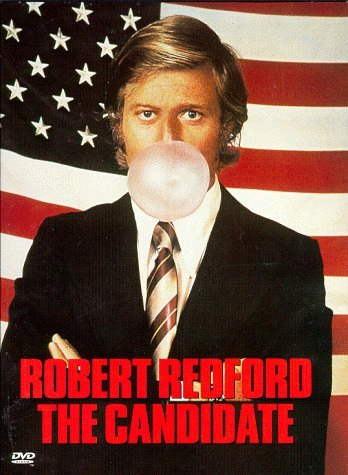
“The Candidate” takes us through the elections process and entertains; true, it still needs to have characters tell us what the polls say and what the results are, and it never totally explains why one candidate gains ground, but it shows the ups and downs of retail politics and how dubious alliances are formed. The politics of “Eddington” are far more time-specific — how things like mask mandates, which the film actually seems to avoid taking positions on, can drive people to insanity.
Depicting a dystopian environment appeals to a lot of filmmakers. The pandemic era though is not dystopian and not highly photogenic. It generally involves 1) empty streets, 2) people standing 6 feet apart from each other, and 3) people wearing doctor masks. Even in this beautiful natural area, Aster’s characters are constantly checking cellphones, to keep tabs on our non-visual data center and election. One reason the characters constantly check phones is because, inexplicably, several characters are teenagers, who don’t belong here but deserve their own movie. Aster includes a prominent news subject of the time, Black Lives Matter, plus conspiracy theories and repressed memories of abuse. (Among subjects not included are inflation, climate change, Afghanistan, Middle East conflicts, Ukraine war, shooting incidents, pronoun usage.)
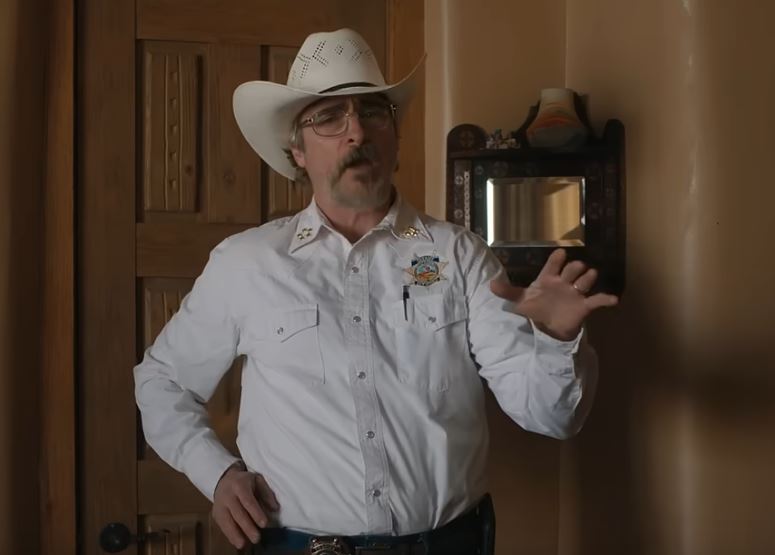
The movie hints that there’s going to be an exploitation theme of tribal land/resources, but that never really unfolds, and the purpose of Officer Jiminez Butterfly appears to be as what Roger Ebert called the Reliable Observer, the unbiased character whose observations are accurate.
Despite what it seemed at the time, “Eddington” actually reminds us that the “pandemic” (the starting and ending points can differ) really didn’t last that long. Many businesses were closed for the last 9 months of 2020 but gradually reopened in early 2021 with the arrival of vaccines. The mask era, for most people, was probably about 18 months; occasionally you’ll see one around town now, but it’s rare. Some photography sleuths could probably examine news pictures of 2021 and determine signifcant moments when fewer and fewer people were seen wearing masks and when people waiting in lines or chairs didn’t have to be 3 feet away from someone.
Moreover, the huge chasm in American life probably wasn’t mask disagreements. Rather, it was that around 10% of the working population, typically in hospitality-type jobs such as restaurants, hotels, airlines, was out of work, while the other 90% kept working and needed none of the government checks that got firehosed out for about 12 months and was buying endless stuff (including non-fungible tokens or NFTs) online and becoming quite frustrated when, after closures were lifted, the much-in-demand hospitality businesses no longer had enough employees for adequate service. This type of economic disruption is unique in history, and one of these days, there will come a film that smartly explores the precedents set.

“Eddington,” meanwhile, for some reason is obsessed with municipal boundaries; that is not a visual subject unless the boundaries are natural and the site of showdowns, such as rivers or cliffs. The characters argue over the lines. It’s whoever you want to believe. And then they don’t seem to matter anyway.
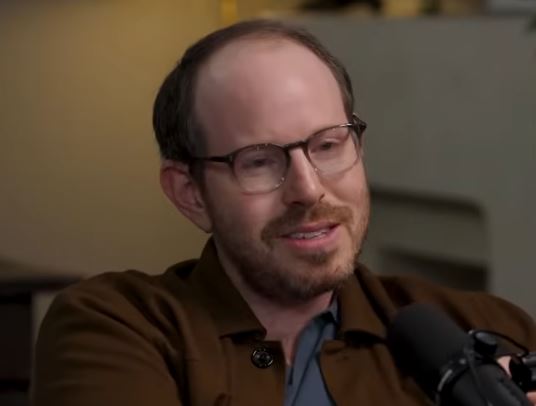
Aster spent much of his youth in Santa Fe. He notes that New Mexico is a blue state with pockets of red everywhere, making it an intriguing locale for him. Some notable films including “Oppenheimer” and “Ace in the Hole,” at least partly, take place in New Mexico, but those films don’t dwell on the state’s mindset. Aster is trying for a “Fargo”-like depiction. Eddington is not a real town. “Eddington,” according to simple Google searches, is basically an English word, and Aster did in fact live in the U.K. for a time. He says in a video podcast that he showed his crew two films, “The Last Picture Show” and “Nashville.”
More than a century ago, well before there was TV, internet, podcasts, Facebook, other options for our time, Hollywood started arriving at some kind of consensus about the ideal length of feature films. That length, to this day, is 2 hours. That’s long enough to feel like something special without wearing us out. Comedies typically get less. Aspirational, epic visions can get a lot more. Many shouldn’t. “Eddington” clocks in at 2 hours, 28 minutes. A film needs to earn its extra time. If not, those 28 minutes suggest a dreaded term in the critical community: “indulgent.”
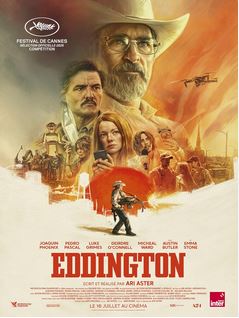
You can’t blame casting for the shortcomings of “Eddington.” Joaquin Phoenix, Pedro Pascal, Emma Stone and Austin Butler are all on the marquee. They are bolstered by some adult characters but flooded by the dubious inclusion of high school kids to carry out subplots that require way too much mental energy. There are maybe three to four high school kids in various stages of protests and love triangles, a homeless man, a wife and mother-in-law both strangely quiet but influential, all providing little except additional means for relaying backstory.
Aster and cast have given interviews, many of them being little more than compliment sessions. No one seems to ask what the title means, but the best question would be this: If another pandemic happened again today — not COVID, a different virus with the same impact and same wait for a vaccine — what would society do differently?
Aster isn’t providing a commentary on social order; his work is a Greatest Hits of 2020s politics, a decade only half over and rapidly leaving shelter-in-place in the dust.
2 stars
(August 2025)
“Eddington” (2025)
Cast:
Joaquin Phoenix as
Joe Cross ♦
Deirdre O’Connell as
Dawn ♦
Emma Stone as
Louise Cross ♦
Micheal Ward as
Michael ♦
Pedro Pascal as
Ted Garcia ♦
Cameron Mann as
Brian ♦
Matt Gomez Hidaka as
Eric Garcia ♦
Luke Grimes as
Guy ♦
Amèlie Hoeferle as
Sarah ♦
Clifton Collins Jr. as
Lodge ♦
William Belleau as Officer Jiminez Butterfly ♦
Austin Butler as
Vernon ♦
Landall Goolsby as
Will ♦
Elise Falanga as
Nicolette ♦
King Orba as
Warren ♦
Rachel de la Torre as
Paula ♦
David Pinter as Thin, Tattooed Man ♦
Keith Jardine as
Muscular Man ♦
David Midthunder as
Santa Lupe Pueblo Sheriff ♦
Christine Hughes as
Tina ♦
William Sterchi as
John ♦
James Louis Cady as
Fred/Old Man ♦
Thom Rivera as
Grocery Store Owner ♦
Auburn Ashley as
Medical Worker ♦
Mickey Bond as
Elderly Woman ♦
Manny Rubio as
Employee — Grocery Store ♦
Ralph Alderman as
Gil ♦
Vic Browder as
Phil — Council Member ♦
Diane Villegas as
Council Member — Zoom ♦
Kristin K. Berg as
Tam ♦
Robyn Reede as
Irate Woman ♦
Dan Davidson as
Brian’s Father ♦
Guia Peel as
Woman — Grocery Store ♦
Amadeo Arzola as
Laird ♦
Mack MacReady as
Greg (Protest) ♦
Marcela Salmon as
Woman with Rifle ♦
Sterling English as
Boy Jumps on Hood ♦
Jason Potter as
Paramedic ♦
Jean Dumont as
Hospital Guard ♦
Emery Barrera as
David ♦
Steven Foldy II as
Conservative ♦
Eddie Garcia as
News Anchor ♦
Justice McLean-Davis as
Martin ♦
Abby Townsend as
Michelle ♦
Kaleb Naquin as
Young Man ANTIFA ♦
GiGi Bella as
Gloria ♦
Ophelia Benally as
Jasmine ♦
Sam Quinn as
Protest Leader ♦
Sam Toledo as
Mexican Man at Cell Tower ♦
Gabe Kessler as
Teen Boy — Jail Cell ♦
Bill Capskas as
Maga Man ♦
Robyn Casper as
Maria ♦
Bendicion Garcia as
Jordan ♦
Giancarlo Beltran as
Man Yells to Ted in Video ♦
Blane Aranyosi as
Valentino ♦
Rainer King as
Man With Dog
Directed by: Ari Aster
Written by: Ari Aster
Producer: Ari Aster
Producer: Lars Knudsen
Producer: Ann Ruark
Co-producer: Luca Borghese
Associate producer: Jean-Paul Chreky
Executive producer: Timo Argillander
Executive producer: Len Blavatnik
Executive producer: Tyler Campellone
Executive producer: Danny Cohen
Executive producer: Alejandro De Leon
Executive producer: Robert Dean
Executive producer: Harrison Huffman
Executive producer: Todd Lundbohm
Executive producer: Andrea Scarso
Music: Bobby Krlic, Daniel Pemberton
Cinematography: Darius Khondji
Editor: Lucian Johnston
Casting: Ellen Chenoweth
Production design: Elliott Hostetter
Art direction: Matthew Gatlin, Landon Lott, Emma Rentz, John Snow
Set decoration: Adam Willis
Costumes: Anna Terrazas
Makeup and hair: Anji Bemben, Colin Penman, Michelle Connolly, Lisa Hansell, Carmen Jones, Rocky Faulkner, Heather Hawkins, Kayla Dobilas, Shaun Hunter, Georgia Laladaki, Steve Newburn, Nysh Yellowhorse
Executive in charge of production: Joshua Gonzales
Head of production: Michael Maida
Production manager: Harrison Huffman
Production supervisor: Cory Lewis
Unit production manager: Ann Ruark
Post-production executive: A24: Brian Hayashi
Stunts: Timothy Eulich, Dan Brockett, Lexi Dali, Ed Duran, Heath Hensley, Johnny Ives, Eddie Morris, David Pinter, Elan Simon, Corinne Fox, Jacob Garcia, Lucas Swallow, Brian Avery, Rico Burgos, Zac Henry, David Samonte, Brett Sheerin, Ernie Vigil