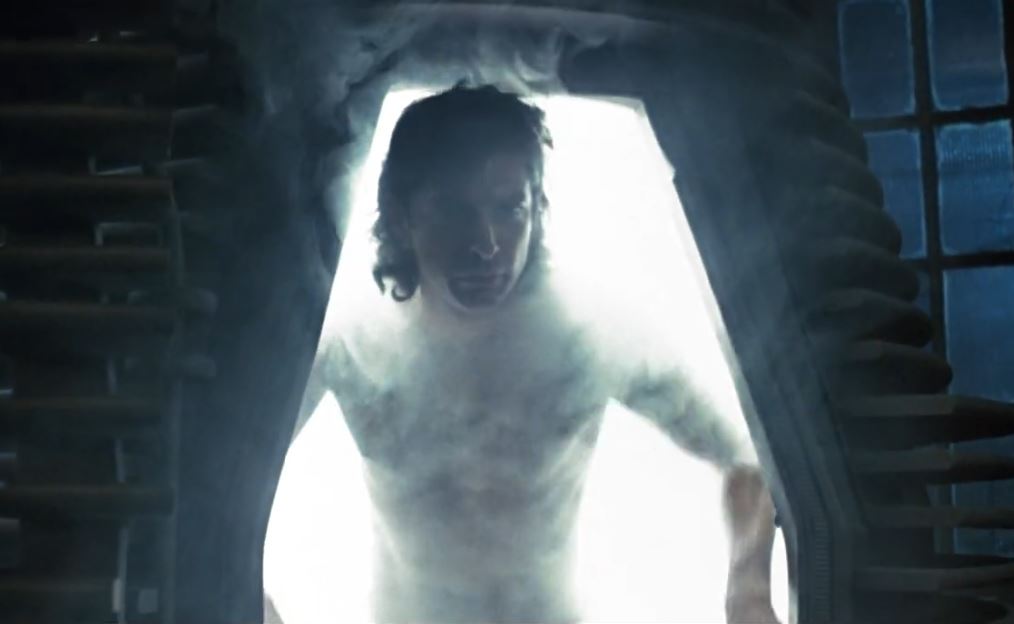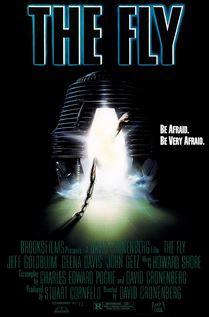

A man turning into an insect dreams of a political career in ‘The Fly’
If we really could “teleport” ourselves, how would that work?
Presumably it would look something like our current airports. Instead of waiting to board planes, people would be lining up to enter a phone booth-like apparatus, from which they’ll disappear, only to reappear somewhere far away.
That type of transportation is likely at least a few years away.
It wasn’t a new idea in 1986. The USS Enterprise had already perfected it in the ’60s. Of course, that show was about the distant future. Which is part of what puts David Cronenberg’s “The Fly” at a very curious midpoint of moviemaking, computing and pop culture.
Cronenberg’s film is a remake of the 1958 classic of the same name, which starred Al Hedison and more famously included Vincent Price. A few years after that film came a much more positive take on the notion of human-bug combinations: Spider-Man, in which a young man is bitten by a radioactive (it was the fallout shelter era) spider and merely adds wall-crawling ability and extra strength while remaining completely human, completely sane. He doesn’t grow eight legs and disgusting hair all over his body.
A recurring message of Spider-Man is the great responsibility that comes with extraordinary ability. The message of both of “The Fly” films is a typical one, that groundbreaking science inevitably gets out of control, either out of greed or ignorance or startling sloppiness. That humans are capable of great discoveries that they really shouldn’t be trusted with.
There are big differences though in the two “Fly” films. The first is remarkably tragic, a family with children torn apart. It looks vintage 1958. Cronenberg’s is the hipster “Fly” version, sexy young people with numerous instances of the camera eager to show underwear. He’s into the body horror. But it looks exactly like 1986 films (and TV) look like. Jeff Goldblum’s Seth Brundle not only has no family, he really has no connection to the opposite sex (despite brains and a perfect build). It’s still tragic, but if he ends up proving expendable, it won’t cost us tears.
Most remakes attempt to be “modern.” The 1998 “Psycho,” for example, is updated for inflation. But there's really nothing about 1986 that makes “The Fly” more relevant than the original version, which is why the 1958 version and its look, camp or not, is superior, in the same way the 1953 “War of the Worlds” is superior to Steven Spielberg’s, even though Spielberg made a great film. Yes, in 1986, we did have personal computers, but 1) they really didn’t do anything, and 2) the ones that did do things were pretty tame, and 3) most people didn’t have them in their homes. Cronenberg returns again and again to the screens in Seth’s living room, basically to show us in text what is happening so that character don’t have to say it out loud. This is a movie crying out for AI — but it’s decades before AI will really exist.
One important sci-fi caveat in “The Fly,” though, is that the machines do not actually fail. There remains solid belief in the science. From “2001” to “Westworld” to “WarGames,” drama is triggered by a machine going rogue. Seth’s machine is actually old-fashioned. It does only what it is told. The malfunction stems from human negligence, not something’s wires being crossed.
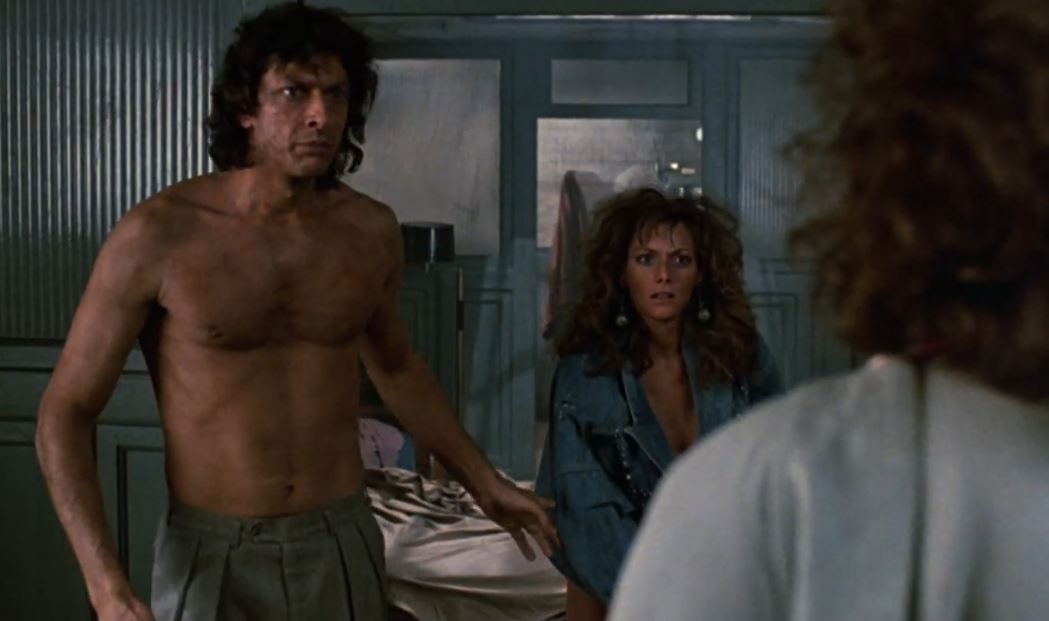
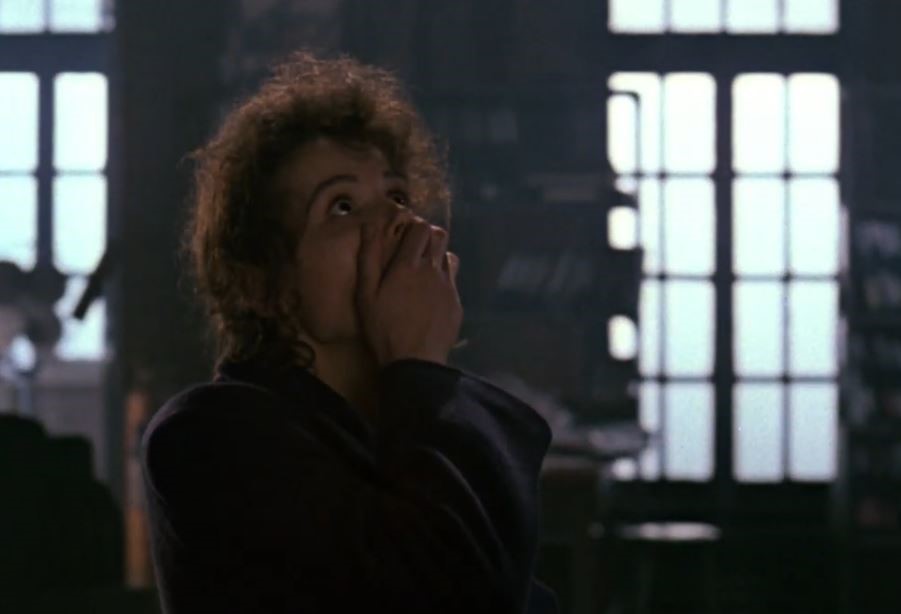
The romance of the 1986 edition of “The Fly” never ignites. That keeps it from greatness. It’s a lost opportunity. The first 22 minutes zip through what will consume entire other movies — a woman eventually connecting with a man, who’s really a grown-up boy — who has so far been unable to connect. Much of the first half of “The Fly” is simply Geena Davis looking beautiful in close-ups. But her Veronica Quaife is never fully convinced by either Seth or his project (even though Davis and Goldblum were a real-life couple). She and Seth connect only because, Why not? Her scenes with her boss/ex are strangely neutral. The supposed assignment she is working on gradually is rendered a meaningless macguffin. Most people’s response to Seth’s condition would be to call his relatives/doctor/state police. Ronnie’s remedy is to seek an abortion. Overnight.
Cronenberg decides against giving Ronnie scientific insight. He only wants her to be the Beautiful Admirer, the collateral damage. He could’ve had her quickly grasp what Seth is doing and determine a way to program the contraption to possibly save him. Instead, she ends up in a “Rosemary’s Baby”-like situation, admittedly this time not having to deal with a whole team of creeps. Her job is to burst in on Seth at a few very opportune times, either to be surprised or do the surprising. Because she is not Seth’s peer, and because the “action” involved in Seth’s work is merely getting into and out of pods, Seth and Ronnie’s ex, the notably named Stathis Borans, will have to spend significant moments explaining Seth’s work to her (and the audience), including his cockamamie final scheme to make some three-person genetic combo.
On the surface, Seth’s rapid physical maturity, if that’s the correct term for it, seems caused by his scientific mishap. But maybe instead of the chemical change, it’s like he is exploding with a sense of accomplishment, he apparently has achieved his very lofty goal. Hair growth and pimples point to adolescence. But actually, what happens to Seth is more like all those warnings you’ve heard about anabolic steroids, including roid rage, except that also is linked to erectile dysfunction, which doesn’t fit with the movie. Steroids were often hinted at, and snickered about, in sports, bodybuilding and pro wrestling, but it would be years before pro leagues would adopt rules and testing. Cronenberg isn’t sweating the details. He just has to turn this character into an instant monster, and it works.
Another important decision by Cronenberg is that Seth does not develop wings. There is great potential here if he did — flying around town, causing pandemonium. He does, however, climb walls, which makes him more like Spider-Man. Cronenberg, to his credit, doesn’t get sidetracked by the possibilities but keeps the story tight and contained. The roughly 90 minutes roll by.
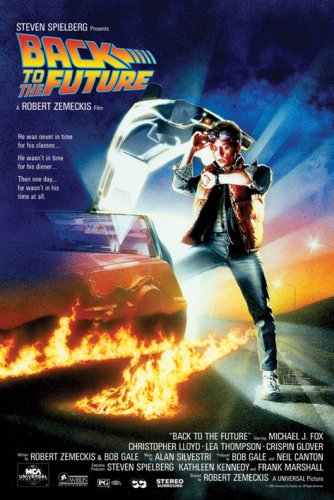
“The Fly” shares a characteristic, but also has differences, with a very prominent movie of a year earlier, “Back to the Future.” In each movie, an asexual male has some kind of home laboratory out of the way of everyone else where landmark discoveries are made that no one knows about. But his motives differ. Doc Brown creates things for personal amusement. Seth Brundle, whose supposed paranoia is mocked by Ronnie, is creating something for no other reason than to “change the world as we know it.”
Seth’s plight is the movie. Stronger motivation would help. Let’s hypothesize that the device works perfectly. What does he hope to gain from it? Skipping an airline ticket? He indicates no interest in patents or wealth. The machines are all in his living room. This is pre-internet. How would they transport someone from Phoenix to Milwaukee? With an extension cord?
Because Seth has little more aspiration than to be the subject of a magazine cover, it’s kind of just down to the makeup artists. Most of the appeal of the film is the anticipation of what Cronenberg’s got next for each stage of the changeover. “The Fly” did receive one Oscar nomination, for Best Makeup. And Chris Walas and Stephan Dupuis won, besting entries from “The Clan of the Cave Bear” and “Legend,” in the early days of that category when only three nominees were selected.
Collectively, “The Fly” team overdid it. The original proves that in terms of body horror, less is more. The sight of the 1958 fly hand through the coat is more powerful than any of Cronenberg’s skin rashes or Thing-like body (that’s The Thing of the Fantastic Four comics, not the 1981 movie, although there are a few similarities to that one also). Seth looks like countless zombies. Which is why the strongest scene of the movie is when he arm-wrestles, basically as a human being. Someone should’ve told Cronenberg — Stop! Stop! This is what works, a fly-man interacting with everyday society that thinks he’s a normal person.
Likewise, the pods in Seth’s living room aren’t really scary or funny or exciting; they almost seem like the bottle that Jeanie inhabited in “I Dream of Jeanie.” Superman and Underdog cartoons turned regular phone booths into exploding game-changers. Cronenberg’s pods seem like a place to read a book.

An ad for “The Fly” on July 17, 1958
One of the 1986 movie’s problems that is not a problem for the 1958 version is that flies aren’t really known for killing things, certainly not humans. They’re pests that ruin picnics, swarm garbage and end up in spider webs. Not exactly the most fearsome adversaries. They really shouldn’t scare anyone no matter the size. Even the ones that drink blood couldn’t possibly drain a human. The 1958 film shows how vulnerable a fly actually is. Cronenberg prefers something along the lines of “The Terminator,” a recent film of the mid-1980s, where the beast appears like a quirky human for a while, only to be stripped down to a grotesque hunk of something.
It would make more sense for Cronenberg to slip a bee into Seth’s pod. On the other hand, flies are nasty when seen up close. They are among the most detested bugs. Cronenberg decides to make his fly dangerous by spewing a vomit that disintegrates body parts (of course, with the explanation of how a fly actually eats). Why this would work on humans when regular flies land on humans all the time without destroying body parts, we can thank artistic license.
Diluting the horror is Cronenberg’s reliance on humor. But the movie just isn’t that funny. Instead of alarm at realizing he is gradually turning into a giant fly, Seth, who keeps virtually all of his human mental acuity until the end, climbs walls and says it’s “Maybe not such a bad disease after all,” and also says he hopes to be the “first insect politician.”
Could this material be hilarious? Sure. But it’s far better as a tragedy. If Seth, instead of being in a movie, were in “The Incredible Hulk” TV show, the authorities would be called in to hunt him down just as he’s about to reveal the secret to teleporting, and he’d save an ailing girl just before the cops got to him. (If you didn’t shed a tear at some of those episodes, you weren’t a kid in the ’80s.)
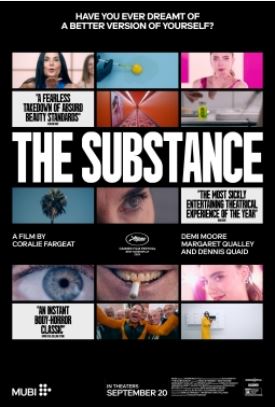
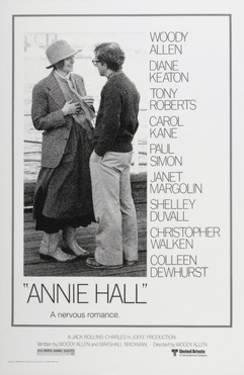
Goldblum is one of the greatest and most prolific film actors who somehow flies under the radar. He has but one Oscar nomination, but it’s for Best Live Action Short Film (“Little Surprises” — it didn’t win). He’s been shut out in the categories he should be in. Some of his early roles were small, but look at the credits: “Death Wish,” “California Split,” “Nashville,” “Annie Hall,” “Invasion of the Body Snatchers,” “Jurassic Park,” “Independence Day,” “The Grand Budapest Hotel.” He is just right as Seth Brundle, and he probably has every reason to wonder, Hey, if Demi Moore can get an Oscar nomination for “The Substance,” why didn’t I get one?
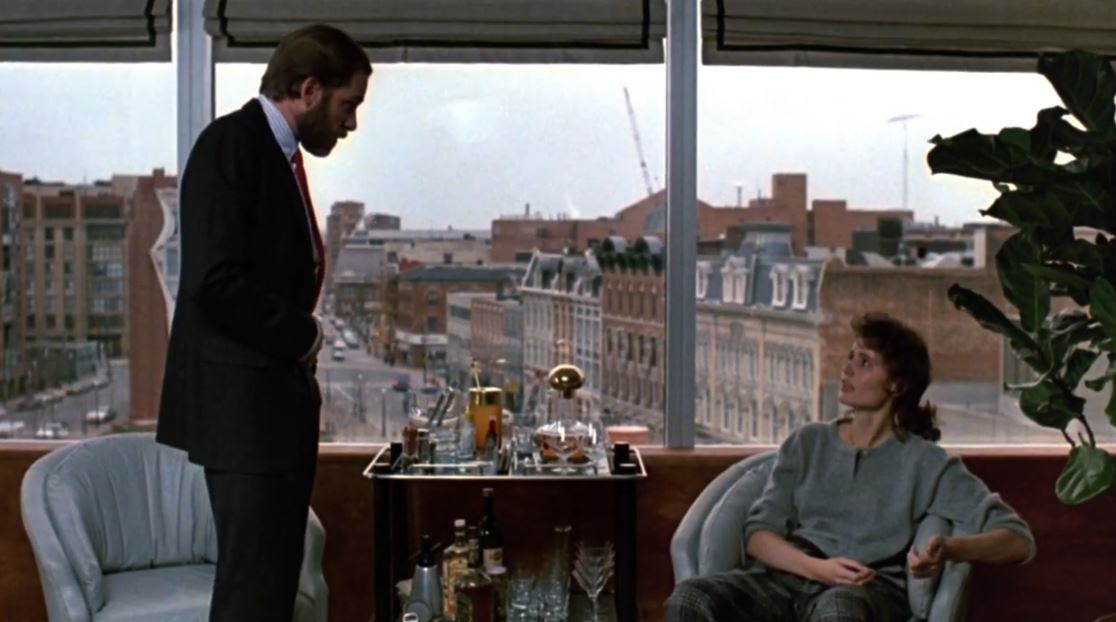
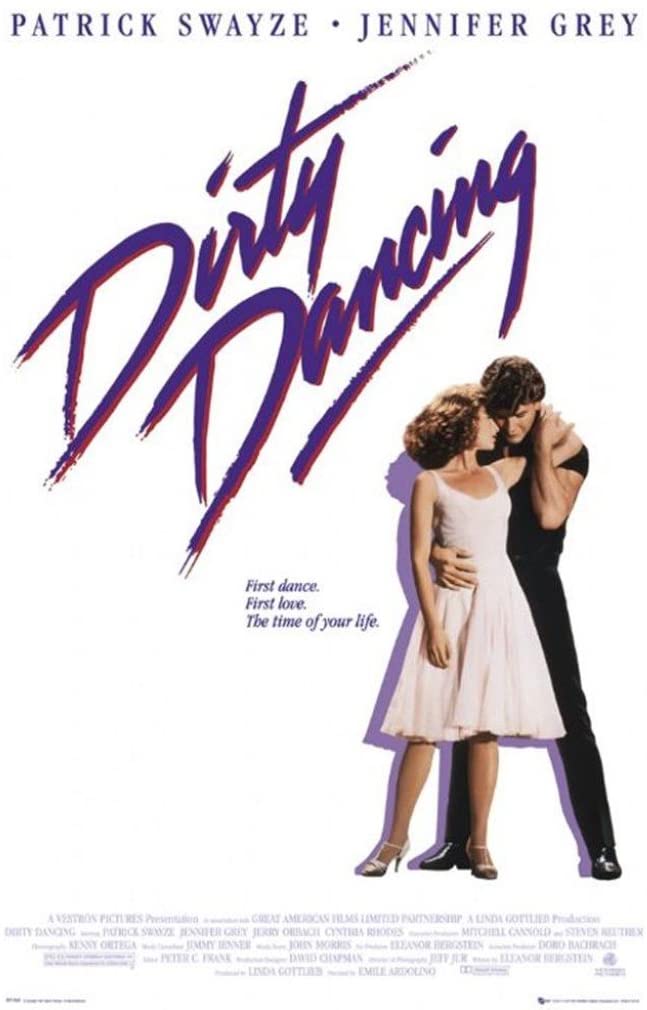
A lot of movie execs would probably cringe upon hearing of an abortion angle in a proposed mass market film. Especially in the ’80s. Maybe that’s why Cronenberg liked the idea so much, he decided to play the doctor. A year later, a completely different kind of movie (“Dirty Dancing”) also featured an abortion angle prominently, and it didn’t seem to hurt the box office.
“The Fly” can’t shake the fact that it finds “His Girl Friday” irresistible. Ronnie and Stathis, played by John Getz, the pride of Davenport, have that classic reporter-editor relationship and enjoy pushing the buttons. He may be smug and cynical, but he’s got a heart. He’s kinda funny. Even as credits roll, it sort of feels like this whole Seth thing might’ve been just another brick in the wall in their tumultuous relationship. She could do worse.
3 stars
(November 2025)
“The Fly” (1986)
Starring
Jeff Goldblum as
Seth Brundle ♦
Geena Davis as
Veronica Quaife ♦
John Getz as
Stathis Borans ♦
Joy Boushel as
Tawny ♦
Les Carlson as
Dr. Cheevers ♦
George Chuvalo as
Marky ♦
Michael Copeman as
2nd Man in Bar ♦
David Cronenberg as
Gynecologist ♦
Carol Lazare as
Nurse ♦
Shawn Hewitt as
Clerk
Directed by: David Cronenberg
Written by: Charles Edward Pogue (script)
Written by: David Cronenberg (script)
Written by: George Langelaan (story)
Producer: Stuart Cornfeld
Co-producer: Marc Boyman
Co-producer: Kip Ohman
Music: Howard Shore
Cinematography: Mark Irwin
Editor: Ronald Sanders
Casting: Deirdre Bowen
Production design: Carol Spier
Art direction: Rolf Harvey
Set decoration: Elinor Rose Galbraith
Costumes: Denise Cronenberg
Makeup and hair: Ivan Lynch, Shonagh Jabour
Unit production manager: David Coatsworth
Stunts: Dwayne McLean, Brent Meyer