
‘The Luckiest Man in America’
thrives on a moral whammy
If you go to a garage sale and discover that someone is selling a $5,000 item for $5, what do you do?
And if you’re the seller who realizes, just as the $5 is being handed over, that the item you’ve tagged for $5 is really worth $5,000, what do you do?
Taking advantage of, vs. being taken advantage of, is the conflict in “The Luckiest Man in America,” a movie about the dubious 1984 “Press Your Luck” game show episode that delivers far more truths than probably the movie itself bargained for.
“Luckiest Man” is a rare film about a pressure cooker in which there aren’t any guns and no one is going to die. The beautiful drama ranges from bending the rules to anointing scapegoats. Sure, it’s a true story in which a lot of the true details are changed. Introductory screen text makes clear that “some of the events and characters have been fictionalized, modified or composited.” Perhaps Roger Ebert’s greatest quote was, “Accuracy is no excuse for drama. Effectiveness is.”
“Luckiest Man” premiered at the Toronto fest in 2024 and was released in the U.S. in April 2025. It is directed by Samir Oliveros, Colombian-born and so little known, he has no Wikipedia page. Perhaps even Oliveros assumed this project would simply be a re-creation. The story would sell itself. Whether inadvertently or not, he tells us so much more.
The first thing we learn from “The Luckiest Man in America” is that achieving an appearance on a game show is so difficult, you practically have to be a freak. Millions are entertained by these shows and would love to try. Only a handful get on. Yes, in real life, “normal” people do end up on game shows. They might be photogenic, they might represent a certain demographic, or maybe they were just the most interesting candidates of that day. But before you show up to audition, consider who you’re up against. You’ll encounter people who have relentlessly practiced these games and/or their narrative. Netflix made a 2017 documentary about a “Price Is Right” superfan who basically ... memorized the price of everything.
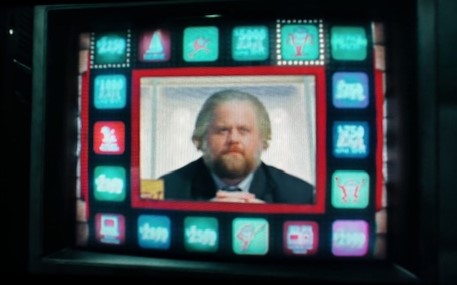
In real life, someone named Michael Larson did compete on CBS’ “Press Your Luck” game show in 1984 and managed to win more than $100,000, an extraordinary amount even now, but especially at that time, for a game show. The event is labeled a “scandal” by Wikipedia. By the end of “Luckiest Man,” you’ll realize that it isn’t.
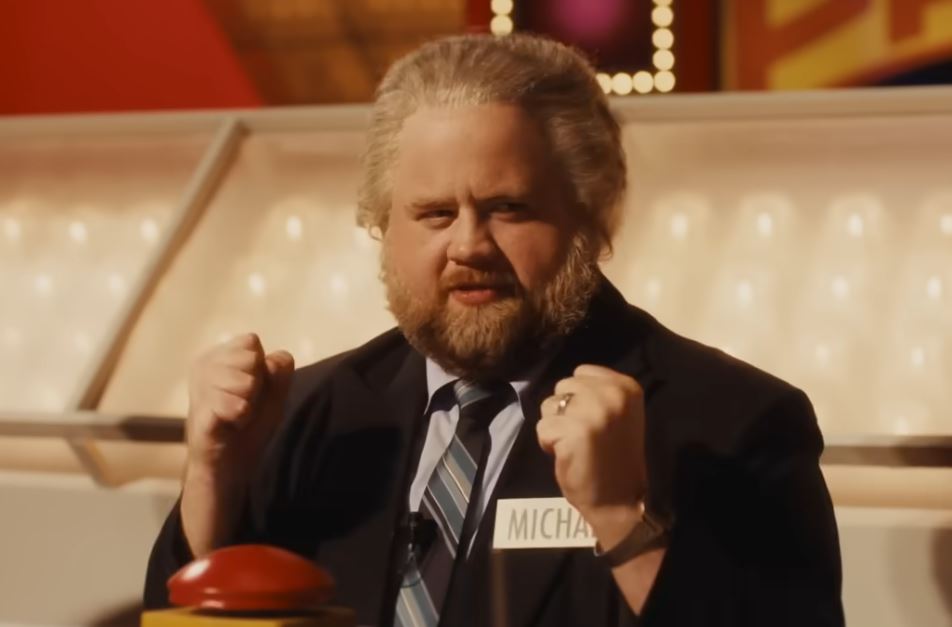
For a while, Paul Walter Hauser, as Larson, keeps us going. Is this all a con job ... or a guy with one skill who is finding everything about his appearance in Hollywood to be fish-out-of-water-like. Eventually, we’re sold on the latter, though it’s not helped by the film’s curious obsession with a red phone and Larson’s need to call his daughter while the show is taping.
Larson’s quirkiness will grow tiresome. As that’s happening, some very important conversations are taking place backstage at CBS. Oliveros gives us the range of reactions. First, the disbelief that this lucky contestant is putting all of his winnings at risk and pity for that decision. Then skeptism about what he is doing and thoughts that they are being had. Then doubts about whether he is actually doing anything wrong. Finally, realization that the notoriety of this event could bring high ratings to CBS. After many constructive comments, execs, some of whom are portrayed dubiously, reach an honorable decision. “Luckiest Man” is better adjudicated within the walls of CBS than just about anything you’ll see in a courtroom.
Oliveros will not adequately describe the rules of the game. This is the film’s biggest shortcoming. Who gets to spin, and how long they can keep spinning, and what it takes to actually “win” or end the game are not clear and in fact are confusing on the actual show. Oliveros does adequately convey that any one bad spin could wipe out Larson’s hefty total.
The second biggest shortcoming is the film’s unconvincing choice of the protagonist. It purports to be Michael Larson. He is supposed to be overcoming the odds to win a large amount of money and notoriety in hopes of restoring his family connections. In spite of those inclinations, the film is not actually Michael’s story — it will drift to David Strathairn’s Bill Carruthers and how a group of executive caricatures successfully respond to a business problem. They took a well-meaning hunch in hopes of making their show better, it backfired financially, and in a short time, they have to come around and do the right thing.
Larson died in 1999. There doesn’t seem to be any record of him commenting on this experience. So how do we know that he did, in fact, memorize the board? Apparently because he didn’t deny it to show officials, his wife recounted how much time he spent studying the program, and because anyone piling up his kind of winnings without some kind of advantage just doesn’t pass the common-sense test. He told Peter Tomarken on the actual show that he kept going because it “felt right” and that he watches the show “every day.” Tomarken concludes, “Obviously you felt right.”
Game shows are an angle of an arthouse film of the early 1980s, Jonathan Demme’s “Melvin and Howard.” A protagonist who coincidentally appeared on “Let’s Make Deal” four times in five years (and also on other shows) also ends up receiving a mysterious document that might be Howard Hughes’ will, in which the protagonist is named. Why would this person be mentioned in Howard Hughes’s will? Because he claimed to have given Hughes a ride in the desert a decade earlier.
Some might say that such a person had a habit of seeking attention. According to “Luckiest Man” and various articles, that doesn’t seem the case with Larson. His lifelong interest, apparently, was in outsmarting the system to make a quick buck. At some point in his life, well after his “Press Your Luck” appearance, he went too far. Like they say about such people, had he only put his intellect to positive use, he would’ve more than come out ahead.
Game-show drama is generally contained to a single episode. Contestants are introduced, the game is begun, and viewers can rely on the assumption it will conclude at the end of the half-hour or hour with a winner of some degree. Some shows, as is the case in this movie, bring back champions the following “day” to keep going and supposedly heighten the suspense.
By the 1980s, viewers could rely on those outcomes as legit. In the 1950s, they couldn’t. Robert Redford’s excellent “Quiz Show” explored the scandals of “Twenty-One” and a few other game shows in the early days of television. In those times, media standards, not just on TV game shows but spanning newspaper and broadcast coverage, were astoundingly different than today. Photography was doctored for cosmetic reasons, interviews and quotes could be manufactured to “reflect” whatever the story was about. TV execs and sponsors didn’t want boring contestants and boring programs, especially when champions returned for the next episode. The solution, in a few instances, was to recruit their preferred contestants and script the outcomes. If you think that kind of internal tolerance of rigged outcomes is shocking, you obviously haven’t seen much pro wrestling.
“Luckiest Man” hints at massive truths about the casting process. For all of these non-Michael Larsons who show up, exactly how is CBS determining which people get on the show? Test scores? How they look on camera? How much they love the show? Undoubtedly, CBS and all other channels/studios producing game shows have stated objective criteria as well as a lengthy legal disclaimer that applicants must sign so that they can’t sue over some perceived mistreatment or favoring of other applicants/contestants. But we sort of get the idea in “Luckiest Man” that the overriding factor for show honchos is basically “anyone they want.”
A prominent pro football writer has regularly opined that NFL teams, despite being billion-dollar entities, are actually run like mom and pop shops. That seems to be the case with “Press Your Luck.” Employees are shown often as diligent and hard-working, but other times clueless. The biggest oversight is that no electronics/math experts apparently were ever asked to study the function of the game board and how predictable it might be. Nor did it occur to the show before Larson’s appearance to put in a maximum winnings cap to keep any odds-beaters in check.
At one point, an exec is chastising Bill for only creating five patterns for the “Press Your Luck” grid. Bill protests that “we didn't have the budget” to make more. But another person in the room says it would’ve cost less than the $65,000 that their star contestant had currently amassed.
The movie does not address what would be a very important question in the aftermath of this event: How does anyone know that the board, in general, is not rigged? Could it be like a circus carnival where, despite appearances, it’s nearly impossible to win. Clearly, the squares were not lighting up “randomly.” But until this incident, viewers wouldn’t know that. Either the board, like a slot machine, is completely random and no skill, or it’s some kind of high-level wack-a-mole in which skill can be developed. Slot machines have to be certified. But a made-for-TV light diplay is not a slot machine. Presumably some government or CBS official had to vouch for the fact that the whammy board is as pure as a roulette table.
Viewers may have this notion that trying out for “Press Your Luck” would be like visiting IBM headquarters; a bunch of folks in suits leading you up and down hallways for rigorous testing and vetting in conference rooms. Not exactly. “Luckiest Man” enjoys lampooning the TV scene.
The CBS lot is depicted as a circus. “Press Your Luck” contestants, apparently as a courtesy and a way to pass the time while waiting for their own tapings to start, are given a quick tour of the rest of the studio. They pass by at least one schlocky production in which an actress can’t recall a simple line. Then the tour group is chided for interrupting a scene in another production. A mascot lumbers around the set, sometimes pulling pranks. T-shirts are distributed to — and refused by — potential contestants who won’t get a chance because of the length of the taping. At one point, a distraught Larson will wander off the “Press Your Luck” set and somehow walk into a CBS talk show, a detour that seems included only to help this impressively tight film reach a 90-minute run time.
The circus, in the movie, even extends to the “Press Your Luck” taping. The host reminds another contestant, Ed, that he won $11,000 “yesterday.” Ed correctly says it “feels just like 15 minutes ago.” Another contestant, Janie, introduces herself as a hygienist who works with a crazy Polish dentist who sometimes serves booze before working on patients. That comment and the host talking about “E-cup brassieres” were comments from the actual show (as was a question about miniskirts). In the movie, Michael Larson uses profanity early in the episode, prompting groans, admonitions and a workaround, a sign of both his rough edges and lack of studio warning.
There is indeed a vetting process overseen by a diligent individual, a coordinator named Chuck, but crackpots can still fairly easily sneak their way in. Chuck also can be overruled by his boss, Bill Carruthers, a real-life figure who was well-entrenched in the game-show world and who evidently has enough time in his day to observe the casting process like a hawk.
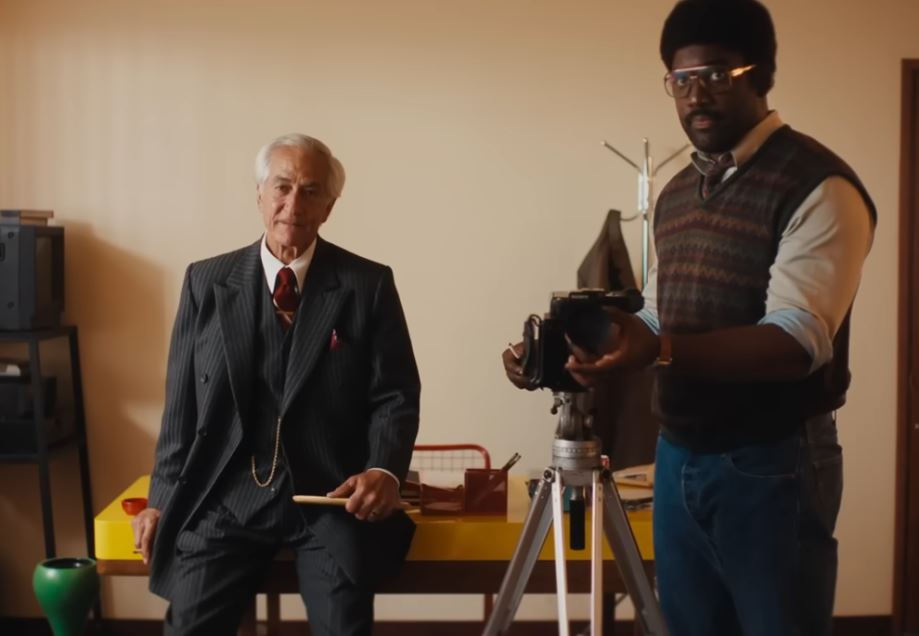
“Luckiest Man” soars in this initial conflict between Chuck and Bill. Chuck is absolutely correct that Larson (or whatever his name is) is a dubious figure whom the show should avoid. Bill, though, has a heart — and a sixth sense about a good story. Chuck has the much stronger argument. Bill’s instinct, though, doesn’t seem ridiculous, something Chuck acknowledges. You get the feeling Bill may be doing the right thing.
The conflict between Bill and Chuck will range from campy to profound. Bill is white. Chuck is African American. On some level, they do kind of click. But Bill won’t hesitate to condescend to Chuck or, worse, throw him under the bus. Oliveros has drawn up a beautifully ambiguous scenario. We see that the show contestants and host are white, and so is most of the staff and audience, as well as the folks on the CBS lot. But not all. Besides Chuck, observing the program in the control room is another African American person who does not outrank Bill but holds sway. Is racism the real cause of this Michael Larson fiasco? Or does racism have nothing to do with it? Some viewers may lean the former, others the latter.
There is no one named Chuck associated with the real incident. Oliveros is perhaps using artistic license to add an intriguing angle to his drama. Meanwhile, Chuck, played by Shamier Anderson in one of the strongest supporting roles in recent memory, is extremely savvy about this game-show scene. He’s a seasoned skeptic. It’s fun to watch him work. Almost all of his research, which happens in real time in the movie, must be a composite of Larson’s Greatest Hits, because some of Larson’s transgressions revealed by the belongings in his truck didn’t happen until later in his life. (Michael during a taping break is advising fans to sign up and cash out of a bank account, in which you could collect a sign-up gift from the bank and then get your money back and then later open a new account under a different name, reportedly something Larson did to beat the system.) (And why someone would need a restraining order over a Ponzi scheme, who knows; usually any character involved in a Ponzi would never visit you again anyway.) This is artistic license at its finest. Chuck is an amateur detective. But he’s brilliant. His (fictional) idea near the end of the movie for derailing Larson’s record run is a stunner — as is Larson’s ability to dodge it.
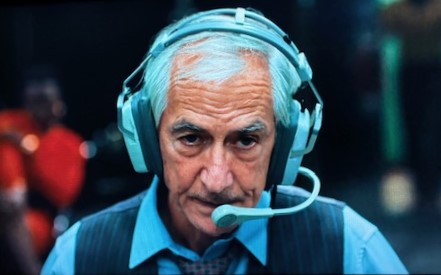
David Strathairn is in so many good movies — just a few of them are “Silkwood,” “The Firm,” “L.A. Confidential,” “Lincoln,” “Nomadland” and the film he’s most associated with, “Good Night, and Good Luck.” He’s only getting better and better. He is mostly likable here as a genteel steward of a popular property, the type who others in the building could ask for career tips. But he has an edge. He provides great range at first while on an exercise bike and sweating a bit, defending Michael’s presence on the show, then indicating to others backstage I told you so as Larson begins winning, only to start sweating for real as the costs to CBS start piling up.
Maybe the funniest line of the movie is when Bill decides in the control room, “The good news is that he is cheating.”
But it’s not that simple. And the execs will conclude otherwise. As Larson has a meltdown late in the game, Bill will say that Larson memorized the game. “Is that cheating?” Larson earnestly asks Bill. Bill’s response is that “we want you to win” because Larson is a “star.”
Bill’s best moments, by far, are the couple of occasions when he has to talk Michael into returning. There is a level of sincerity here. But in several instances, Bill will reveal ugly character flaws that makes us question where his heart is, if there actually is one.
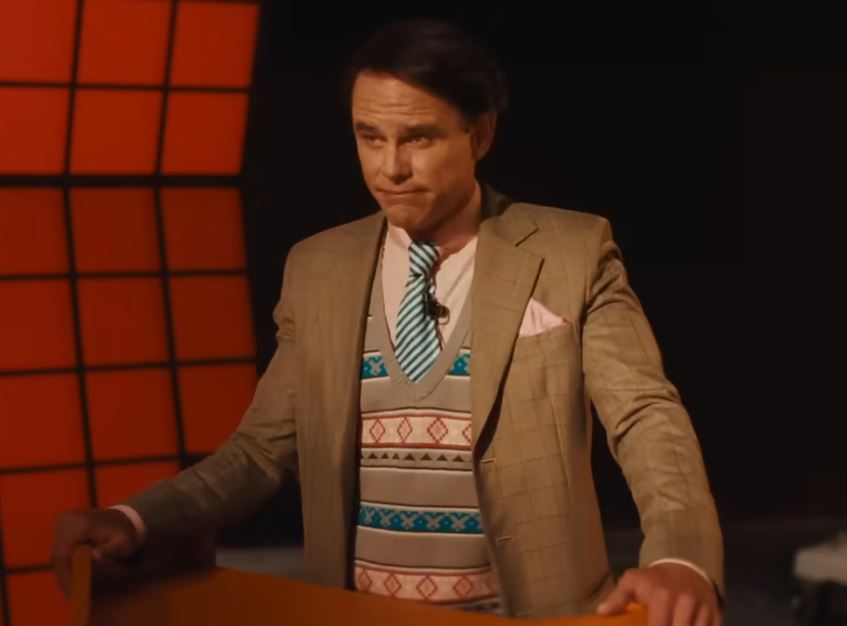
In fewer scenes is Walton Goggins as Peter Tomarken. He plays the host as a glossy camera-lover who provides narration to both show and movie viewers and, whenever needed, has a heart. He is quirky. The movie repeats his comment about “E-cup brassieres.” Peter likes the job and is very good at it. The events of this particular episode make Tomarken little more than an observer. He can’t interfere with what Larson is doing, he can only make a suggestion here and there. In a couple instances, he feels like he’s being used. He is told to push and prod, but by the end, he is simply fair.
What’s it like to work in this environment? Oliveros conveys that there are a lot of tedious tasks, and a lot of sitting around, that go into a simple half-hour TV show. Among employees, there is bickering, badgering, boredom and even backstabbing. In a curious sequence, Peter declares on the show, “And welcome to the most Vegas game in America,” while Bill sighs in the control room, “This guy.” Then a technician in the control room assures Bill, “He’s just bustin’ our balls. He doesn’t mean anything by it.” Bill responds, “He’s here to look pretty, not to have opinions.” So the Vegas reference is unscripted, but why it’s even mentioned in the movie or considered a dig at the brass, who knows.
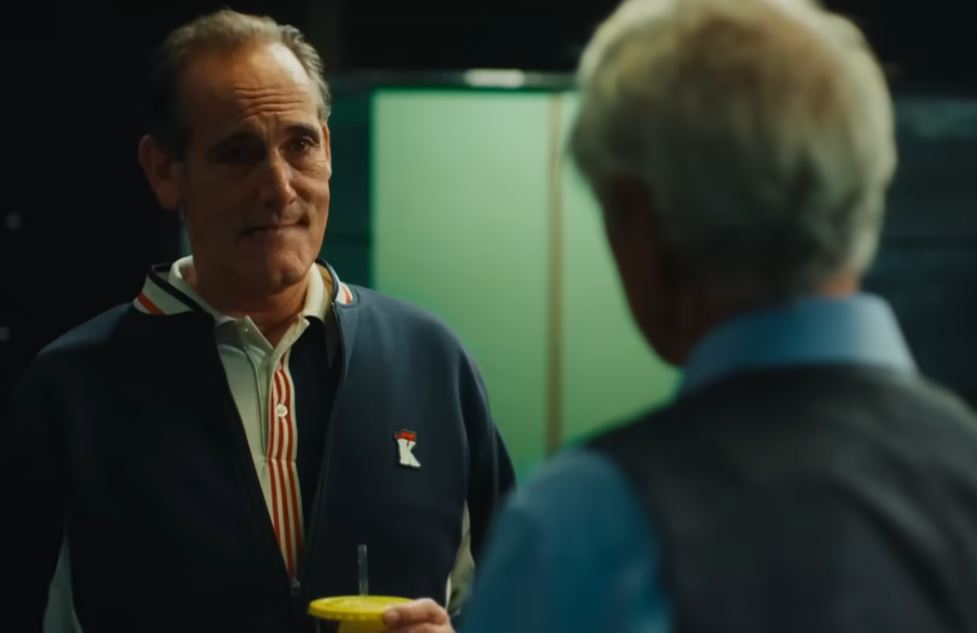
The highest-ranking executive shown in the movie is the character Ron Kauffman, played by Damian Young, who in this film resembles the Grand Moff Tarkin of “Star Wars.” Like in another recent film, “Jay Kelly,” we have a Hollywood exec obviously summoned at the tennis court for an emergency and arriving at the emergency locale in tennis gear.
In a key moment, Larson’s wife is on a phone line, and Peter emcees the call during the show taping. This goes badly as Patricia, once she realizes who/what she is talking to, demands of Larson, “What is wrong with you. You’ve got to stop. You’re making me absolutely crazy. I don’t want a TV character. I want normal.” Shortly after, we see a chain reaction of CBS blame for this call, with no one admitting that they set it up.
But there is some positive electricity in manufacturing the drama. One of the sobering findings of this film is how processed this drama is: Audience members are told what sounds to make, and the host is instructed to nudge things in a certain direction, all so that people thousands of miles away don’t change the channel to a talk show. We are letting our buttons be pushed at base levels. Why? To pass the time during the day, when we’re not at work and have already read the paper.
“Luckiest Man” demonstrates how game shows, or pretty much any kind of competition, are far more exciting before people really get into it. Trivia at a moment’s notice is fun. Spelling bees after kids have studied dictionaries for months are excruciating. College football used to be a rivalry activity for students to entertain themselves and pass the time. It surged in popularity, prompted recruiting (sometimes off the books) and now is a staggering business entity with no connection to the universities’ actual mission. The quality of the activity is enormously higher than decades ago, but the drama isn’t — it’s only more complicated.
Oliveros could’ve done a better job of clarifying the unfolding CBS strategy. It appears for a time that Bill is advocating for two opposing developments — he wants Larson to pass the spin so he stops making so much money. For that, Bill instructs Peter Tomarken to “scare him.” But Bill also seems to want Larson to play long enough to hit a whammy.
A film project about this event apparently had been conceived since 2000, with Bill Murray originally slated to star. For whatever reason, that never happened, and it took a quarter-century to come to fruition. (Which is another way of saying, nobody was particularly sold on the idea.) “Luckiest Man” is a film by Protagonist Pictures, which is based in the United Kingdom, according to its website. The film is co-produced by Fabula, a Rome company. The movie looks like something easily manufactured in Hollywood, but it’s significantly a Colombia-related production. Jaguar Bite is among the credits. According to its website, Jaguar Bite has a presence in Colombia and Mexico and provides services “for the main Hollywood studios.”
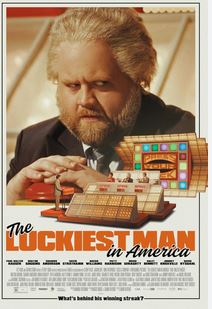
The right title can elevate a movie either in terms of box office or pop culture stature. “The Luckiest Man in America” does not seem the greatest choice. For one thing, the wording closely resembles the Lou Gehrig speech, which happened a long time ago but remains well known and is a far different kind of event. For another, it implies nothing about game shows or big winnings or scams and is not, as many such titles would be, a play on words about “Press Your Luck.” The title is explained by a CBS discussion late in the film about how this episode will be marketed. That “The Luckiest Man in America” became the title is itself sort of an indication that maybe this event does not have enough pop culture notoriety for box office success. That is unfortunate for the moviegoing public.
Hauser in the film resembles the real Michael Larson. That’s a nod to accuracy. Hollywood, though, has a way of drawing parallels in character appearance. Larson in the movie kind of looks like the writer/poet Walt Whitman but also, slightly, Lon Chaney Jr.’s Wolfman of the 1941 classic.
The real Larson did collect a large haul from the show. A chunk would go to taxes. His story would not be so dubious were he not associated with other get-rich-quick schemes. Some, like this one, only pushed the boundaries. Others crossed the line. In one of the film’s strongest scenes, Michael’s eyes light up after an early spin of the board, when he realizes that all of his preparation really is about to pay off, like when a person attempting something dubious begins to see that it can actually succeed.
Larson was clearly a sharp guy. But you have to think that far smarter people could’ve figured this out faster than he did, had it only occurred to them to try it.
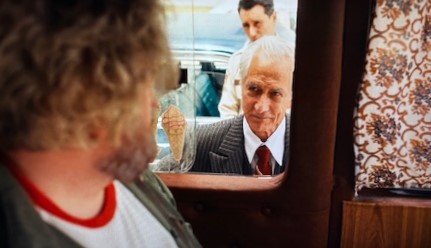
Larson apparently, for a time, really did drive an ice cream truck and was an HVAC technician. He either took a plane or a bus to Los Angeles (depending on which account you read), but he didn’t drive an ice cream truck to California. After the show, he apparently lost a lot of cash while trying to win a serial-number contest. In trying to make this Michael’s story, the movie goes against the grain and falls short. It is suggested that Michael is losing connections with his wife and daughter and is attempting this game show odyssey as a way to impress them and bring them back into his life. But even artistic license can’t really go that far. In a strange ending, Michael’s daughter can’t even watch the episode but is whisked away to school by mom’s current significant other, implying that the family life he yearned to restore has already passed him by. Mom, though, is seen watching with a level of admiration for a man who was just too exasperating.
Driving this film is the very difficult question of what we do, in the moment, when life hands us an undeserved break. Or even if we achieve such a break through our own hard work. That is not a big dilemma in “Rain Man,” in which Charlie realizes that Raymond has a legal way of winning at the casino that can bail out Charlie’s business. Charlie does not feel any guilt. He surely believes it wouldn’t have happened if Charlie hadn’t taken the time to get to know his brother and deal with the frustration. Also, he’s not collecting cash from some unlucky guy, but a big, prominent business.
Imagine if Larson, instead of watching a TV show, had instead studied a video poker machine and determined a pattern to the combinations. He enters the business and wins an unusual amount of money. Most likely, he would not want the business to realize that he has discovered something about the game. He might play it again. Eventually, the business would get suspicious. The outcome would probably be as in “Rain Man,” that they would ask him to leave.
Notice in “Luckiest Man” that Larson shares nothing about studying the board to either his fellow contestants, audience or CBS brass. Imagine if he had said, while initially posing as someone named Travis Dunn in hopes of landing on the show, “No, I’m not Travis Dunn, but I want to be on the show because I have cracked your code, and I’ll win the most money in game-show history.” He almost certainly does not get on the show. If he makes such an announcement during the taping of the game, then it’s a really big mess for CBS. Broadcast authorities would likely have to be involved. The episode probably has to be canceled and some kind of financial settlement reached. The CBS execs note in the movie that the actual episode legally has to air once, but no more.
The fact Larson kept his “Press Your Luck” secret to himself is evidence that he found it questionable. But other than actually appearing on the show, it’s hard to see how else he could’ve benefited from his research. Theoretically, he could consult a lawyer, explain what he has found, and then have the lawyer contact CBS to see if it will pay him for revealing the flaw in the game. Most people with Larson’s knowledge would simply request an audition. He doesn’t seem to have suffered from this event. Where you come out on his act is up to your conscience. Fortunately these filmmakers are happy to press our buttons.
4 stars
(December 2025)
“The Luckiest Man in America” (2024)
Starring
Paul Walter Hauser as
Michael ♦
Walton Goggins as
Peter ♦
Shamier Anderson as
Chuck ♦
David Strathairn as
Bill ♦
Brian Geraghty as
Ed ♦
Patti Harrison as
Janie ♦
Maisie Williams as
Sylvia ♦
Ricky Russert as
Whitman ♦
David Rysdahl as
Todd ♦
Shaunette Renée Wilson as
Donna ♦
James Wolk as
Junior ♦
Damian Young as
Kauffman ♦
Haley Bennett as
Patricia ♦
Johnny Knoxville as
Leon Hart ♦
Lilli Kay as
Lisa ♦
Tatiana Ronderos as
Barb ♦
Stefano Meier as
Lyle ♦
Carlota Castro as
Susie ♦
Carlos Manuel Vesga as
Jim ♦
Genesis Rodriguez as
Jail Actress ♦
Paulina Diazgranados as
Breakfast PA ♦
Evan Sudarsky as
Travis Dunn ♦
Ilia Spozhnikov as
Cop 1 ♦
Brendan Lawler as
Cop 2 ♦
Brendan Corrigan as
Cop 3 ♦
Miguel Cantillo as
Cop 4 ♦
Marcela Vargas as
Store Clerk ♦
Johan Ortega as
Asist. Director ♦
Oleana Lientsova as
Female Contestant 1 ♦
Olga Dyakova as
Female Contestant 2 ♦
Amit Takar as
Male Contestant ♦
Tinna Rey as
Audition Woman 1 ♦
Maggie Briggs as
Audience Member ♦
Salome Amazo as
Baby Susie ♦
Manolo Bellon as
Biker Man ♦
Camilo Cortés Villota as
Band 1 ♦
Daniel Caicedo Soler as
Band 2 ♦
Mateo Sangiovanni as
Band 3 ♦
Camilo Martínez López as
Key Grip ♦
Naomi Jones as
UCLA Teen 1 ♦
Judah Jones as
UCLA Teen 2 ♦
R.J. Glass as
Young Man 1 ♦
Tyler Youngblood as
Stoner Man ♦
Nea Dune as
Female Contestant (voice) ♦
Lisa Stanley as
Female Contestant (voice) ♦
Allen Enlow as
Male Contestant (voice) ♦
Chris Nichter as
Rod Roddy (voice)
Directed by: Samir Oliveros
Written by: Maggie Briggs
Written by: Samir Oliveros
Story by: Maggie Briggs
Story by: Samir Oliveros
Story by: Amanda Freedman
Producer: Amanda Freedman
Co-producer: Constanza Muñoz
Associate producer: Dan Ragussis
Associate producer: Ricky Russert
Line producer: Nathalie Burnside
Post producer: Juan M. Betancourt
Executive producer: Pablo Larraín
Executive producer: Juan de Dios Larraín
Executive producer: Andrew Hevia
Executive producer: Paul Walter Hauser
Executive producer: Sara McFarlane
Executive producer: Juan Pablo Solano
Executive producer: Simón Beltrán
Executive producer: Ron Black
Executive producer: Josh Sapan
Executive producer: Damiano Tucci
Executive producer: Tiziano Tucci
Executive producer: Sophia Banks
Executive producer: Arun Thapar
Executive producer: Divya Shahani
Executive producer: Roger Lolly
Music: John Carroll Kirby
Cinematography: Pablo Lozano
Editor: Sebastián Hernández
Casting: Kharmel Cochrane
Production design: Lulú Salgado
Art direction: Diego Garcia
Set decorator: Gaspar Camilo Ospina
Costumes: Carolina Serna
Makeup and hair: Johan “Azul” Romero, Maria Fernanda Silvestre Pico, Juana Santa María, Viviana Ávila, Suzana Ortiz Lenis, María Catalina Jácome E., María Camila Mejía Gómez, Lorenzo Badalacchi, Mary Guillén, Gabriela Iglesias, Astrid Martínez, Paula Medina, Laura Moncada, Vianey “Janeth” Moreno
Unit production manager: Amanda Neme Barrero
Unit production manager assistant: María Camila Ortíz
Production manager: Jaguar Bite: Natalia Rendon Rodríguez
Special thanks: Andres Beltran
Special thanks: Suki Cohen
Special thanks: Doriane Desfaugeres
Special thanks: David Rios
Special thanks: Salomon Simhon
Special thanks: Dimitris Tsilifonis
Special thanks: Duvan Duque
Special thanks: Alvaro Villegas
Very special thanks: Allison Freedman
Very special thanks: David Freedman
Very special thanks: Sidney Freedman
Very special thanks: Susan Freedman
Very special thanks: Albert Lee
Very special thanks: Mauricio Leiva-Cock
Very special thanks: Gabriel Oliveros
Very special thanks: Ikram Zayed
Very special thanks: Salma Zayed
Dedicatee: for those we loved: Dawn Freedman
Dedicatee: for those we loved: Russell Jacobson
Dedicatee: for those we loved: Adel Zayed