

Pumping Irons — Jeremy earns category inflation while convincing you Dershowitz is doing the noble thing in ‘Reversal of Fortune’
The legal case that is being picked apart in “Reversal of Fortune” stinks, and one reason we know it stinks is because the defendant, despite receiving a 30-year sentence, doesn’t even have to report to jail.
It would seem, then, that the real-life judge probably was even more skeptical of Claus von Bulow’s conviction than Alan Dershowitz, whose insistence that this appeal is a monumental challenge with little hope of victory is what’s supposed to turn “Reversal” from a dry appellate legal procedural into a heartwarming tale of rallying for someone you’d really rather not help out. All Alan really has to do is point out how bad this case is. He goes beyond that benchmark with an interesting straddle — indicating he is thinking that legally, von Bulow is innocent, but that “morally,” it’s between Claus and his conscience. (Which is called, having it multiple ways.)
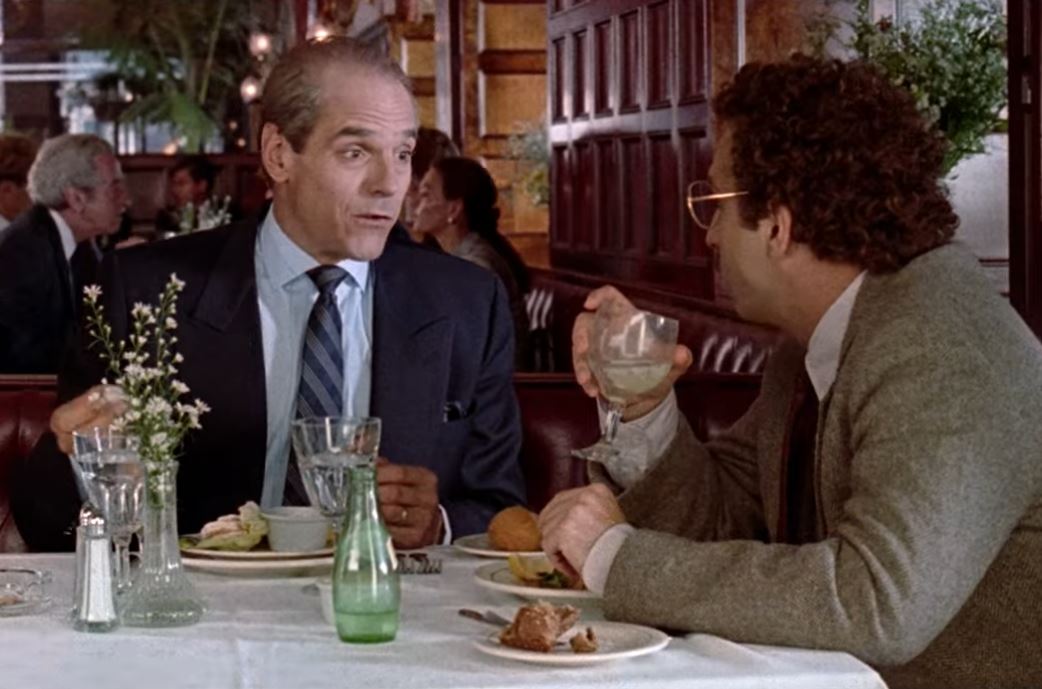
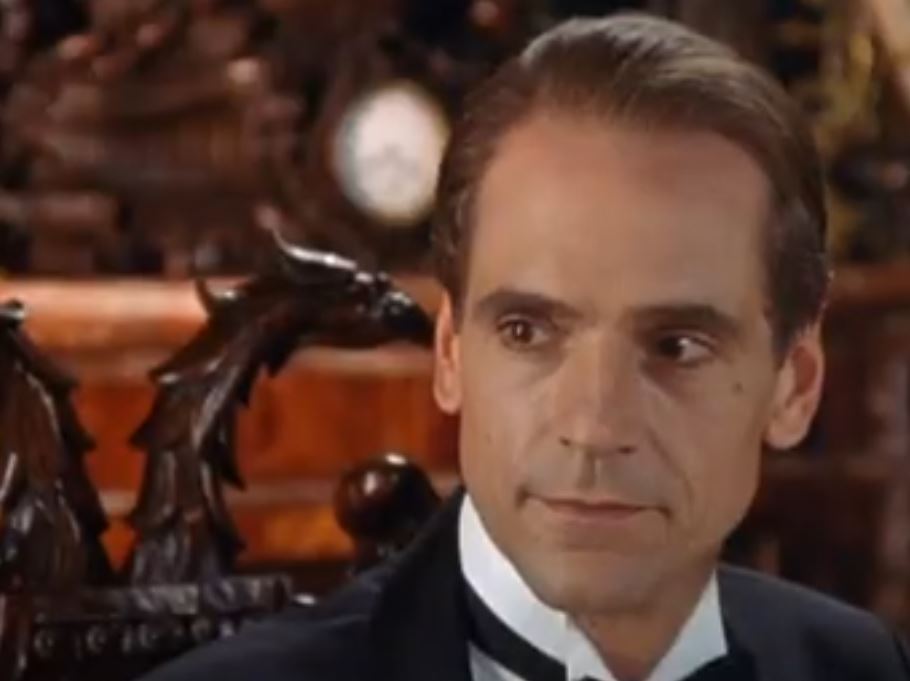
“Reversal of Fortune” is a great movie and still highly watchable today largely because of the extraordinary performance of Jeremy Irons, whose Claus von Bulow is certainly far more interesting than the real thing, something that great actors accomplish. His von Bulow is either completely fearless or completely out of touch. Both are the ingredients for memorable characters. As an old-money figure, he presents himself with a certain aristocratic decorum, even when hanging out with college kids. On the surface, he is a fish out of water trying to keep up with the young brainiacs of Dershowitz’s group. But is he really a fish out of water? Or is he using them?
Roger Ebert seems to think it could not be the latter. “Irons is able to suggest, subtly, that some of this over-the-top behavior is the result of fear ... beneath his facade he is quaking,” Ebert writes in his four-star 1990 review. Yet Irons’ von Bulow will provide none of the self-reflection typical of legal thrillers. Most of them are not about guilt, but the degree of guilt. As Dershowitz basically indicates (without using these exact words) in “Reversal,” if you’re in this mess in the first place, there’s probably a valid reason.
Pauline Kael credits extraordinary work by Irons for the film’s appeal. “It’s a masterly conceit” and “bizarrely witty,” or what critics “used to call ‘delicious.’ ”
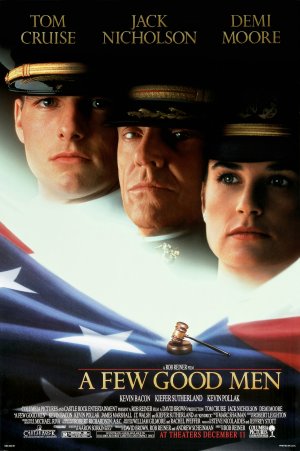
In “The Reader,” Hanna Schmitz is adamant that she had to follow orders but comes to the realization that her order-following failed humanity. So do Dawson & Downey in “A Few Good Men.” Irons will have to cede that angle to Ron Silver’s Dershowitz. Because, despite everything you’ve heard about the acting of this film, it’s Dershowitz’s movie. Kael suggests that effort doesn’t work so well: “Probably most of us would be even happier if it weren’t for the time consumed by Ron Silver as Dershowitz.”
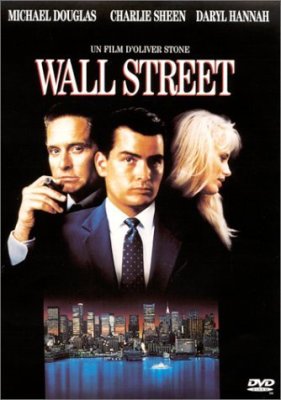
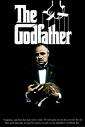
One reason “Reversal of Fortune” is a significant film is because of the awards-category chicanery that was rampant in the late 1980s and early 1990s, when unforgettable supporting characters were scooping up Best Actor Oscars. Michael Douglas in “Wall Street,” Dustin Hoffman in “Rain Man,” Irons in “Reversal,” followed by Anthony Hopkins in “The Silence of the Lambs” and even Al Pacino in “Scent of a Woman.” (“Reversal” in fact is produced by the “Wall Street” team of Edward R. Pressman and Oliver Stone.) From time to time, it happens (Brando in “The Godfather,” Peter Finch in “Network”). But not ever with this regularity. “Who should care,” someone might say, and the answer would be “No one — except those who take this arts criticism thing a little too seriously.”
Supporting characters are given a pass. They are like a basketball player told that he has to score as often as possible but cannot attempt rebounding or defense. That’s an easier assignment than a lead role. Supporting actors are given one note and must maintain that note for the duration. They do not have to change. They throw stuff at the lead actor(s) and force them to change. The pressure is on Ron Silver, as Dershowitz, to make “Reversal” a movie. He has to, as an offbeat Harvard type who is reluctant to take this case, ooze skepticism, then rally to the cause as his team’s findings suggest, more and more, that they actually are doing the right thing.

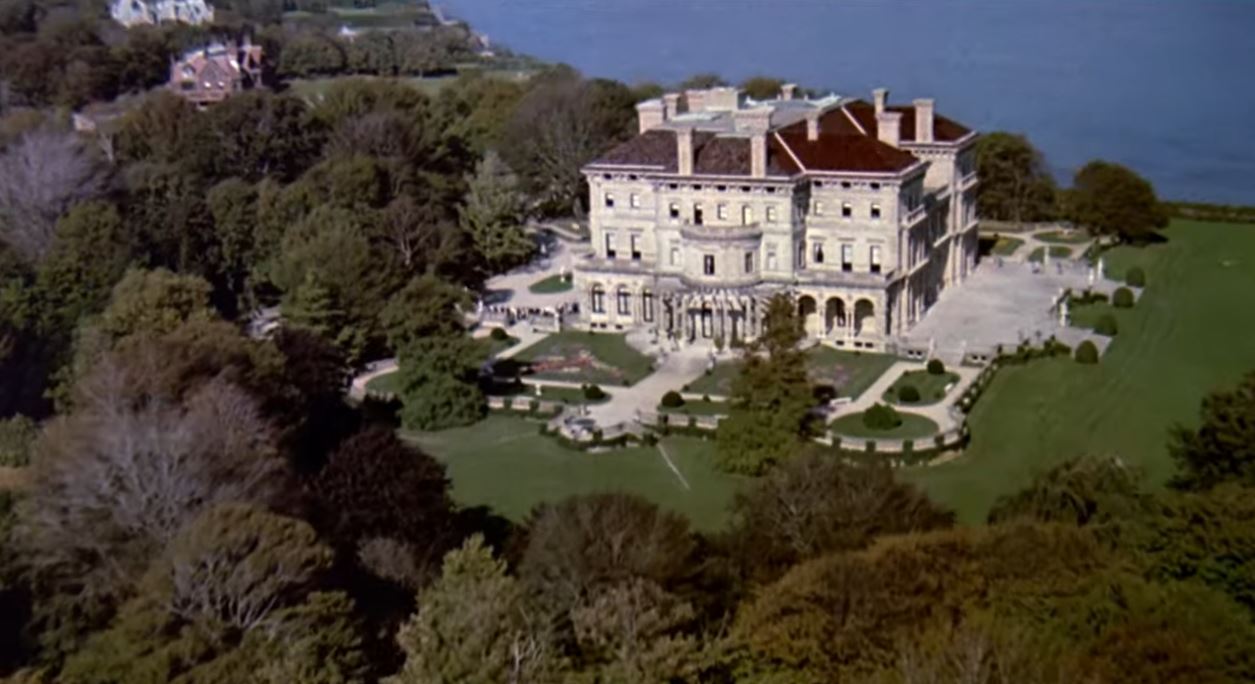
Does Silver succeed? He literally gives it the ol’ college try. His workaholic lifestyle is a big part of the appeal of this film, a dozen hypersmart people in a home trading provocative questions and one-liners off each other and staying up till the wee hours. (Notably, no one is dating anyone in this picture, yet it still feels like a sexy activity, though there’s the obligatory comment or two for a pretty co-ed.) Sometimes, the limited visuals — typically, people in a room arguing indications of innocence with each other, or the von Bulows in bed — are flat, but the opening spree of waterfront mansions and the later presence of a tiger give the film life. Exciting projects make great cinema. You see it in “The Social Network,” when college students renting a house are working ’round the clock on coding. The reality for Dershowitz’s team, as in “All the President’s Men,” is that the students were likely making their biggest discoveries only after sitting in libraries for hours and re-reading rulings and transcripts.
But Silver is unable to match the presence of Irons. In real life, Dershowitz is a much more formidable person than von Bulow. But not in this movie. Where Silver nearly comes close enough is in humor. He’s somehow able to make jokes about the situation surrounding his innocent clients (two young African Americans) in a completely different case who are, according to the movie, facing execution at the time of von Bulow’s appeal. Silver’s Dershowitz is funny. Von Bulow is not. Except, well ... it’s Irons who actually delivers the two or three funniest lines. In the category of laughs, Silver wins on points, but Irons delivers the knockouts. The Harvard team has sharpened their skills and expanded their horizons and perhaps even done the right thing, but the sense you’ll have at the end of this movie is that von Bulow is the straw that stirs the drink; if Dershowitz had stumbled, another team would’ve been hired for the same outcome.
One of those students working on the case for Dershowitz was none other than CNBC star Jim Cramer. Cramer in 2005 actually claimed in a book that von Bulow was “supremely guilty.” Dershowitz fired back in an op-ed that Cramer’s work on the appeal was “minimal” and he was “in no position to know whether Von Bulow was supremely innocent, supremely guilty or somewhere in between.” Dershowitz asked whether CNBC viewers should trust Cramer’s financial advice, writing that in his comment on the von Bulow case, Cramer “had absolutely no knowledge upon which to base his opinions. His opinion was based on abysmal ignorance and a desire to make a point about why he hated law school and rarely attended his ‘bor[ing] classes.’ Maybe if Cramer had gone to class and paid attention to his teachers, he would have learned not to breach his fiduciary obligation to clients.”
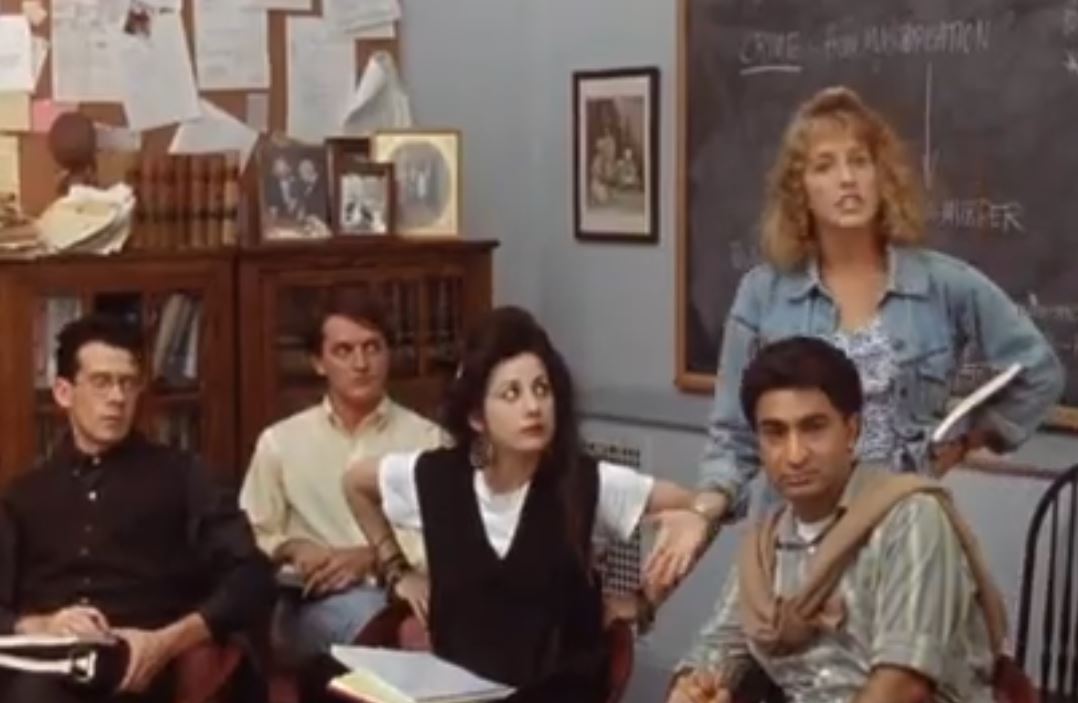
It’s a fair question as to what Dershowitz’s students receive in exchange for doing all of this work. Perhaps it involves an important legal credit, or perhaps it is part of their grade, or perhaps they are compensated. In “The Paper Chase,” Hart is invited by Kingsfield to submit an extra-curricular paper that could seemingly impress the prof and other luminaries who may read it. In “Real Genius,” the plot revolves around physics wunderkinds whose work is corrupted by a professor.
Two of the biggest decisions facing many films are Where to start it? and Where to end it? The first von Bulow trial was certainly among the biggest of the 1980s. It was one of the first trials to be televised. However, “Reversal of Fortune” curiously stays away from that event, seeing all the drama occurring afterwards, because that’s when its protagonist entered the scene. There is some awkwardness in the early stages of explaining to the audience where the case is at before appellate lawyers are called. The ending occurs not when von Bulow is acquitted, but when the convictions are tossed, and Silver’s Dershowitz has to admit that there’s still a lot of work to do. While repeated references are made to the original trial, one of your lingering questions after the movie will be, how in the world did von Bulow’s first lawyers screw this up so bad?
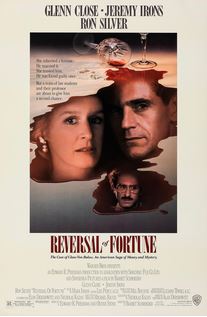
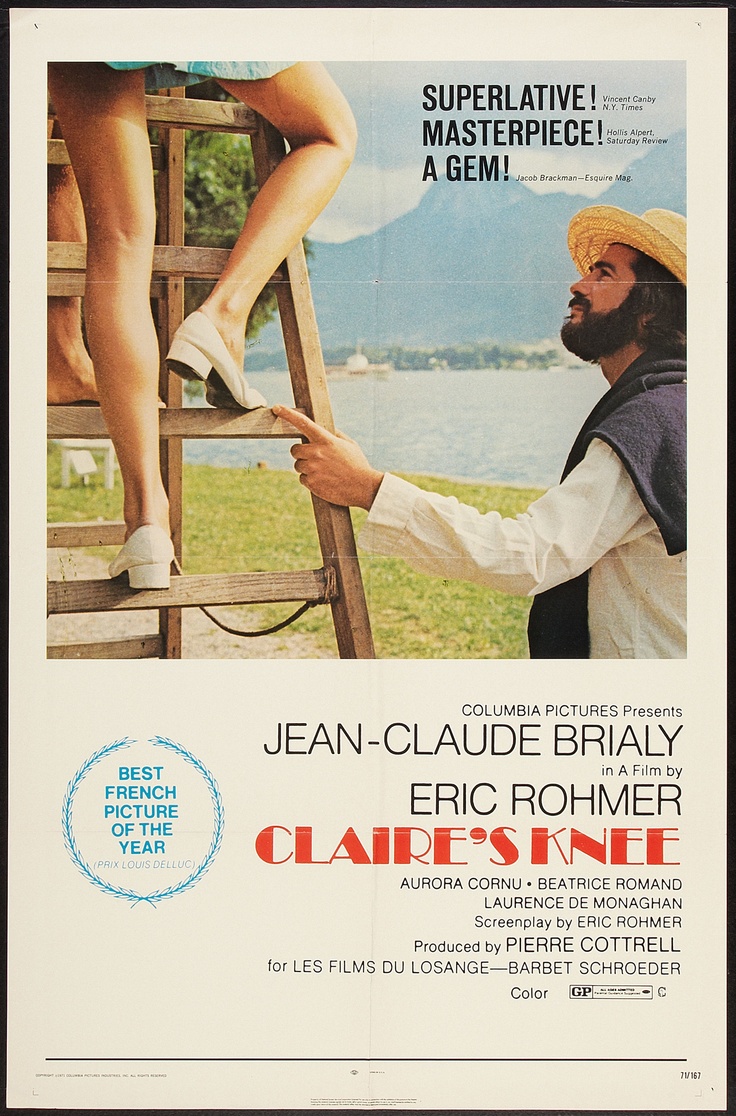
“Reversal” director Barbet Schroeder emerged as a producer of an astonishing batch of French art-house classics including “Claire’s Knee,” “Love in the Afternoon” and “Celine and Julie Go Boating,” among many. Born in 1941, he was still making movies as recently as 2023. An American legal thriller is not atypical of his staggering repertoire. He makes a key decision to cast an A-list actress, Glenn Close, as the beleaguered Sunny von Bulow who will narrate this story as not an angry but very reliable observer — not as to what actually happened, but what people claim happened. Still, too much of what she is doing is reading the book to us. Nevertheless, Roger Ebert, noting that the real Sunny at the time of the film’s release was still in this same coma, asserts that the “genius” of the film is that it’s “narrated by Sunny from her sickbed,” which “gives us permission to look at the film in a more genial mood.” (Actually, late-night comedians and “SNL” had been doing that for the past decade.)
It’s tempting to put the action into a courtroom. Schroeder mostly declines. One of the strengths here is that he does not depict courtroom battles, like many films, as performance art. Surely, that is true on some level. The message from “Reversal” is that it was hard work and savvy research that made the difference.
However, the film will stall whenever it zeroes in on needles and syringes. Movies that find excuses to do the “Law & Order” procedural are smart because it’s so damn entertaining. On some level, we do have to know exactly what he was accused of doing and why the procurement of that evidence may have been faulty. But the details here quickly become a blur, two incidents, slightly different outcomes, something to do with insulin, figuring out the family tree, the adversary turns out to be someone named Brillhoffer ... Schroeder is better at giving us satire of the 1%. The rich people in this film — there are really only two of them, plus some extended family members — don’t really have jobs or anything to do. At times, their boredom becomes our own. And even that casts a little more doubt on the prosecution theory that someone dying could considerably help out someone else financially. To do more of the same nothing?
Legal thriller, in which a protagonist is a lawyer, is a great genre. Some, such as “Philadelphia” or “The Verdict,” hand us emotional material. Others endlessly entertain to varying degrees of seriousness, from “Legal Eagles” to “A Few Good Men” to “The Firm.” “Reversal of Fortune” is more aspirational than those latter three, but you may be less inclined than with the others to switch over to it when it shows up on the cable TV grid.
The von Bulow case was a talker for a decade. After the litigation ended, it quickly faded, even as Sunny remained in a coma. She spent more than a generation in that state, passing away in 2008. Claus von Bulow died quietly in 2019. Dershowitz in the 1980s may have been thinking, or just had us thinking, that “Reversal of Fortune” was some kind of remarkable principled effort to rescue a persecuted individual. Then he went on to Leona Helmsley, O.J. and Jeffrey Epstein. Once is a fluke. Two’s trouble. Three’s a trend ... In case you thought he was spending all the rest of his time on those innocent kids facing execution.
3.5 stars
(February 2026)
“Reversal of Fortune” (1990)
Cast:
Glenn Close as
Sunny von Bulow ♦
Jeremy Irons as
Claus von Bulow ♦
Ron Silver as
Alan Dershowitz ♦
Annabella Sciorra as
Sarah ♦
Uta Hagen as
Maria ♦
Fisher Stevens as
David Marriott ♦
Jack Gilpin as
Peter MacIntosh ♦
Christine Baranski as
Andrea Reynolds ♦
Stephen Mailer as
Elon Dershowitz ♦
Christine Dunford as
Ellen ♦
Felicity Huffman as
Minnie ♦
Mano Singh as
Raj ♦
Johann Carlo as
Nancy ♦
Keith Reddin as
Dobbs ♦
Alan Pottinger as
Chuck ♦
Mitchell Whitfield as
Curly ♦
Tom Wright as
Jack ♦
Gordon Joseph Weiss as
Tom Berman ♦
Michael Lord as
Ed ♦
Lisa Gay Hamilton as
Mary ♦
Bill Camp as
Bill ♦
John David Cullum as
John ♦
Jad Mager as
Alexander von Auersberg ♦
Sarah Fearon as
Ala von Auersberg ♦
Kristi Hundt as
Older Cosima ♦
Kara Emerson as
Young Cosima ♦
Michael Wikes as
Steve Famiglietti ♦
Thomas Dorff as
Brillhoffer ♦
Bruno Eierund as
Alfie von Auersberg ♦
Bernt Kuhlmann as
Alfie’s Friend ♦
Redman Maxfield as
Dr. Paultees ♦
Frederick Neumann as
Judge ♦
Conrad McLaren as
Sheriff ♦
Edwin McDonough as
Bailiff ♦
Brian Delate as
Jury Foreman ♦
Dess Philpot as
Emergency Room Doctor ♦
Steven Black as
Maitre D’ ♦
Kender Jones as
Party Goer #1 ♦
Haes Hill as
Party Goer #2 ♦
Dan Rea as
Newscaster ♦
Leo Leyden as
Englishman ♦
Malachy McCourt as
Englishman ♦
Jessika Cardinahl as
Dinner Guest ♦
Ericka Klein as
Dinner Guest ♦
Joko Zohrer as
Dinner Guest ♦
Directed by: Barbet Schroeder
Written by: Nicholas Kazan (screenplay)
Written by: Alan Dershowitz (book)
Producer: Edward R. Pressman
Prdoucer: Oliver Stone
Co-producer: Elon Dershowitz
Co-producer: Nicholas Kazan
Associate producer: Michael Flynn
Associate producer: Diane Schneier
Executive producer: Michael Rauch
Music: Mark Isham
Cinematograpy: Luciano Tovoli
Editing: Lee Percy
Casting: Howard Feuer
Production design: Mel Bourne
Art direction: Dan Davis
Set decoration: Beth Kushnick
Costumes: Judianna Makovsky
Makeup and hair: Alan D’Angerio, Jean Luc Russier, Allen Weisinger, Marie-Ange Ripka, Toni Trimble
Production manager: Steven Felder
Post-production supervisor: Kerry Orent
Special thanks: Lynn Pressman Raymond