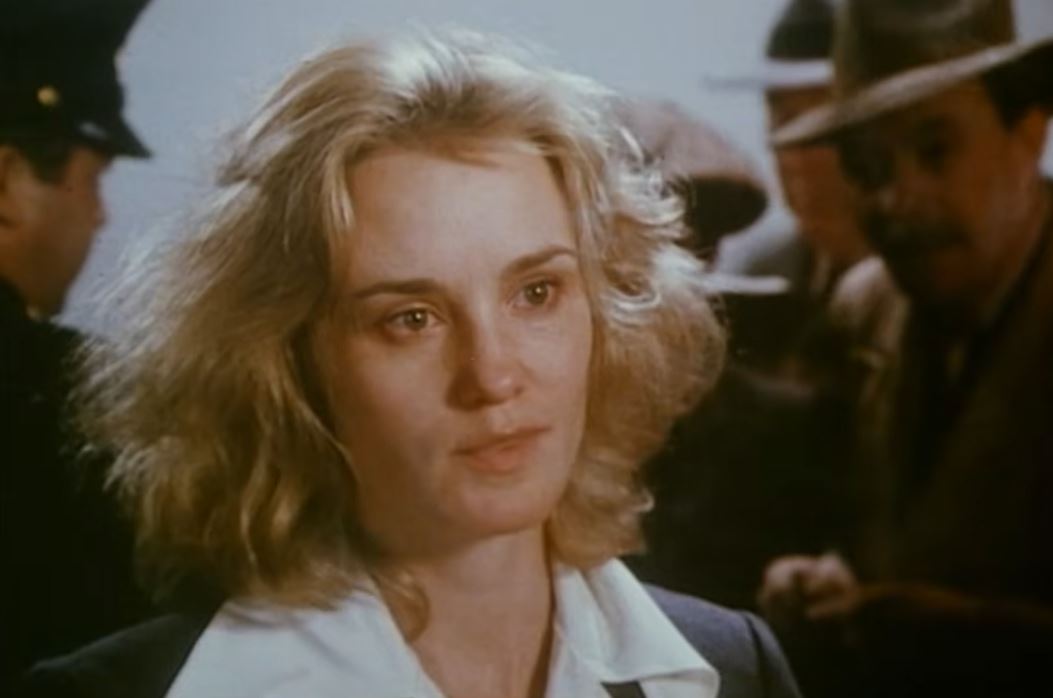
Farmer’s market —
Interest in ‘Frances’
is simply mind-boggling
The most interesting assessment of Frances Farmer comes not from a movie nor movie review, but a song title: “Frances Farmer Will Have Her Revenge on Seattle.” It could’ve stopped after six words. The eighth is the key. It’s the title of a 1993 Nirvana song, and its author, Kurt Cobain, identified with the beleaguered actress, apparently after reading the 1978 book Shadowland, by the Seattle Post-Intelligencer’s William Arnold. Within a couple years, Mel Brooks was putting together the feature film “Frances.”
The life of Farmer is indeed a tragedy. It’s not a movie. But someone was bound to try, because she is, on some level, “Hollywood,” a machine that can’t help but feed itself.
“Frances” became the first film directed by Australian Graeme Clifford, who had been an editor on about six films, including “The Rocky Horror Picture Show” and, more significantly, “The Postman Always Rings Twice,” which starred Jessica Lange. In “Frances,” he has given us a film that’s aspirational and watchable, though far from great.
Nothing about “Frances” is quite as aspirational as its one-word title. Those should probably be reserved for the most well-known celebrities ... “Elvis” ... “Amelia” ... “Ray” ... “Janis” ... “Amy” ... “Maria” ... even those last two are a bit of a stretch, but they are individuals with far more notoriety than one Frances Farmer, whose first name was not associated in 1982 with a different actress, but certainly is now.
The biggest disappointment, or outright mistake, of “Frances” is that it actually has very little to do with Hollywood. It’s a horror movie that makes ample use of screaming but never makes the case that this person’s celebrity is the source of her calamity. Roger Ebert, in a generous 3½-star review, concedes, “When I was asked the other day to name a few of Frances Farmer’s best films, I had to admit that, offhand, I couldn’t think of one.”
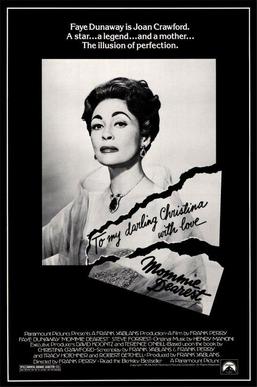
The film would be strongest as a takedown, or even parody, of public fascination with celebrities. That a person decades earlier who reached only a brief and low level of stardom and who is this indifferent to her profession and this difficult to work with and this prone to insulting people would be a sympathetic character of fascination should be an embarrassment to us. We do it to ourselves. Frances Farmer is a little like the talented player in “Rudy” who’s not into college football nearly as much as Rudy is. One reviewer finds “Frances” to be in the “freak show vein of ‘Mommie Dearest.’ ” But Clifford isn’t doing camp. He’s playing it straight.
In certain ways, he succeeds. Awaiting Frances’ next meltdown is unfortunately the catalyst of the film. Whether at local events in Seattle, on her movie sets, in court or in psychiatrist’s offices, she’s bound to say something that’s not going to go over well. Sometimes, she’ll physically attack. Is it a cry for help? Or just hard-core orneriness? Clifford doesn’t actually seem sure and settles on both.
Sam Shepard, as the composite character Harry York, is there to fill the role of Roger Ebert’s Reliable Observer, since Frances’ mother can’t fully be trusted. Not only is Shepard the observer, he’s often the narrator, because there just aren’t enough visuals here to illustrate what Frances is thinking. Harry at first seems relevant, then superfluous, kind of like Oliver Stone’s strange idea to make Richard Rutowski a bald version of death stalking Jim Morrison in “The Doors.” Eventually, Harry is tedious, reading a book to us when we’re trying to watch a movie. Vincent Canby suggests Harry may be just a figment of Frances’ imagination, as well as “writer’s desperation.”
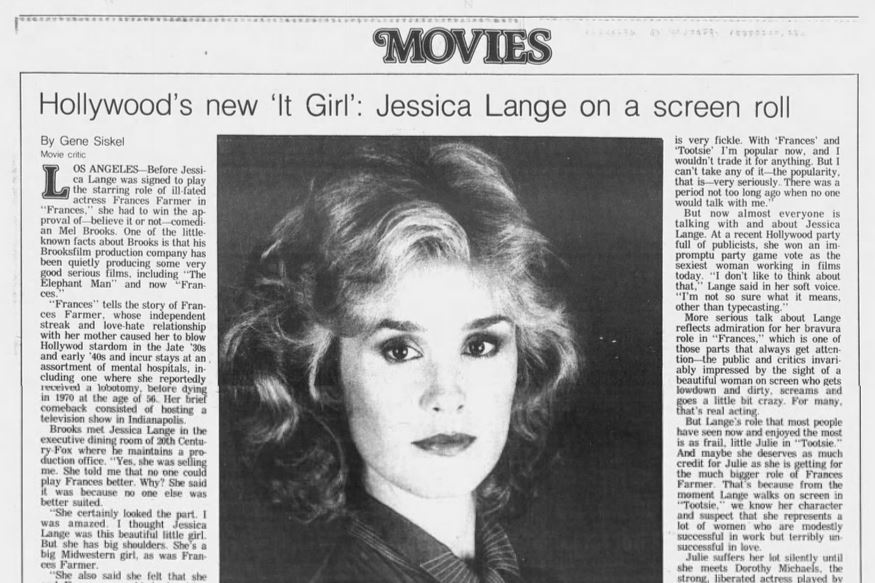
Reviews of “Frances” are remarkably consistent. Its flaws are duly noted, and ratings aren’t necessarily high, but everyone’s in agreement that Jessica Lange is a superstar. Gene Siskel apparently didn’t review “Frances” for the Chicago Tribune but nevertheless in an article about the film dubbed Lange “certainly this year’s ‘It Girl’ in Hollywood.” Pauline Kael also did not review “Frances” and later calls it a “dud movie” but praises Lange for the “tension” she brings to the character and the “brilliant nuances” she demonstrates.
Canby bluntly says Lange is “stunningly beautiful” and “emerges as a major film actress,” even though he calls the film a “colossal downer.”
Larry Kart, who reviewed the movie for the Chicago Tribune and draws the “Mommie Dearest” comparison, allows that Lange is “one of those actresses the camera seems to love.” Nevertheless, “it’s hard to figure out whether Lange is the prime source of the confusion or a more-or-less innocent victim of first-time director Graeme Clifford’s ineptitude.”
The movie posits that Frances was forever vulnerable and exploited, initially not in the worst ways but in kind of superficial ways, by leftists, the arts community, Hollywood and her mother, and all of these slights gradually nudged her over the edge. Then, the dam breaks, and she is physically terrorized in insane asylums even though, oddly, she keeps getting out of them. Her mother and entertainment elites all had reason to think there was more to her than what there actually was. Despite gushing about her persona and screen/stage presence, the Hollywood of “Frances” is not interested in her doing anything like Method Acting, and Clifford Odets seems intrigued for something different than artistic reasons. Much of this must be told in conversations, but perhaps the film’s strongest scene, depicting the professional disdain for her, is showing Frances having to fall into mud over and over, under the guise of getting a perfect scene but perhaps just for the amusement of the director, who taunts her as a “serious artist.”
2 hours and 20 minutes is, unfortunately, all too common for a movie now. In 1982, it was a serious indulgence. Graeme Clifford is spending too much of that time checking Frances into and out of mental hospitals. There is, astonishingly, nothing about her trip to the Soviet Union, which we’re informed early is a major source of tension with her mother. Harry tells us “I guess she had a good time over there in Russia.” She could’ve been a character in “Reds,” which came out only a year earlier. In its opening scenes, “Frances” implies that Frances is an atheist and that will be a big factor in this film ... “Religion was too vague,” she says ... only to have Harry indicate she isn’t. Nor is there really an explanation as to why she somehow ended up married to a man who changed his name three or four times, to the point no one knows what it currently is.
It’s amusing how films about real people attempt to describe what the films are portraying. “This film is based on the true life story of Frances Farmer,” says the text at the opening of “Frances.” The inclusion of ‘true” is most curious; why is it necessary?
Especially when the truth about Farmer’s life is not exactly clear.
Frances Farmer died in 1970. Two years later, an “autobiography” surfaced, called Will There Really Be a Morning?, apparently ghost-written, by at least one of Farmer’s acquaintances, though it’s not clear exactly who. It alleged institutional rape, straitjackets and mother issues. And Hollywood didn’t care. But it would.
Then came Shadowland, which examined Farmer’s treatment by the mental-health system. It was reviewed as “Nonfiction” by The New York Times on July 2, 1978, and deemed “fact” by the review writer, Caroline Seebohm. But the Wikipedia page for Shadowland introduces it as “a journalistic memoir in the form of a novel.”
Shadowland has something important to Hollywood that the autobiography evidently did not. According to Seebohm, “Mr. Arnold makes a good case for the possibility that the actress had some sort of brain operation.”
“A good case” is all Hollywood needed. “Frances” will show us a doctor with an ice pick who resembles a biker. In the Associated Press review of “Frances” attributed to Bob Thomas, it is declared that “a lobotomy cured her rebelliousness.” Vincent Canby writes that the movie includes a “surgical destruction of a personality.” Kart asserts that Farmer was “subjected to” lobotomy.
Was she?
The New York Times obituary of 1970 says Farmer “was in mental hospitals from 1942 to 1949,” but nothing about abusive behavior or a lobotomy. The Chicago Tribune evidently ran no obituary.
What about the allegations of the “autobiography.” In a letter to the editor of The New York Times published Aug. 6, 1978, Suzette A. Henke faults Seebohm’s review for not mentioning what Henke claims is the “principal source” of Shadowland — the 1972 purported autobiography. According to Henke, “Miss Farmer describes, in poignant detail, the tortures of insulin shock, hydrotherapy and brutal incarceration: She was kept naked and caged in a ‘pen’ for incurables; she witnessed a lesbian rape that left its victim mutilated and catatonic. At one point, she was forced by a guard to eat her own excrement. Few prisoners have undergone such hellish torment. Yet she not only endured: she survived the inferno to write a stirring autobiographical account of her experiences. ...” Henke goes on to call it “Miss Farmer’s firsthand account.”
Was it? Henke’s letter would not be mentioned here, except that Arnold months later responded with his own letter to the Times published Nov. 26, 1978. Arnold says that though he “generally liked” the 1972 book, “there was always a great problem as to its veracity. The book was, in fact, written entirely after Frances Farmer’s death by a ghostwriter who apparently did little research into the facts of the case ... even the gruesome mental hospital where she spent so many years goes unnamed ... most of the more dramatic and sensationalized scenes of the book are entirely fictional.”
A lengthy 2025 online account, by an actor/playwright who did a Farmer play and “spends hours every day trying to correct misinformation on the internet,” details Farmer’s death and funeral and says the lobotomy implication is a “now-debunked idea.” However, his article does not list its sources.
With all due respect to Arnold and his considerable research, Hollywood seems to have taken Frances Farmer book material on an “Amityville Horror” joyride, as it kind of did with “Mommie Dearest.” It helps script writers if the subjects are dead and unable to object, but writers can gain additional cover by making the movie at times ambiguous as to whether something is actually happening or whether a character maybe only thinks it’s happening. That allows the production to milk the apparently important “true” labeling ... which still is not going to help their movie earn more money than “Star Wars” or “The Wizard of Oz” or “E.T.” Mel Brooks and Graeme Clifford should’ve asked themselves if they could’ve done a much better movie creating an actress who scored with all kinds of A-list actors while checking in and out of asylums like they were apartments. (God forbid someone might actually be helped by one of these places.)
More curiosities about the production of “Frances” ... the Wikipedia page for Shadowland claims that film rights to the book were sold to Noel Marshall (husband of Tippi Hedren), and that Marshall and Arnold sued Brooks in 1981 alleging that the “Frances” film “substantially copied” the Shadowland book. These allegations happen in Hollywood. The Wikipedia page calls this “one of the most-publicized show business legal disputes of the 1980s.” But there doesn’t seem to be any coverage of this case in archives of The New York Times or Chicago Tribune. The ruling apparently went in favor of Brooks. Arnold, curiously, around the time that Shadowland was published, became the Post-Intelligencer film critic and held that post for decades. (Presumably he did not review “Frances.”) He was known for championing the Peter O’Toole film “The Stunt Man,” which landed three Oscar nominations.
It’s not just the eight-year span of asylum treatment that is evidently open for speculation. Exactly how big of a star was Frances Farmer? The New York Times obituary of 1970 called her “a leading figure on the stage and screen in the 1930s.” In his “Frances” review, Vincent Canby only says she had “Some measure of Hollywood fame.”
She appeared in about 14 films before her hospitalization, including co-starring with Bing Crosby and Cary Grant. Her biggest hit was likely “Come and Get It,” featured in “Frances.” It’s from an Edna Ferber generational novel about greed and the logging industry. Farmer has a unique dual role — she plays a spurned singer, and later, the singer’s daughter, both of whom draw attention from the same man. Aside from its place as perhaps the high point of Farmer’s career, the movie is most known for producing the first Best Supporting Actor Oscar, to Walter Brennan, in the category’s inaugural year.
But there seems to be universal agreement that Farmer did not get elite roles and butted heads with Hollywood bosses and was indifferent, if not disdainful, toward promoting films (apparently, she also was criticized for shunning glamour in her clothing, enhancing her authenticity status); that’s why she bounced between Hollywood and the stage.
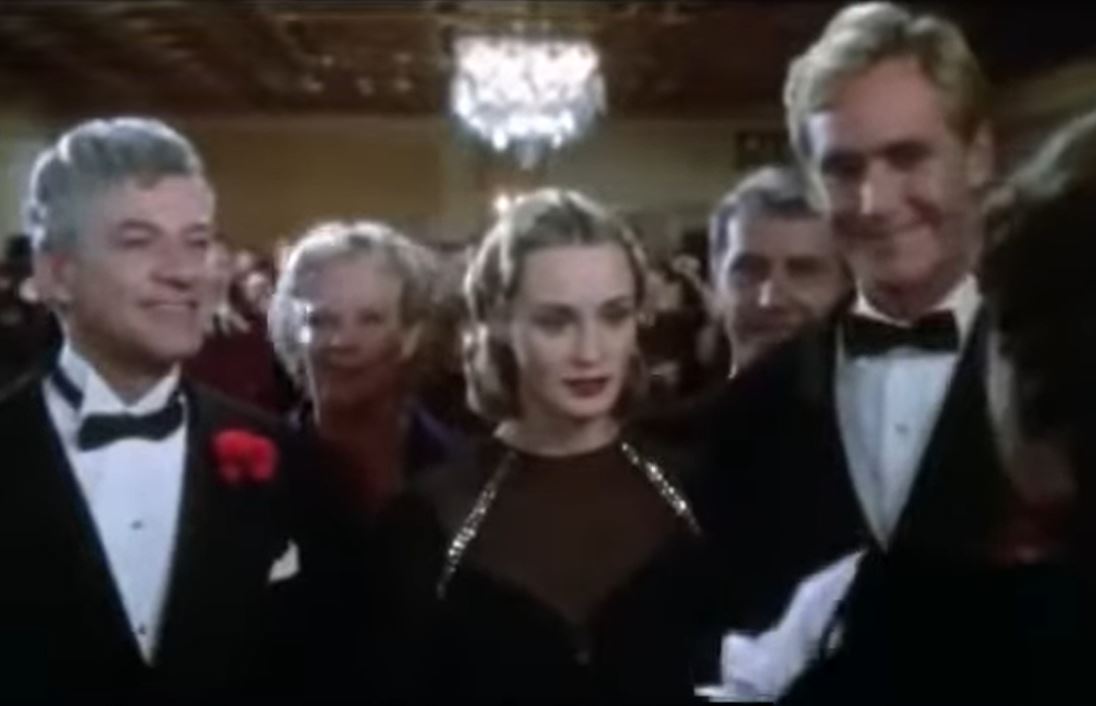
Harry York in “Frances” tells us, “So in spite of herself, Frances became a movie star.” The “Come and Get It” premiere was held in Seattle, presumably to capitalize on Farmer’s hometown popularity. Evidently, the studio didn’t do any research beforehand. The depiction in “Frances,” which certainly invokes artistic license, suggests this was anything but a happy event — Farmer is greeted in a big crowd by a woman who years earlier had denounced Farmer’s “God Dies” essay, and Frances can’t help but call her out, telling her “Bull----,” and declaring “You folks aren’t pleased to meet me at all.”
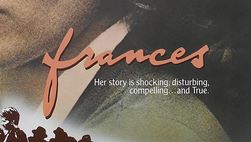
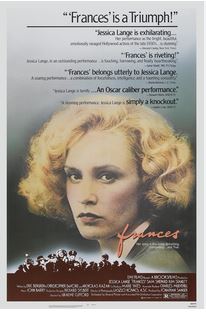
The title font on the “Frances” poster
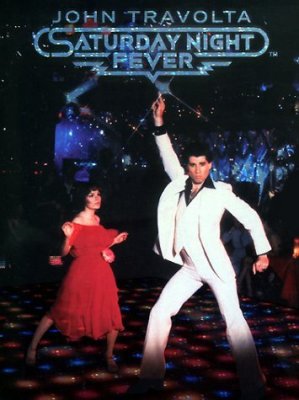
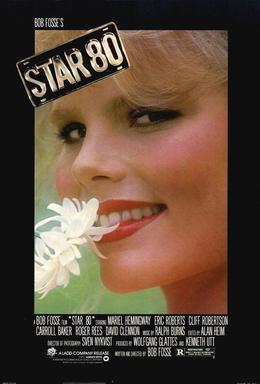
Some films, most notably “Saturday Night Fever” but also even “Good Will Hunting,” like to suggest that geography holds characters back. (Liverpool didn’t seem to hurt The Beatles.) There are hints in “Frances” that Seattle isn’t cultured enough for this wunderkind. But in fact, that’s where she was discovered. From Seattle, it was on to New York and Los Angeles as well as Nevada, where her problems really materialized. If anything, more than a grudge against Seattle, she could probably identify with Bob Fosse’s “Star 80.”
That’s evidently not how Kurt Cobain sees it. With one title, he likely made Farmer more famous than Arnold’s book or Clifford’s movie did. His wife, Courtney Love, wore a Farmer-owned dress for their 1992 wedding. Cobain evidently saw Farmer as a celebrity with mental health issues who was wronged by her hometown, maybe because of the reaction to her youth essay depicted in “Frances” but more likely because she was involuntarily committed to Washington’s dubious Steilacoom facility for years. She deserved better, but so did everyone else there. Any revenge is most likely his, not Farmer’s. Cobain’s song includes the refrain “I miss the comfort in bein’ sad.”
If the Seattle area even had a guilt trip, it’s irrelevant, because filmmakers apparently used locations in California, where Farmer’s experiences apparently were more benign, but the state still felt compelled to make a bargain with the filmmakers in this ending credit that probably hardly anyone saw: “In exchange for the use of certain facilities and per agreement with the California Department of Mental Health, the producers have agreed to the following disclaimer: ‘SINCE THE 1940’S, THERE HAVE BEEN MAJOR ADVANCES IN THE CARE AND TREATMENT OF THE MENTALLY ILL. THE REPREHENSIBLE CONDITIONS EXPERIENCED BY FRANCES FARMER ARE NOT TYPICAL OF MENTAL HEALTH TREATMENT TODAY.’ ”
One of the reasons that mental-hospital films are so horrifying is because they tend to be told from the protagonist’s point of view, and of course, the protagonist sees nothing wrong with his/her behavior and can’t figure out why he/she is here. They were screwed by someone, reacted to it, and now are being unfairly punished. Falsely accused. Farmer’s real life problems with running away from home aren’t shown. Could she live safely on her own, safely interact with other people? Her family and the courts seemed to think not.
Those who believe in general that too many people are phonies will find a champion in Frances Farmer. But then, she married a Hollywood flake who’s most famous for changing his name, and until she started physically attacking people, her story was probably typical.
The most serious conversations about art in “Frances” take place when Farmer is being recruited by Harold Clurman and Clifford Odets for “Golden Boy.” Clurman emphatically talks about changing society. Odets merely explains, “I think you’re very beautiful, Miss Farmer,” and that art should “shoot bullets,” and “you make very attractive ammunition.” Farmer will have an affair with Odets and the play will be a hit, but eventually Farmer loses both and will feel used. Clurman, who curiously resembles an important later character in the film, Dr. Symington, does have an interesting line: “It seems we always lecture those who are on time for those who are tardy.”
Years before “Frances,” Jessica Lange debuted in Hollywood in the controversial remake of “King Kong,” which, like Gus Van Sant’s “Psycho,” may have initially turned off moviegoers who feel such a classic shouldn’t be remade. But the 1976 “King Kong” has earned respect with time. Lange in 1981 was in “The Postman Always Rings Twice” with Jack Nicholson; Pauline Kael says it is “overcontrolled” and “wrongheaded” but has “taste and craftsmanship,” and that Lange is “the best reason” for seeing the movie. In December 1982, when Lange was 33, came “Tootsie” and “Frances,” for which Lange would receive the very rare distinction of two acting Oscar nominations in the same year, winning Best Supporting Actress for “Tootsie.” Like they often say about actors playing entertainers, Lange is probably a better Frances than Frances Farmer was.
Lange wasn’t the only nominee for “Frances.” Kim Stanley, as Frances’ mother, was nominated for Best Supporting Actress and lost, curiously, to Lange’s “Tootsie” role. So Lange and Stanley were each nominated, losing to Meryl Streep and Jessica Lange. Stanley is part of the considerable star power of “Frances” and among the reasons why, despite being a dubious project, it’s watchable. John Barry composes the music, and László Kovács is the cinematographer. Six-time Oscar nominee Richard Sylbert is production designer and George Gaines, a four-time nominee, is set decorator. Anjelica Huston, also in “Postman,” is credited as a mental patient, and the cast includes James Karen, Jonathan Banks and M.C. Gainey, and Kevin Costner has an uncredited role. They could’ve had a stronger project, but Brooks gave it every chance to succeed.
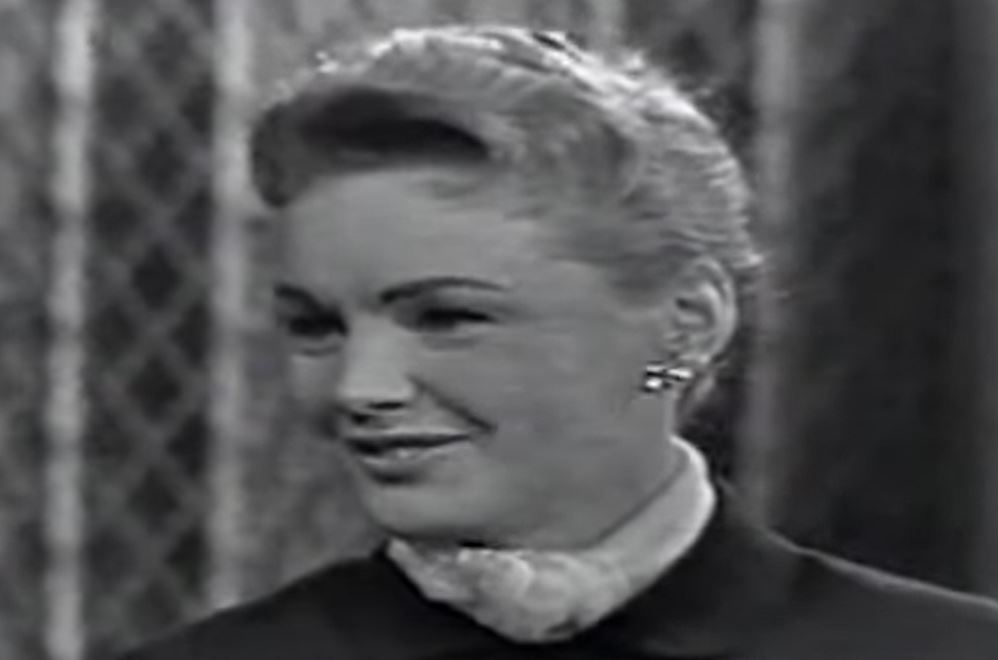
In her 1958 appearance on “This Is Your Life” that included many stark details of her life, Farmer, whose Hollywood beauty is still evident here around age 44, alternates between suggesting that she wasn’t really sick when first committed — “If you get treated like a patient, you’re apt to act like one.” — and then that the system didn’t have the “means” for “individual psychiatric care.” She mentions “electric shock treatment” and “hydrotherapy” as used almost more for crowd control for the “enormous” number of patients than providing individual help. However, she clearly says, “I don’t blame the hospital at all.”
She suggests she was able to “refind” her faith, leading to recovery and release, and she went “back to church.”
After all of the trauma shown in “Frances,” it was plain old booze and cigarettes that did in Frances Farmer — she died at 56 of esophageal cancer. Pills surely didn’t help either, nor did the fact she did not have a reliable husband who could vouch for her. The film doesn’t mention that “she underwent several abortions,” according to a New York Times reviewer in 1983. Surely there were a lot of health/behavioral issues affecting this person that weighed on her life even more than her speculated treatment at mental hospitals.
One telling visual of “Frances” is the title font. It’s not like an all-caps, all-red horror motif, but a dainty, sweeping cursive, implying that its subject deserves kindness and that this film will be kind. In real life, Frances did regain some measure of control, found at least some happiness in Indianapolis, and most importantly, salvaged the rest of her life.
But then came the “autobiography.” And a book about a possible/could’ve-been/maybe/within-the-realm-of-possibility lobotomy. And suddenly, Frances Farmer is a Hollywood circus freak. We not only get “Frances,” but, incredibly, a 3-hour TV movie airing just weeks after “Frances” premiered. Exploited yet again. They couldn’t leave well enough alone.
2.5 stars
(June 2026)
“Frances” (1982)
Cast: Jessica Lange as
Frances Farmer ♦
Kim Stanley as
Lillian Farmer ♦
Sam Shepard as
Harry York ♦
Jonathan Banks as
Hitchhiker ♦
Bonnie Bartlett as
Studio Stylist ♦
James Brodhead as
Desk Sergeant ♦
Bart Burns as
Ernest Farmer ♦
J.J. Chaback as
Lady at Roosevelt Hotel ♦
Jordan Charney as
Harold Clurman ♦
Daniel Chodos as
‘No Escape’ Director ♦
Rod Colbin as
Sentencing Judge ♦
Donald Craig as
Ralph Edwards ♦
Sarah Cunningham as
Alma Styles ♦
Lee De Broux as
‘Flowing Gold’ Director ♦
Jeffrey DeMunn as
Clifford Odets ♦
Jack Fitzgerald as
Clapper Man ♦
Nancy Foy as
Autograph Girl ♦
Anne Haney as
Hairdresser ♦
Richard Hawkins as
Bum on Street ♦
James Karen as
Judge Hillier ♦
Darrell Larson as
Louella’s Spy ♦
Patricia Larson as
Mrs. Hillier ♦
Albert Lord as
‘Flowing Gold’ A.D. ♦
Vincent Lucchesi as
Arresting Sergeant ♦
Jack Manning as
Studio Photographer ♦
Gerald S. O’Loughlin as
Lobotomy Doctor ♦
Woodrow Parfrey as
Dr. Doyle ♦
Christopher Pennock as
Dick Steele ♦
Rod Pilloud as
Martoni Kaminski ♦
Larry Pines as
Man on Phone - Bookie Joint ♦
John Randolph as
Kindly Judge ♦
Allan Rich as
Mr. Bebe ♦
Jack Riley as
Bob Barnes ♦
David V. Schroeder as
Studio Lawyer ♦
Helen Schustack as
Wardrobe Mistress ♦
Sandra Seacat as
Drama Teacher ♦
Charles Seaverns as
Real Estate Man ♦
Lane Smith as
Dr. Symington ♦
Karin Strandjord as
Connie ♦
Vern Taylor as
Studio Executive ♦
Andrew Winner as
Firechief ♦
Biff Yaeger as
Motorcycle Cop ♦
Keone Young as
Chinese Doctor ♦
Alexander Zale as
Man in Screening Room ♦
Paul Fleming as
Reporter / Publicist / Photographer ♦
M.C. Gainey as
Reporter / Publicist / Photographer ♦
Roger Galloway as
Reporter / Publicist / Photographer ♦
Matthew Goldsby as
Reporter / Publicist / Photographer ♦
Paul Keith as
Reporter / Publicist / Photographer ♦
F. William Parker as
Reporter / Publicist / Photographer ♦
Charles Shull as
Reporter / Publicist / Photographer ♦
Teda Bracci as
Mental Patient ♦
Jan Burrell as
Mental Patient ♦
Flo di Re as
Mental Patient ♦
Dodds Frank as
Mental Patient ♦
Patricia Gaul as
Mental Patient ♦
Robin Ginsburg as
Mental Patient ♦
Pamela Gordon as
Mental Patient ♦
Anjelica Huston as
Mental Patient ♦
Jamie Johnston as
Mental Patient ♦
Ola Kaufman as
Mental Patient ♦
Donna LaMana as
Mental Patient ♦
Sharmagne Leland-St. John as
Mental Patient ♦
Jane Lillig as
Mental Patient ♦
Alexandra Melchi as
Mental Patient ♦
Patricia Post as
Mental Patient ♦
Zelda Rubenstein as
Mental Patient ♦
Nina Schneider as
Mental Patient ♦
Marlene Silvers as
Mental Patient ♦
Vicki Williams as
Mental Patient ♦
Susan Wolf as
Mental Patient ♦
Tom Amundsen as
Doctor / Nurse / Orderly ♦
Anne Haslett as
Doctor / Nurse / Orderly ♦
Barry Jamesby as
Doctor / Nurse / Orderly ♦
Len Lookabaugh as
Doctor / Nurse / Orderly ♦
Oceana Marr as
Doctor / Nurse / Orderly ♦
Vahan Moosekian as
Doctor / Nurse / Orderly ♦
Tom Pletts as
Doctor / Nurse / Orderly ♦
Eileen T’Kaye as
Doctor / Nurse / Orderly ♦
Lila Waters as
Doctor / Nurse / Orderly ♦
Charles Prior as
Soldier ♦
Carl Kraines as
Soldier
Directed by: Graeme Clifford
Written by: Eric Bergren
Written by: Christopher Devore
Written by: Nicholas Kazan
Producer: Jonathan Sanger
Co-producer: Marie Yates
Associate producer: Charles Mulvehill
Music: John Barry
Cinematography: Laszlo Kovacs
Editor: John Wright
Casting: Jennifer Shull
Production design: Richard Sylbert
Art direction: Ida Random
Set decoration: George Gaines
Costumes: Patricia Norris
Makeup and hair: Toni Walker, Dorothy Pearl, Florence Avery, Melanie Levitt, Robert Stevenson, Nadia
Unit production manager: Charles Mulvehill
Stunts: Jerry Wills