When the Reagans screened ‘Reds’ at the White House with Warren Beatty and Diane Keaton
Ronald Reagan was a conservative president. He was also a movie star. The former didn’t limit his enthusiasm for the latter.
Included at the website of the Ronald Reagan Presidential Library & Museum is a list of movies watched by the first couple during Ron’s eight years as president.
The list is not sourced. And there is reason to question its accuracy. (More on that in a moment.) The vast majority of screenings were at Camp David, not the White House. Most of the White House screenings are listed as taking place in 1981 and 1982.
There is no description in the list as to who else attended the screenings. Of course, there is a big difference between the first couple dropping in for a few scenes, and the first couple hosting a director and stars.
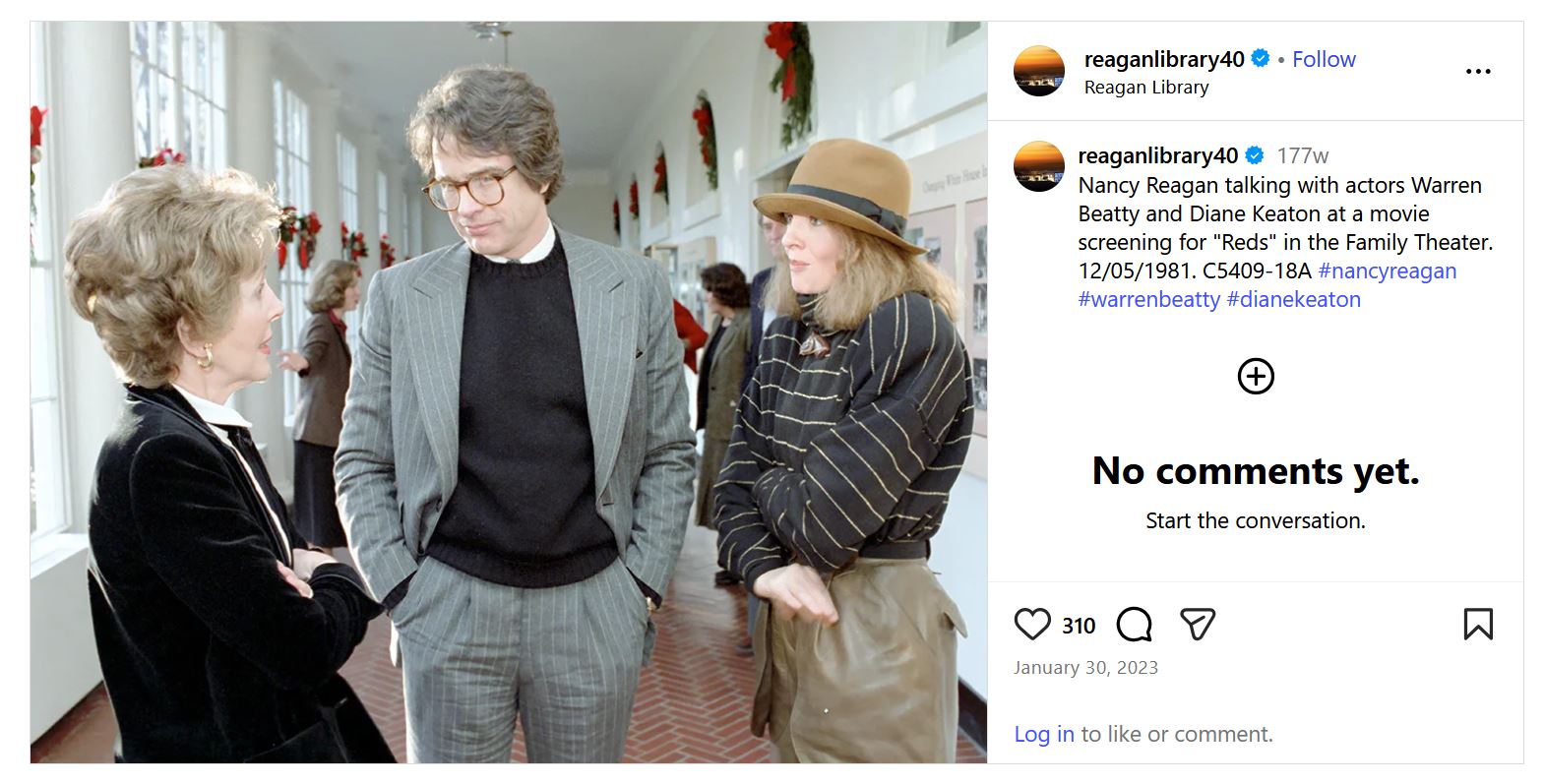
The latter is clearly what happened on Dec. 5, 1981, when the Reagans welcomed Warren Beatty and Diane Keaton to the White House for a showing of Beatty’s new film, “Reds.”
That should seem like a curious gathering. Reagan and Beatty, both Californians, were respectively probably the most prominent conservative movie star and most prominent liberal movie star during the 1970s. Enhancing his credentials, Beatty campaigned even for George McGovern in 1972.
Whatever Reagan’s and Beatty’s political differences, they evidently agreed on the power of film.
Reagan’s first year in the White House was 1981, the same year as Beatty’s biggest project. It wasn’t the mostly nonpolitical “Heaven Can Wait,” Beatty’s massive crowd-pleaser of 1978. It was “Reds,” a 3-hour, 15-minute epic celebrating an early socialism figure in America (John Reed) who idealized the Soviet revolution.
The idea of any U.S. president of either party during the Cold War, especially a staunch anti-communist, holding a screening for this type of film seems jaw-dropping. Yet there are photos and news accounts: On Saturday, Dec. 5, 1981, the Reagans hosted a screening of “Reds,” attended by Warren Beatty and Diane Keaton as well as Cary Grant and Douglas Fairbanks Jr. and Audrey Meadows, about 30 guests total.
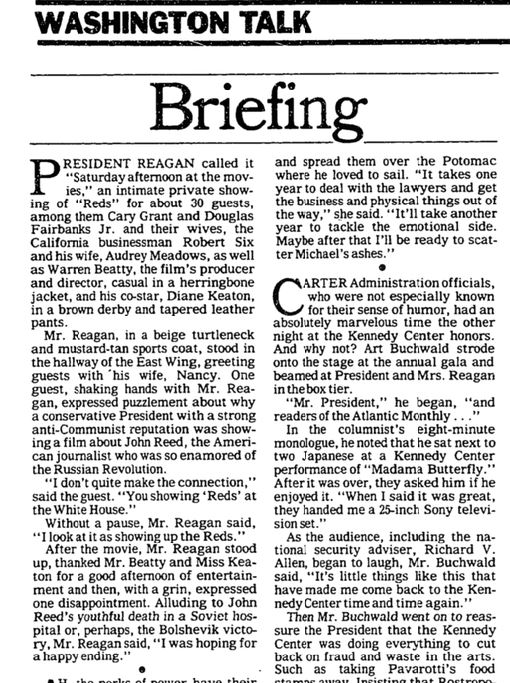
The New York Times account of this event notes the apparent political oddity. It says one guest “expressed puzzlement about why a conservative president with a strong anti-communist reputation was showing a film about John Reed.” Reagan responded, “I look at it as showing up the Reds.”
Beatty is a massive mainstream star, and critics and audiences took the subject matter in stride. Evidently, too much in stride. The film did, apparently, make money, but not a ton. Its production values are impressive. It received 12 Oscar nominations and won 3.
But it’s long, and a little boring. Gene Siskel gave it 2½ stars. Pauline Kael calls it “a rather sad movie, because it isn’t really very good.” Kael, who not long before this movie had taken, then quickly abandoned, an offer from Beatty to be a consultant for Paramount, suggests that Beatty had envisioned this project for so long, he “lost the clarity needed to dramatize it.” She calls it “tenative, full of doubts and second thoughts.” While praising much of Beatty’s effort, Kael nevertheless deems it, in terms of technique, “the least radical, the least innovative epic you can imagine.”
Roger Ebert writes that John Reed “is the only American buried within the Kremlin walls.” Kael bluntly says “he isn’t.” Kael notes the real-life people who knew Reed and speak about him, but, “Regrettably, in the movie they’re all robbed of identity — probably out of fear that names at the bottom of the screen might suggest a TV news show.)”
According to the Reagan library’s list, the first couple watched generally the award contenders and mainstream hits of the 1980s, but also a lot of older films, including some featuring Ronald Reagan. There are arthouse classics like “Vertigo,” “The Maltese Falcon” (unclear which version) and Beatty’s own “Splendor in the Grass.” The Reagans in 1983-84 evidently watched “Yentl,” “Funny Girl,” “Funny Lady” and “The Way We Were,” and also “A Star is Born,” though unclear whether it is the Streisand version.
The Reagans in 1983 apparently also watched “Frances,” the controversial (if not a little ludicrous) biopic of onetime starlet Frances Farmer who once won a trip to the Soviet Union and was purportedly punished in part over her politics.
Not only does the Reagan library list lack sourcing, it clearly has one key date wrong — it lists the date of the “Reds” screening as Dec. 8, 1981. That was a Tuesday, and it’s the day the New York Times account appeared in print, referencing the event happening on Saturday (Dec. 5). The list also does not mention the shocking TV film “The Day After,” which Ronald Reagan was said to have seen in October 1983, a month before it aired on ABC. The White House movie theater was famously installed by Franklin Delano Roosevelt in the 1940s, but special events there are kind of rare (such as George W. Bush hosting Sen. Ted Kennedy for “Thirteen Days”), and most of the Reagans’ movie-watching was taking place at Camp David. The Reagan library list is probably not an authoritative detail of the president’s schedule but still a curious snapshot of 1980s pop culture, when there was no internet, no streaming, and not a whole lot in the way of cable TV.
Ronald Reagan made about 51 feature films, according to the Internet Movie Database, and also did a lot of short films and television work. Nancy Reagan had about 11 feature-film credits, according to the Internet Movie Database, all as Nancy Davis. His most famous role is playing Notre Dame football legend George Gipp, whose cinematic legend has been upended in recent decades by Sean Astin’s “Rudy.” Times changed, but not the Reagans’ appreciation for Hollywood.
(June 2026)