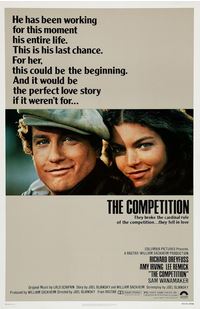

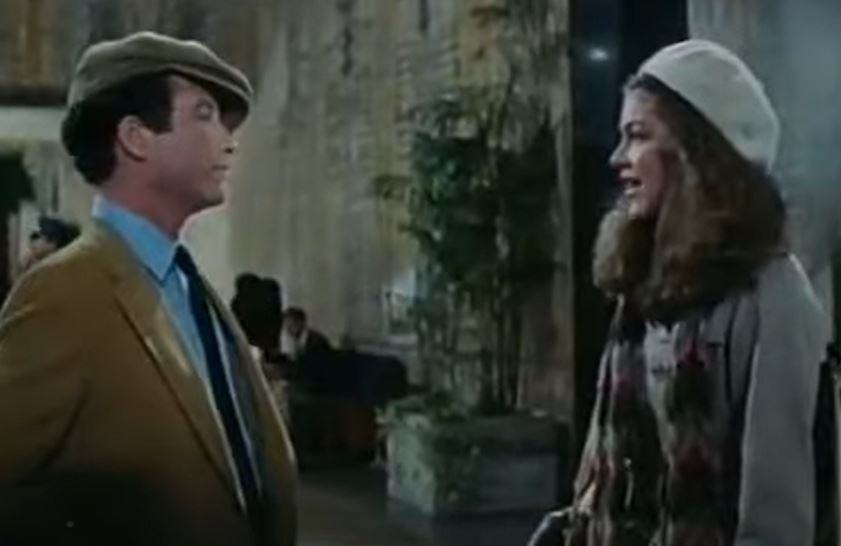
In ‘The Competition,’ Amy Irving makes Richard Dreyfuss a better man — but does she make him a better actor?
The world of classical music is not a mature, gray-haired, genial scene — it’s a scheming, cutthroat world dominated by young whippersnappers who consider serious ethical infractions not demerits, but steppingstones.
That’s not only the message of Joel Oliansky’s 1980 “The Competition,” but also of Todd Field’s “Tar” decades later. According to these movies, chicanery is the norm in this industry, an implication that the difference between contenders for contests and prestigious jobs is so slight that getting ahead comes down to who can manipulate the most artificial factors.
“The Competition” stars Richard Dreyfuss and Amy Irving, and to its credit, the plot does not involve someone having to sleep with a decision-maker in order to win.
In fact, the judging in “The Competition” is remarkably straight. Contestants may have to wage psychological battles with themselves and each other (mostly with themselves, generally over the question “Why am I doing this, again?”), but the verdicts are considered pure and bribery-free. That is one breath of fresh air in a movie that should make any aspiring maestros realize that “this isn’t worth it.”
There is also a nice nod to the value of coaching, which only one character seems to get.
The ’80s weren’t nearly as kind to Richard Dreyfuss as the ’70s were.
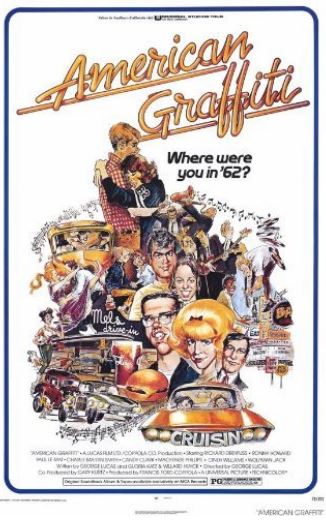
In four years, he achieved about as much success as a film actor can have — he starred in two of the most popular and highly regarded films ever made, “American Graffiti” and “Jaws,” he starred in a sci-fi classic, “Close Encounters of the Third Kind,” and he even won an Oscar for Best Actor for a rom-com, “The Goodbye Girl.”
Very hard to beat.
But immediately after that, the story changes.
Dreyfuss’ movies suddenly fell out of favor, and he had personal problems (perhaps not necessarily in that order), and one of the most memorable film actors ever somehow fell permanently off the A list.
He continued making movies and is still highly productive to this day. And if you haven’t yet seen his 1995 “Mr. Holland’s Opus,” you’re in for a treat.
Whether “The Competition” for Dreyfuss was the end of the beginning, or beginning of the end, is a tough call. It pales to those other four films. But it’s not a bust. It is, as Roger Ebert basically put it on his TV show, a likable film despite some significant faults.
Dreyfuss was by no means a natural for this role. The AFI description of the film says Dreyfuss was a “novice” with no piano-playing experience who has small hands and “struggled with coordination.” He is, however, an elite actor, and he figured it out enough, with tutelage of Jean Evensen Shaw, to pass muster. The music you hear, as you may have guessed, is not actually being played by Dreyfuss and Irving, but they mastered a silent keyboard in which the movements of their hands would synch up with the real thing.
Curiously, “The Competition” practically riffs on the dilemma of Dreyfuss’ character, Curt, in “American Graffiti” — he’s bright enough to earn a ticket out of this “turkey town” to college but not sure he’s competitive enough to leave. But where “Graffiti” and “The Goodbye Girl” gave Dreyfuss ample opportunities to crack hilarious one-liners, “The Competition” immediately paints him into a corner as a hopelessly grousing worrywart, 29 going on 59, even though he’s really never grown up, that’s why he’s living with his parents and has no friends and is still driven by Pop’s insistence that his son has talent like no one else.
The beginning of “The Competition” tells us so much as to virtually negate the rest of the movie. Paul gets third place in a Cleveland pianist event, which says several important things: He’s not a superstar, he’s not going anywhere, he has no idea what to do with his life. Yes, it presents opportunity — if this person can maybe find some personal spark, perhaps it will elevate his performance to a new level.
The movie has a big problem with backstory. When someone’s not playing the piano, they are likely having one of the numerous résumé-filler conversations for the benefit of the audience (the worst being the two times that Amy Irving has to recall for viewers how she and Paul first met) though it’s never explained why it’s grownup journeymen at these contests and not 15-year-olds already accepted into Juilliard.
Nor is the endgame here ever clear. Are the contestants trying to win international prestige? Large cash prizes? Orchestra jobs? It seems like a combination of the above. Most musicians at this level of skill are probably employed by an orchestra and/or teaching, which is offered in this film as an unappealing grind that involves a “certain amount of substitute” assignments.
Regardless of the occupation of the protagonists, “The Competition” is a standard love story that has to work on a romance level, and it really doesn’t. We get the hint early that Paul and Heidi are supposed to be destined for each other, but we don’t know why, there’s no “meet cute.” Why does she like him? Neither one appears to be changing the other’s life, though it does seem they might make a good team, relying on each other’s criticisms rather than those of their parents and teachers.
For a brief period of time, Amy Irving was white-hot. Her most significant role was Significant Other to Steven Spielberg (for a while). She debuted in “Carrie” and appeared in “The Fury” and then Willie Nelson’s “Honeysuckle Rose,” another movie in which she plays a musician who is at first an afterthought than the object of desire of a jaded older musician. After a few years off, she would earn an Oscar nomination for “Yentl” (losing to Linda Hunt in “The Year of Living Dangerously”).
Her hair is among the most beautiful in film, and she has an impressive list of credits that includes “Traffic” and “Crossing Delancey.” The latter, like “The Competition,” is an indication of how she is perhaps perceived: educated, articulate, soft-spoken, shy, modest, down to earth. “The Competition” was probably something of a homecoming; Irving attended the American Conservatory Theater while growing up in San Francisco. She’s just not particularly funny. That’s fine for the awkward events in “Honeysuckle Rose.” It’s a problem for the comedy needs of “The Competition.”
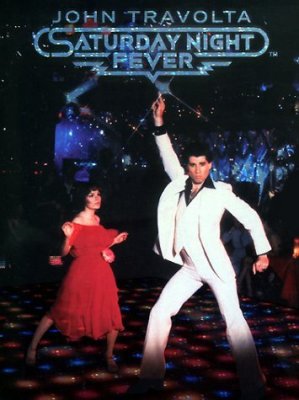
To supply the laughs, Oliansky turns to the supporting characters of Lee Remick’s Greta Vandemann and Joseph Cali’s Jerry DiSalvo, and both deliver in spades. Cali relishes the script’s in-jokes to “Saturday Night Fever” — he makes one reference to “Travolta,” then takes to the dance floor like it’s 2001. He refers to himself and the rest of the contestants as the “12 Apostles” and makes up a checkered past about himself to create a “hook” and a “handle” and generate a newspaper story. He also uses the three-letter “f” word, which he probably also said at some point in “Saturday Night Fever.”
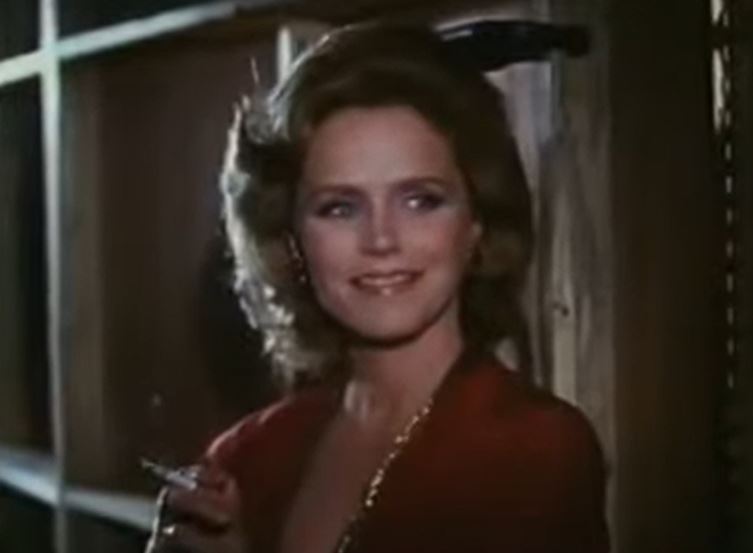
Remick is the barracuda and celebrated former champion who smokes and wouldn’t hesitate to break off a romance for the sake of winning a recital. She will at one point dismiss Paul with a great one-liner: “And it always ends the same way — he feels misunderstood.” Apparently well-traveled in this sphere and too familiar with how it works, she scoffs at rules and ethics, boasting that her pupil’s entree to the competition stems from a tape that “I recorded and put your name on,” which she says is done “all the time.”
The caveat, and the reason we can’t despise her, is that she pronounces Heidi qualified for the competition, and we trust her word on that particular assessment, so while someone else may have been cheated out of a spot in this event by a rigged tape, it’s not like the beneficiary didn’t deserve it.
Other characters illustrate the appealing international diversity of the classical music scene. There are echoes of the movie “Fame.” Some are hams. Others are bookworms. These prodigies probably tend to be from upper middle class or upper class homes, but they legitimately come from anywhere. And any could rightly win. It comes down to a matter of style, and luck. Ty Henderson’s Michael Humphries gets a few great scenes, but Oliansky wasted some potential here with a needless red herring about a Soviet girl.
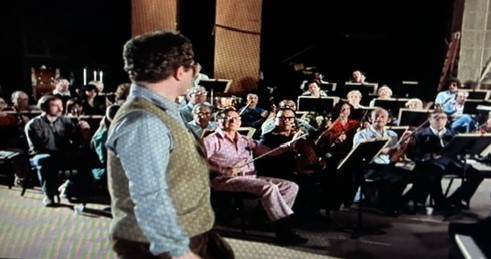
Another supporting character, Sam Wanamaker, thrives as the free-spirited but fair conductor who must have a giant ego but isn’t ruled by it. In the movie’s best scene, he receives Paul’s criticism of his orchestra’s treatment of Beethoven with humor, asking Paul if he “spent a lot of time” with Beethoven and whether Beethoven may have been an “old friend of the family.” He invites Paul to take the baton and lead the orchestra in the way he wants it, and the orchestra responds and provides Paul an entertaining round of applause by clacking their instruments.
Pauline Kael, who was fairly but not totally dismissive of “The Competition,” says Wanamaker “shows up Amy Irving and Richard Dreyfuss,” who come across as “a pair of counterfeit lovers.” Irving, Kael says, has “a bad case of the tremblies,” and “Dreyfuss is limply self-conscious.” Kael complains Remick “comes out sounding incomprehensibly weird.”
Paul is from Chicago, but the movie decides that San Francisco wins; he spends nearly all of his time there, and we get the hills, the Golden Gate Bridge, even a gratuitous and obviously product-placement depiction of a United Airlines flight. This is the big time of this universe, a far cry from Chicago’s classrooms. (Why attending this competition for one week should cost him a teaching job isn’t made clear.)
Music wins in feature films. Hollywood underrates this. “The Competition” is about music, and Oliansky enlists the venerable Lalo Schifrin, a six-time Oscar nominee who eventually received an honorary award and is best known as the creator of the “Mission: Impossible” tune. The movie has plenty of great music — even some disco tunes in a spectacular ending with closing credits — but classical is kind of a cinematic hard sell, only because movie plots typically require jingles, not compositions. “The Competition” did receive an Oscar nomination for Original Song, “People Alone,” by Schifrin and Will Jennings. It lost to “Fame” and the song “Fame.” The only other Oscar nomination for “The Competition” is an intriguing one, for David E. Blewitt and Best Film Editing. He lost to Thelma Schoonmaker of “Raging Bull.” That category tends to be reserved for the most celebrated films, unless there are hooks like flashbacks or reverse-time sequences. Perhaps what caught voters’ eye in “The Competition” is the depiction of the actors’ hands on the keyboard. Kael says the keyboard camerawork is perhaps too tight, that “we begin to fear for the musician and to expect some horrible, disqualifying booboo.”
Roger Ebert on his TV show calls the movie a “cornball romance” with a “ridiculous subplot,” referring to the Soviet defection, but nevertheless, “I felt a real affection toward this film after all.” He concludes, “You get caught up in the romance and you forgive the faults.”
Not totally.
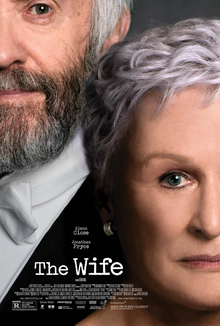
“The Competition” is drawn up by a man, which is probably why it tiptoes with jokes around the significant drama it is portraying that is anything but “cornball” — whether a woman has to fear that outperforming a man will cause her to lose him. Oliansky would’ve been well-served to provide that same drama to Richard Dreyfuss. Instead he has paired a superstar, (at the time) the youngest-ever winner of the Best Actor Oscar, with an actress who had been in a couple films. Many potential couples are in the same profession. There’s a very cynical take on this subject in the recent Glenn Close film “The Wife.” Oliansky’s interpretation will end on a happy note.
3 stars
(July 2026)
“The Competition” (1980)
Cast:
Richard Dreyfuss as
Paul Dietrich ♦
Amy Irving as
Heidi Joan Schoonover ♦
Lee Remick as
Greta Vandemann ♦
Sam Wanamaker as
Andrew Erskine ♦
Joseph Cali as
Jerry DiSalvo ♦
Ty Henderson as
Michael Humphries ♦
Vicki Kriegler as
Tatjana Baronova ♦
Adam Stern as
Mark Landau ♦
Philip Sterling as
Mr. Dietrich ♦
Gloria Stroock as
Mrs. Dietrich ♦
Bea Silvern as
Madame Gorshev ♦
James Sikking as
Brudenell ♦
Delia Salvi as
Mrs. DiSalvo ♦
Jimmy Sturtevant as
Vinnie DiSalvo ♦
Kathy Talbot as
Denise DiSalvo ♦
Elaine Welton Hill as
Mitzi ♦
Stephen Corvin as
KGB Agent ♦
Jan Ivan Dorin as
KGB Agent ♦
Priscilla Pointer as
Mrs. Donellan ♦
Rachel Bard as
Judge Andruss ♦
Laurie Main as
Judge Wyeth ♦
Corinne Kason as
Judge Rankin ♦
Ronald Hoiseck as
Judge Pyck ♦
Ross Evans as
Judge Heimling ♦
Allan Gruener as
Judge Douzenko ♦
John Clavin as
Judge Weatherall ♦
Bill Conklin as
Fellow Passenger ♦
Lynn Arden as
Consulate Receptionist ♦
Koki Iwamoto as
Watanabe ♦
Kurt Stefl as
Theobald ♦
Robert Vega as
Contreras ♦
John Mezz as
Steinmetz ♦
Sam Ratcliffe as
Delisle ♦
Rhio Blair as
Karnow ♦
Rex Benson as
Brownell ♦
Jack Denbo as
Master of Ceremonies ♦
Howard Osias as
Gary ♦
François Gondoin as
French Sailor ♦
Jean-Claude Personnat as
French Sailor ♦
Alain Rocaboy as
French Sailor ♦
Ben Hammer as
Nichols ♦
Sterling Swanson as
Rudko ♦
Fielding Greaves as
Doctor ♦
Eric Barnes as
Consulate Aide ♦
Mark Anger as
Consulate Aide ♦
Nick Outin as
Consulate Aide ♦
Joe Bellan as
Consulate Servant ♦
Carl Arena as
Capitano ♦
Marti Cate as
Columbine ♦
Robert Dawson as
Recorder Player ♦
Anne Hodgkinson as
Recorder Player ♦
Peter Hallifax as
Lute Player ♦
Andrew Letchworth as
Punchinello ♦
Jeanne Lauren as
Cymbal/Drummer ♦
Patrick Martin as
Harlequin ♦
Richard Dupell as
Sign Carrier ♦
Leslie Allen as
Desk Clerk ♦
Ann Cooper as
Reporter 1
Directed by: Joel Oliansky
Written by: Joel Oliansky
Written by: William Sackheim
Producer: William Sackheim
Executive producer: Howard Pine
Music/composer: Lalo Schifrin
Cinematography: Richard H. Kline
Editor: David Blewitt
Casting: Jennifer Shull
Production design: Dale Hennesy
Set decoration: James Payne
Costume design: Ruth Myers
Makeup and hair: Leonard Drake, Carolyn Ferguson, Jack Freeman, Leo Lotito
Unit production manager: Howard Pine