For two guys barely eating in a restaurant, ‘My Dinner with Andre’ has a lot on its plate
There’s something about the Laurel & Hardy thing. People of opposite shapes debating things in amusing ways. Siskel & Ebert. Skipper & Gilligan. Belushi & Aykroyd. R2 & 3PO.
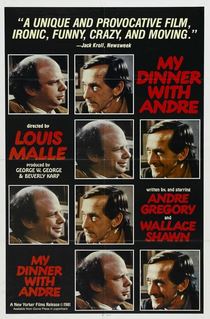
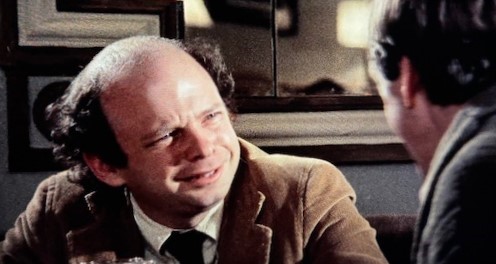
Wallace Shawn and Andre Gregory aren’t the most prominent duo to come to mind. They pull it off, though, in Louis Malle’s “My Dinner with Andre,” one of the most controversial films ever made.
Its critical clout runs deep. Roger Ebert ranked it his No. 1 film of 1981. On his Great Movies portal in 1999, Ebert calls it “entirely devoid of clichés. ... wonderfully odd ... unwatchable ... enchanted ...”
Pauline Kael, in a positive review, calls it “surprisingly entertaining” and credits Gregory for an “amazing performance.” Vincent Canby calls it “very funny, extremely special.”
Ebert’s TV partner, Gene Siskel, ranked it No. 2 (behind “Ragtime”). Siskel was so impressed, he said on their TV show that recommending “My Dinner with Andre” is when critics “stand for something.”
But not everyone can stand it. Today, you can go to Reddit and see comments such as “most boring movie of all time.” Those comments are fair too. “Andre” is a film invention, but its format is what anyone would call a stage production, put together by theater veterans and not really the material of a feature film. In fact, there is so much of an introductory speech to maybe think it all should just be a book. As a film, on important levels, it works — and you wonder why somebody doesn’t try this approach more often.
“My Dinner with Andre” is a bitch session, New Age style. The mid-30s protagonist explains that he has forsaken a comfortable, happy, (presumably) corporate/executive life (his real-life father was the New Yorker editor William Shawn, who famously hired Pauline Kael) to take a crack at the arts, and for that, he continues to pay the price. He set out to create things and entertain people, but his life is one of rejection.
For the next couple of hours, he will be hearing what it’s actually like to succeed, from his first mentor who “discovered” him who recently has, some fear, become unhinged.
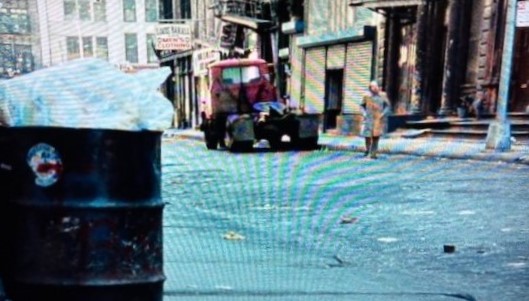
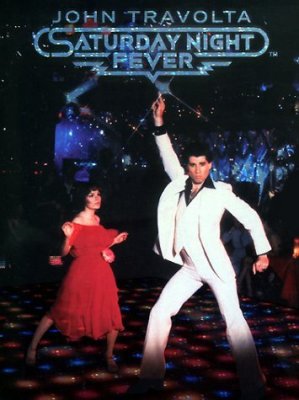
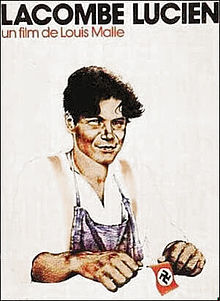
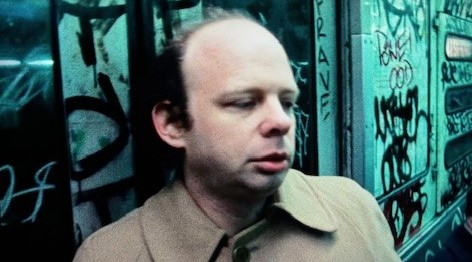
Malle, who at this time was in the middle of a decade-and-a-half scorching hot streak that would include “Lacombe, Lucien,” “Atlantic City” and “Au revoir les enfants,” makes the very most of his limited visuals, starting with Wally’s public transit trip to Café des Artistes in Manhattan. Wally emerges on a street with overflowing trash cans. The train is sickeningly full of graffiti. There is something about his walk to the train that paints a contrast with the opening of “Saturday Night Fever.” This is not a young man eating pizza and buying shirts and flirting with pretty girls and dreaming about the weekend. This is a beaten, nearing middle-age man, irritated that he had to wake up by 10 a.m. on this day and take time out of his busy schedule for a fine dinner.
But why Wally is making this journey can’t really be shown, so the narration piles it on deep. “Andre” will give itself a semi-common problem — characters trying to tell us way too many details about another character whom the audience hasn’t even seen yet, forcing an early overload of mental homework. Concerns about Andre are relayed by Shawn comically. One would think Wally would be concerned about a onetime mentor who used to be a very close friend and look forward to a meal and catching up and, if nothing else, maybe picking up a few leads on script-takers. Instead Andre is someone Wally has been “avoiding literally for years.” In a major lapse, Shawn never makes the sale for why he is supposedly dreading this dinner so much.
Shawn admits in a 2009 Criterion Collection interview with Noah Baumbach that as the project began to take shape, he found it “at first discouraging” because he “saw no pattern or a story in there.” Gregory though in his own separate interview with Baumbach said that one reason he was optimistic was because among other things, he correctly thought the “difference between our voices” could be “very comedic.”
While those bored by the film will rightly note that it’s basically two hours of conversation, it is also a pretty simple and valid structure. Wally starts off the movie complaining about everything, then at the end is reveling in the smallest things of everyday life. He’ll take the train in, and a cab out. His job is not to convince Andre that Andre maybe needs to see a shrink; his job is to realize his own life isn’t so bad. “The life of a playwright is tough,” Wally assures us, but after hearing from Andre, he gains a new respect for what he’s got. He will not, in the duration of this film, gain any ground professionally or romantically (which is a curious omission; girlfriend Debbie, mentioned a few times, is his real life partner to this day). But he is heartened that, unlike Andre, he’s not old enough for a mid-life crisis. He’s not thinking about the coffins, but the coffee.
One of the innovative elements of “Andre” is that the actors are playing themselves and including real life details (their significant others, for example), but the characters are still fictional. It raises a tremendous question: Is “My Dinner with Andre” actually a “documentary” ... or could it/should it be?
“I can’t watch the movie,” Shawn admits in the Baumbach interview, because it’s “a little bit too heartbreaking.” Apparently, the enlightenment of his character troubles him because it’s not what he gets from everyday life. He says, “I didn’t know I was revealing” a “warmer view of life than I have.” Shawn says Malle, who died in 1995, was “ill at ease” in regular life but had a warmth as a filmmaker.
Malle was interviewed by Shawn for a 1984 BBC program intended to mimic the movie conversation that Shawn has with Gregory. Malle explains that “I was pretending that fiction was documentary.” Gregory, in his own 2009 interview with Baumbach for the Criterion Collection (it was conducted separately from Shawn’s interview; it would’ve been interesting if there were significant disagreements between the actors, but there are none), says the concept came about because “I had a real need to tell my story,” which he says is a “profile of a failure.” In a 1981 essay about the movie included in the 2009 DVD issue, Gregory writes that he originally suggested he and Shawn write a musical, Shawn declined, then Shawn called back a year later and suggested what became the movie. Shawn and Gregory recount originally meeting through Renata Adler. Gregory (whose “Andre” generally is shown including an accent mark on the “e” but not in the film’s official wording) admits to Baumbach, “I’m playing a character based on me.”
So the movie, at least for Gregory, is personal. As for “documentary,” no one has custody of that term. But let’s go to AMPAS, which hands out the statues. According to an apparent list of Oscar voting rules for 1982 posted on a website, “Documentary films are defined as those dealing creatively with cultural, artistic, historical, social, scientific, economic or other significant subjects, photographed in actual occurrence or re-enacted, produced in animation, stop-motion or any other technique, and wherein the emphasis is on factual content and not on fiction. The purely technical instructional film will not be considered.”
Current rules on the AMPAS site are very similar but stress “nonfiction” and include a key additional word, “partial”: “An eligible documentary film is defined as a theatrically released nonfiction motion picture ... It may be photographed in actual occurrence, or may employ partial reenactment, stock footage, stills, animation, stop-motion or other techniques, as long as the emphasis is on fact and not on fiction.”
Both descriptions leave a lot of gray area. “Nonfiction” ... what an explosive word. “The Godfather” is clearly “fiction,” but what about “Titanic”?
One argument against “Andre” as a “documentary” is that it’s not “partial,” but complete, reenactment, though maybe it didn’t necessarily have to be. Gregory tells Baumbach that Gregory and Shawn rented a room at New York University for “about 6 months,” during which Andre told his stories into a tape recorder. Eventually, the material they had was “1,500 pages long.” Ebert writes about Gregory and Shawn recalling later that “as the two old friends talked, they began to see how their conversation might be shaped into a play–or perhaps a film.”
The strongest argument though against “documentary” is that most in Hollywood would probably say that a film with that label will not be seen by anyone.
While the script originates from Gregory’s personal travels, artistic license is available and surely used. No question, some of the greatest acting Shawn has ever done is appearing interested during Andre’s retelling of his experience in Poland.
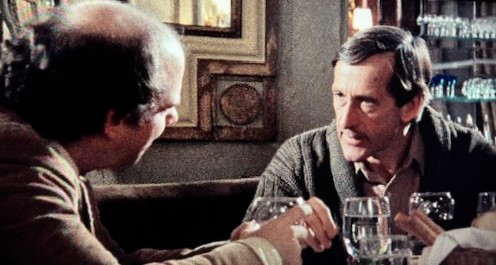
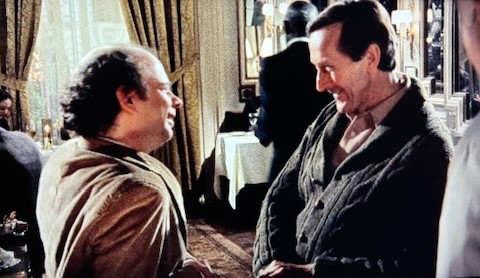
Disappointingly, “My Dinner with Andre” punts on a very intriguing pop culture topic that should be right in its wheelhouse: When two people dine in a restaurant at a traditional table, should they sit across from each other, or side by side? This often becomes an awkward and instantaneous decision before the meal has even begun. For many, sitting across makes it difficult to hear. And for many, sitting next to each other is a little too intimate. Malle positions his actors in a semicircle booth that avoids this quandary and any snap judgments. You have to admit — seating Andre and Wallace at a square table, either way, just doesn’t work.
Notice that, at the restaurant, virtually all the other patrons are in suits. Are these all business-related dinners? Those people, not the stars, are probably the ones looking out of place. Shawn arrives wearing a jacket and feels compelled to add a pre-tied tie outside the entrance. Andre stands out wearing a cardigan sweater, no tie. They are not questioned about their attire. They are underdressed, but not to the point they’d be thrown out. Café appreciates artisans.
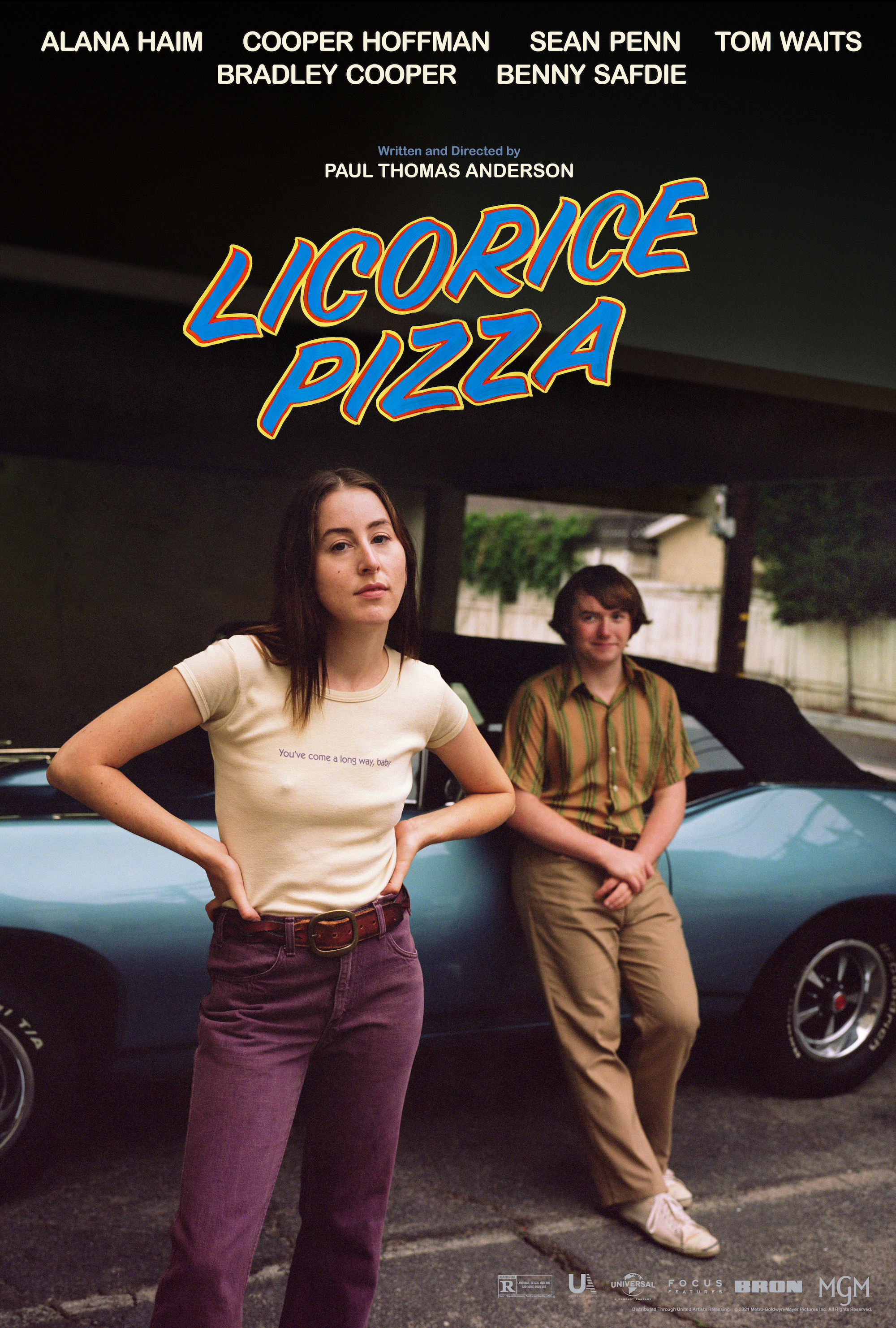
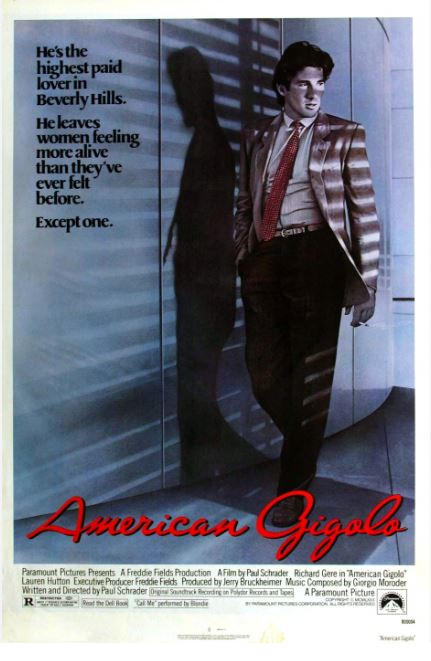
In almost any movie with a dinner table scene, the meal is going to last, at most, about 10 minutes, and only that long if characters at the table have a romantic interest (any number of examples, be it “American Gigolo” or “Licorice Pizza”). In “Andre,” though there is a brief discussion about the menu at Café des Artistes, the food will be completely secondary, and there is obvious artistic license in that neither character is actually shown eating as much as they should be. Gregory says that he and Shawn tried some rehearsals at an actual restaurant, and Malle concluded, “Eating will never work.” They made it work by mostly ignoring it. We all know that waitstaff can be unpredictable — sometimes, they’re at your table every two minutes; other times, you sit there for an hour without anyone coming by. “Andre” impressively does not employ the crutch of the waiter dropping in numerous times to shake off the monotony.
Mirrors, and gestures, do help prevent monotony. Andre is a lanky figure who has a way of pointing that gives his stories a cadence. His remarks may sound like something from Woody Allen, except Andre includes no wit or humor; it is straightforward storytelling. He credits Malle for demanding he “speak faster” in a way that works for film as opposed to stage. Yes, we’re being fooled — nothing Andre is saying is relevant — but he is constantly raising the bar on his New Age excitement. Like Lucy with the football, we keep thinking he is about to share an important revelation that will make this dinner worthwhile.
Andre’s travels, though in different lands, sound like what the Beatles were doing with the Maharishi. Was Andre on drugs during these far-out experiences? He mentions hallucinations and reveals, “I was a on trip.” He does not appear to be under the influence of anything at Café des Artistes and recalls details of his travels with precision. The implication is that Andre indulged in some artistic mind-bending of some sort but isn’t hooked on anything except a mid-life crisis.
The waiter and bartender are both white-haired, almost like characters out of “Last Year at Marienbad.” Their depiction tells you something about the restaurant. It’s not a place that hires flashy young struggling actors; it’s old-school. Though the Café des Artistes was a real place, the building used for at least some scenes in the film was the Jefferson Hotel in Richmond, Va. Gregory tells Baumbach that the Jefferson was owned by a relative of someone who worked on Malle’s “Atlantic City,” and that the heat was off during their filming there, and the actors were freezing. Ebert writes that the conversation was filmed “over a period of weeks” in a “studio.” He says the movie is “only precariously anchored to that restaurant.”
Several topics in “Andre” are recurring. The most common is a concern about not getting the same satisfaction from life in general that we’re getting from work. This is first noted in Wallace’s intro in which he tells of hearing that Andre was moved by a line in Bergman’s “Autumn Sonata.” Andre is not the first movie character, nor human being in general, to realize this. “I haven’t been living; I’ve been acting,” he decides, a quote heavy in subtext. He says he thinks of himself more as a “performer” and less of a “human being.” There is one thing that corrects that notion — the struggle for food and shelter. In a much-commented-upon discussion of electric blankets, Andre admits as much, stating, “Comfort can lull you into a dangerous tranquility.” Andre has done well enough that he can go off the grid for years and travel Europe. Wallace is having trouble paying bills and probably can’t imagine a carefree vacation.
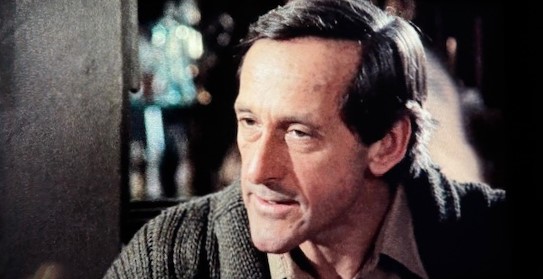
It may seem like the film’s signature line comes in the 69th minute, when Andre declares, “We’re all bored now.” But it’s really in the 89th minute, when Wally reveals, “I don’t really know what you’re talking about.” We should all be so lucky.
Andre not only harbors concerns about himself but projects them onto others. He suggests that the closer you get to a person, the more they're a “ghost,” and in the final minutes, he will discuss being “frightened” by other human beings. Andre states that having an affair makes people feel on “firm ground.” But the two notably leave their domestic situations, which appear to be happy ones, mostly out of the dialogue.
Another thread in Andre’s commentary is a fear of aging, also prominent in the work of Quentin Tarantino. Gregory was born in 1934, Shawn in 1943, and their age difference will certainly affect their viewpoints. “I feel I’ve just squandered my life,” Andre admits about halfway through the film. For a 25-year-old who regrets a decision, there’s plenty of runway to get it right. For someone in their late 40s, it’s not as easy to change.
Like many people in the (statistically likely) latter halves of their lives, Andre thinks the best days — for everyone — have come and gone. “See I think it’s quite possible that the 1960s represented the last burst of the human being before he was extinguished. And that this is the beginning of the rest of the future now,” he confides to Wally. He and Wally will address the state of the theater world and imply a recent dropoff, but “Is the theater really dead” was a Simon & Garfunkel line of the ’60s.
Crime and politics are often regarded by people, at any given time in history, as only a recent menace. Andre claims, “I’ve just been finding the world we’re living in more and more upsetting.” Wallace does not make a counterargument to this observation — after all, to each their own — except to point out the pleasure he gets from things such as reading Charlton Heston’s autobiography or having cold coffee available. Unlike Andre, quite simply, Wally has things to do: “I think that, uh, purposefulness is part of our ineradicable basic human structure.”
The mention of Heston’s “autobiography” is curious. According to internet searches, Heston’s “autobiography” was published in 1995, called “In the Arena.” If Shawn is referring to a real work of the time, he probably means The Actors Life: Journals 1956-1976, a collection of diary entries by Heston published in 1978.
Of course, Andre is troubled by the prospect of death. He sees it as something that happens alone, no matter how many people may be in the room. There are repeated references to the Holocaust, a regular subject for a movie of this type, certainly in 1981 and even today. That is also a common subject for Malle. One of the pop culture references is to Chappaquiddick (though not actually the word “Chappaquiddick”), which would be dated now but was not, as a cultural fascination, dated in 1981 nor for a long time after.
The Andre of the movie, Gregory tells Baumbach, is probably “lonely, uh, right on the edge of going somewhat nuts, feels that he’s a complete failure” with a “need to unburden himself.” By contrast, Gregory reveals, “Wally is hiding behind silence. And I’m hiding behind words.” Wally is able to “start revealing,” while Andre can finally “listen.”
“My Dinner with Andre” is a Merlot Movie. Malle sells it this way, and the anticipation of some kind of breakthrough will keep it going, even though, as Vincent Canby writes, “It might be better if it were a conversation heard at the next table, one on which one could tune in and out at will.” While it gives its two characters as much of a platform for this kind of conversation as could ever happen in a feature film, viewers who might be a little anxious will be frustrated. (Hopefully they will enjoy the mesmerizing closing notes of “Gymnopédie No. 1.”)
Pauline Kael suggests it’s “a mad tea party, or a mad, modern Platonic dialogue about the meaning of life” in which Shawn and Gregory depict “comic distillations of aspects of themselves,” Shawn being the “earthly clown to Andre’s fool of God.” Ebert writes that at an event a year after the film’s New York release, Shawn and Gregory said one thing they might change is to switch roles, “so that no one would think we were playing ourselves.”
Shawn’s statements in the movie are explained by reviewers as the scientific method. But you don’t need a philosophy degree to understand what’s happening here. Gregory’s experiences sound like what Method actors do, but to improve their work, not their lives. Ebert writes that “it is a conversation, in which the real subject is the tone, the mood, the energy.” Though the two films have little else in common, “My Dinner with Andre” and “The Goodbye Girl” both feature New York thespians complaining about their careers and their lives and somehow thriving on it, an appealing us-against-the-world mindset.
Gregory, blessed with the impossible Cary Grant-like hairline, has appeared in other films you’ve heard of (one of them being “The Bonfire of the Vanities”). He founded the Manhattan Project theater company, a clever name mentioned in “Andre.” Shawn has appeared in “Manhattan,” “Atlantic City” and “The Princess Bride,” but he is a national treasure of television, massively prolific to this day. No doubt, after “Andre” and possibly to this day, people with the extraordinarily good fortune to have a meal with Shawn have told him, “Tonight, it’s ‘My Dinner with (insert name)’!” (And then perhaps proceeded to tell Shawn about all of their thoughts and concerns.)
Siskel writes that “My Dinner with Andre” was produced unusually, with small investors buying $500 shares. (Curiously, financing and gross are never discussed in the actors’ 2009 interviews with Baumbach.) Obviously, a film this spare is made cheaply. The Wiki page says it cost $475,000. That price tag is a success. Had theater bigwigs gotten ahold of it, we wouldn’t be thinking about it today. It apparently grossed over $5 million, which according to basic math sounds like a healthy profit, but grosses that small are not making anyone rich. It was out in New York in October of 1981 but wasn’t reviewed by Siskel and Ebert in Chicago until December. Kael’s review is dated January 1982, as was Gary Arnold’s in the Washington Post. The Oscars gave it no attention.
The script lets slip what actors don’t want to admit — they’re obsessed with reviews. Critics are mentioned a few times in the movie. Andre and Wally are in the business of entertaining, and it’s a high enough form of entertainment that instant product reviews — even decades or a century before the internet — are inescapable. “My Dinner with Andre” is a reminder to all of those providing Reader Comments, or online essays, that words matter. Reviewing art is far less personal than, say, reviewing on Yelp how the doctor/lawyer/restaurant treated you. And most reviews may be far less consequential than word of mouth as to whether people go see a production. Yet they pack a Sunday punch. Andre may be a windbag. Wally may be a curmudgeon. They still care what you think.
3.5 stars
(September 2025)
“My Dinner with Andre” (1981)
Starring
Andre Gregory as
Andre Gregory ♦
Wallace Shawn as
Wallace Shawn ♦
Jean Lenauer as
Waiter ♦
Roy Butler as
Bartender
Directed by: Louis Malle
Written by: Wallace Shawn
Written by: Andre Gregory
Producer: George W. George
Producer: Beverly Karp
Associate producer: Dave Franke
Associate producer: Keith W. Rouse
Music: Allen Shawn
Cinematography: Jeri Sopanen
Editor: Suzanne Baron
Production design: David Mitchell
Art direction: Stephen McCabe
Set decoration: Douglas Kraner
Costumes: Jeff Ullman
Makeup: Barbara Rouse
Production manager: Lloyd Kaufman
Special thanks: Mercedes Gregory
Special thanks: Dede Leiber
Special thanks: Steve Leiber
Special thanks: Margaret Ramsey
Special thanks: George Ross
Special thanks: Max Stafford-Clark
Special thanks: Frederick M. Supper